
Join Our JEE Preparation Group
Prep with like-minded aspirants; Get access to free daily tests and study material.
Sign in
Please select an account to continue using cracku.in
↓ →
Join Our JEE Preparation Group
Prep with like-minded aspirants; Get access to free daily tests and study material.
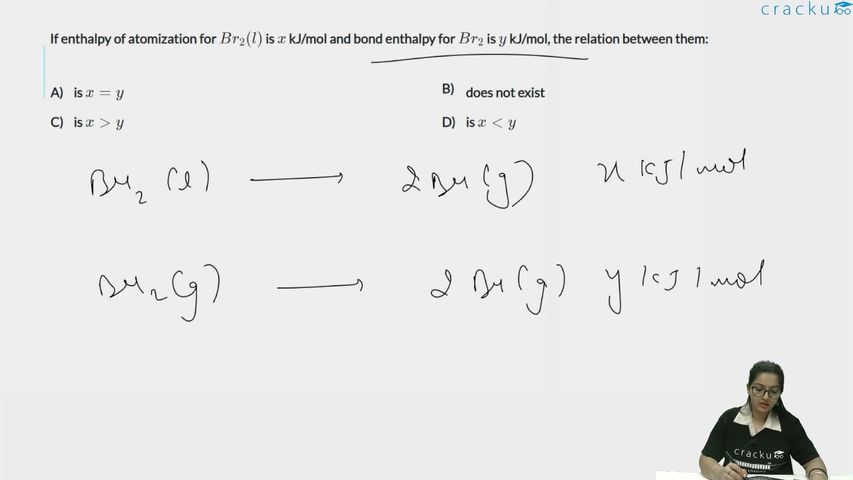
If enthalpy of atomization for $$Br_2(l)$$ is $$x$$ kJ/mol and bond enthalpy for $$Br_2$$ is $$y$$ kJ/mol, the relation between them:
First, let us recall the definitions of the two quantities that appear in the question.
By definition, the enthalpy of atomization is the enthalpy change when one mole of gaseous atoms is produced from the element in its standard state. For liquid bromine the required process is
$$\mathrm{Br_2(l)\;\longrightarrow\;2\,Br(g)}$$
The enthalpy change for this overall process is given to be $$x\ \text{kJ mol}^{-1}$$.
Next, the bond enthalpy of $$\mathrm{Br_2}$$ refers to the energy needed to break one mole of Br-Br bonds in the gaseous molecule:
$$\mathrm{Br_2(g)\;\longrightarrow\;2\,Br(g)}$$
The enthalpy change for this step is given to be $$y\ \text{kJ mol}^{-1}$$.
Now we compare the two processes. The atomization process starts from liquid bromine $$\mathrm{Br_2(l)}$$, whereas the bond enthalpy process starts from gaseous bromine $$\mathrm{Br_2(g)}$$. Therefore, to convert the liquid into the gaseous molecule we must first supply the enthalpy of vaporization $$\left(\Delta_\mathrm{vap}H\right)$$:
$$\mathrm{Br_2(l)\;\longrightarrow\;Br_2(g)}\quad\text{has}\quad\Delta_\mathrm{vap}H > 0$$
Using Hess’s law, we can split the overall atomization reaction into two consecutive steps:
$$ \begin{aligned} \mathrm{Br_2(l)} &\xrightarrow{\;\Delta_\mathrm{vap}H\;} \mathrm{Br_2(g)} \\ \mathrm{Br_2(g)} &\xrightarrow{\;y\;} 2\,\mathrm{Br(g)} \end{aligned} $$
Adding these two steps gives the net process $$\mathrm{Br_2(l) \to 2\,Br(g)}$$, whose enthalpy change is $$x$$. Algebraically, Hess’s law tells us
$$ x \;=\; \Delta_\mathrm{vap}H + y $$
The enthalpy of vaporization $$\Delta_\mathrm{vap}H$$ is always a positive quantity because energy must be supplied to overcome intermolecular forces during vaporization. Hence
$$ x - y = \Delta_\mathrm{vap}H > 0 \;\;\Longrightarrow\;\; x > y $$
Thus the enthalpy of atomization is greater than the bond enthalpy for liquid bromine.
Hence, the correct answer is Option C.
Was this solution helpful?
Click on the Email ☝️ to Watch the Video Solution
Create a FREE account and get:
_1.webp)

Educational materials for JEE preparation

Ask our AI anything

AI can make mistakes. Please verify important information.
AI can make mistakes. Please verify important information.
