
Join Our JEE Preparation Group
Prep with like-minded aspirants; Get access to free daily tests and study material.
Sign in
Please select an account to continue using cracku.in
↓ →
Join Our JEE Preparation Group
Prep with like-minded aspirants; Get access to free daily tests and study material.
The $$K_{sp}$$ for the following dissociation is $$1.6 \times 10^{-5}$$
$$PbCl_{2(s)} \rightleftharpoons Pb^{2+}_{(aq)} + 2Cl^{-}_{(aq)}$$
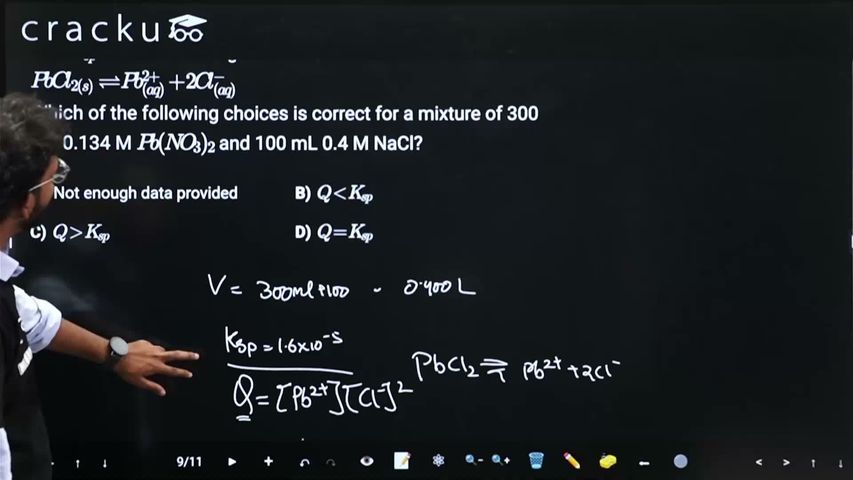
Which of the following choices is correct for a mixture of 300 mL 0.134 M $$Pb(NO_3)_2$$ and 100 mL 0.4 M NaCl?
We are given the heterogeneous equilibrium
$$PbCl_{2(s)} \rightleftharpoons Pb^{2+}_{(aq)} + 2\,Cl^{-}_{(aq)}, \qquad K_{sp}=1.6\times10^{-5}$$
To predict whether a precipitate will form, we first calculate the reaction quotient $$Q$$ for the ions in the mixture. The definition is
$$Q=[Pb^{2+}]\,[Cl^{-}]^{2}\,,$$
evaluated with the actual (initial) ionic concentrations just after mixing but before any precipitation.
We mix two solutions:
• Volume of $$Pb(NO_3)_2$$ solution: $$V_1 = 300{\rm \,mL}=0.300{\rm \,L}$$ with $$M_1 = 0.134{\rm \,M}$$.
• Volume of NaCl solution: $$V_2 = 100{\rm \,mL}=0.100{\rm \,L}$$ with $$M_2 = 0.400{\rm \,M}$$.
The total volume after mixing is
$$V_{\text{tot}} = V_1 + V_2 = 0.300{\rm \,L}+0.100{\rm \,L}=0.400{\rm \,L}.$$
Now we work out the number of moles of each ion contributed by the two solutions.
Moles of $$Pb^{2+}$$ coming from $$Pb(NO_3)_2$$:
$$n_{Pb^{2+}} = M_1 \times V_1 = 0.134\,\text{mol\,L}^{-1}\times0.300\,\text{L}=0.0402\;\text{mol}.$$
Moles of $$Cl^{-}$$ coming from NaCl (each formula unit gives one chloride ion):
$$n_{Cl^{-}} = M_2 \times V_2 = 0.400\,\text{mol\,L}^{-1}\times0.100\,\text{L}=0.0400\;\text{mol}.$$
The initial concentrations after dilution are obtained by dividing these mole amounts by the total volume $$V_{\text{tot}}=0.400\text{ L}$$.
So we get
$$[Pb^{2+}]_{\text{initial}} = \frac{0.0402\;\text{mol}}{0.400\;\text{L}} = 0.1005\;\text{M},$$
$$[Cl^{-}]_{\text{initial}} = \frac{0.0400\;\text{mol}}{0.400\;\text{L}} = 0.1000\;\text{M}.$$
Substituting these values into the definition of $$Q$$, we have
$$Q = [Pb^{2+}]_{\text{initial}}\,[Cl^{-}]_{\text{initial}}^{2} = 0.1005\,\times\,(0.1000)^{2}.$$
Now, $$(0.1000)^{2}=0.01000$$, and multiplying,
$$Q = 0.1005 \times 0.01000 = 0.001005.$$
To compare easily with $$K_{sp}=1.6\times10^{-5}$$, we convert $$Q$$ into scientific notation:
$$Q = 1.005\times10^{-3}.$$
Clearly,
$$Q = 1.005\times10^{-3} \; \gt \; K_{sp} = 1.6\times10^{-5}.$$
Because $$Q \gt K_{sp}$$, the ionic product exceeds the solubility product, so the solution is supersaturated with respect to $$PbCl_2$$ and precipitation will occur.
Hence, the correct answer is Option C.
Was this solution helpful?
Click on the Email ☝️ to Watch the Video Solution
Create a FREE account and get:
_1.webp)

Educational materials for JEE preparation

Ask our AI anything

AI can make mistakes. Please verify important information.
AI can make mistakes. Please verify important information.
