
Join Our JEE Preparation Group
Prep with like-minded aspirants; Get access to free daily tests and study material.
Sign in
Please select an account to continue using cracku.in
↓ →
Join Our JEE Preparation Group
Prep with like-minded aspirants; Get access to free daily tests and study material.
We start by recalling that a substance can behave as a reducing agent only when the central atom present in it can be oxidised to a still higher oxidation state, and it can behave as an oxidising agent only when that atom can be reduced to a lower oxidation state. Therefore, to decide whether a compound can show both behaviours, we must inspect the oxidation state of the central element and see whether states both above and below that value are possible for that element.
Now we examine each option one by one, writing the oxidation state of the central atom in every compound.
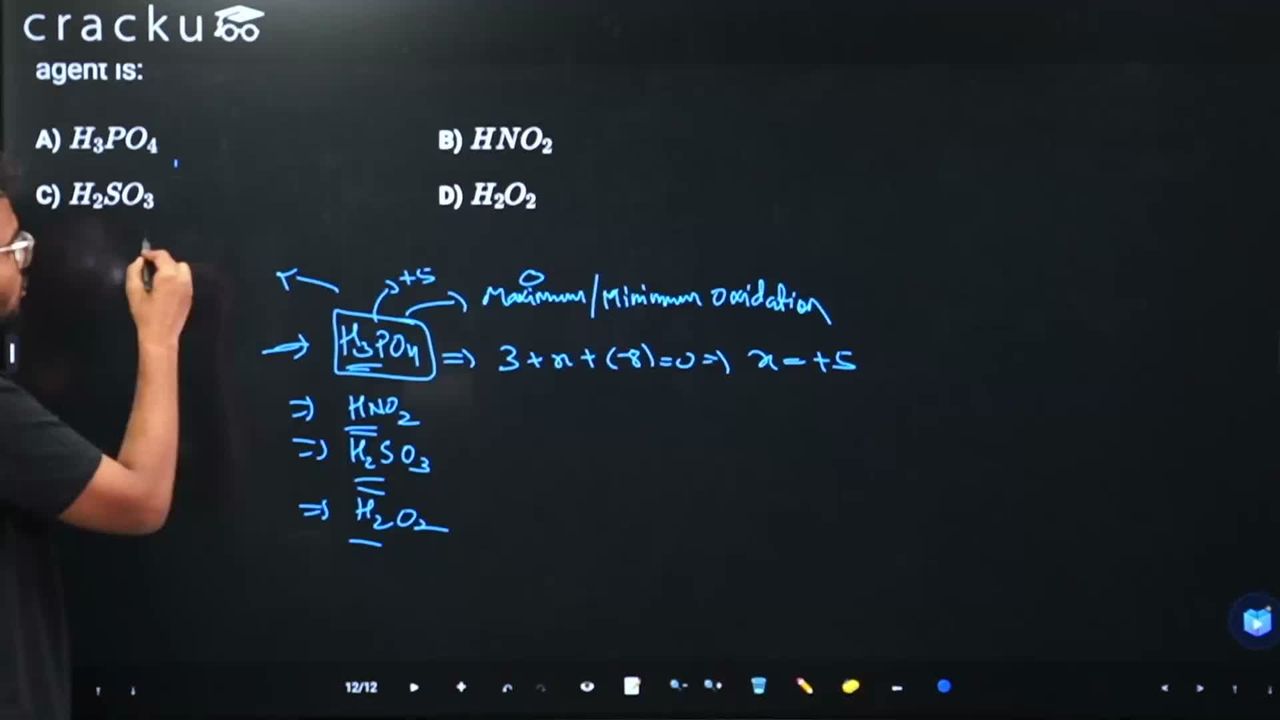
For $$H_3PO_4$$ we let the oxidation state of phosphorus be $$x$$. Using the fact that the oxidation state of hydrogen is $$+1$$ and that of oxygen is $$-2$$, we write the charge-balance equation
$$3(+1) + x + 4(-2) = 0.$$
Simplifying term by term, we have
$$3 + x - 8 = 0,$$
so
$$x = +5.$$
Phosphorus belongs to group 15, and its highest attainable oxidation state is $$+5$$ (equal to its group number). Hence it cannot be oxidised any further. Because further oxidation is impossible, $$H_3PO_4$$ cannot act as a reducing agent. However, the oxidation state $$+5$$ can certainly decrease to $$+3, +1,$$ or $$-3,$$ so reduction is possible and the compound may show oxidising behaviour. Therefore $$H_3PO_4$$ cannot exhibit both actions simultaneously; it can at best act only as an oxidising agent.
For $$HNO_2$$ we assign the oxidation state of nitrogen as $$y$$:
$$1(+1) + y + 2(-2) = 0 \;\Rightarrow\; 1 + y - 4 = 0 \;\Rightarrow\; y = +3.$$
Nitrogen can be oxidised to $$+5$$ (in $$HNO_3$$) and reduced to $$-3$$ (in $$NH_3$$), so it can act both as reducing and as oxidising agent.
For $$H_2SO_3$$ we let the oxidation state of sulphur be $$z$$:
$$2(+1) + z + 3(-2) = 0 \;\Rightarrow\; 2 + z - 6 = 0 \;\Rightarrow\; z = +4.$$
Sulphur can move up to $$+6$$ (in $$H_2SO_4$$) or down to $$-2$$ (in $$H_2S$$); thus $$H_2SO_3$$ can show both behaviours too.
For $$H_2O_2$$ the oxidation state of oxygen is $$-1$$ (because $$2(+1) + 2x = 0 \Rightarrow x = -1$$). Oxygen can be oxidised to $$0$$ (in $$O_2$$) or reduced to $$-2$$ (in $$H_2O$$), so hydrogen peroxide also acts both as oxidising and reducing agent.
Combining all these observations, the only compound that lacks the ability to behave both as oxidising and reducing agent is $$H_3PO_4$$, since its central atom phosphorus is already at its maximum oxidation state of $$+5$$ and cannot be oxidised any further.
Hence, the correct answer is Option A.
Was this solution helpful?
Click on the Email ☝️ to Watch the Video Solution
Create a FREE account and get:
Educational materials for JEE preparation

Ask our AI anything

AI can make mistakes. Please verify important information.
AI can make mistakes. Please verify important information.

_1.webp)
