
Join Our JEE Preparation Group
Prep with like-minded aspirants; Get access to free daily tests and study material.
Sign in
Please select an account to continue using cracku.in
↓ →
Join Our JEE Preparation Group
Prep with like-minded aspirants; Get access to free daily tests and study material.
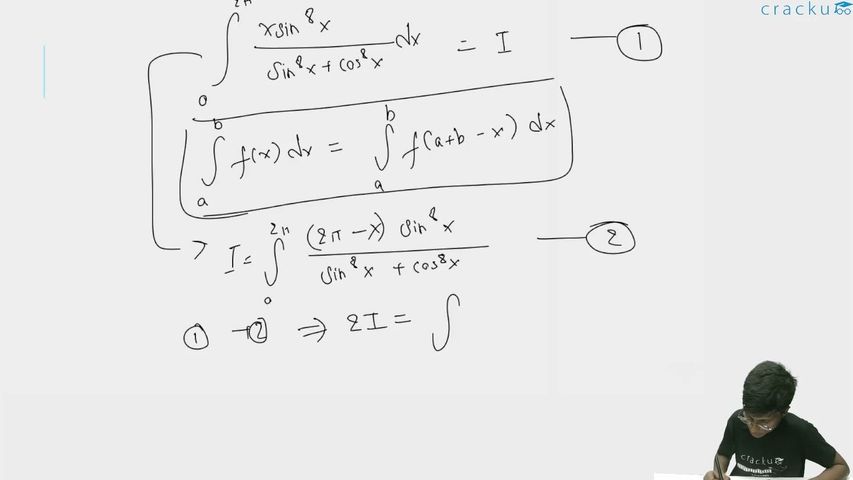
The value of $$\int_0^{2\pi} \frac{x \sin^8 x}{\sin^8 x + \cos^8 x} dx$$ is equal to:
Let us denote the required integral by
$$I=\int_{0}^{2\pi}\frac{x\sin^{8}x}{\sin^{8}x+\cos^{8}x}\,dx.$$
To exploit symmetry, we perform the change of variable $$x=2\pi-t.$$ Under this change we have $$dx=-dt,$$ and when $$x=0$$ we get $$t=2\pi,$$ while when $$x=2\pi$$ we get $$t=0.$$ Substituting, we obtain
$$$\begin{aligned} I&=\int_{x=0}^{x=2\pi}\frac{x\sin^{8}x}{\sin^{8}x+\cos^{8}x}\,dx \\ &=\int_{t=2\pi}^{t=0}\frac{(2\pi-t)\sin^{8}(2\pi-t)}{\sin^{8}(2\pi-t)+\cos^{8}(2\pi-t)}\,(-dt). \end{aligned}$$$
The minus sign reverses the limits, so
$$$I=\int_{0}^{2\pi}\frac{(2\pi-t)\sin^{8}(2\pi-t)}{\sin^{8}(2\pi-t)+\cos^{8}(2\pi-t)}\,dt.$$$
Using the well-known identities $$\sin(2\pi-t)=-\sin t$$ and $$\cos(2\pi-t)=\cos t,$$ and noting that the eighth power removes the minus sign, we get
$$$\sin^{8}(2\pi-t)=\sin^{8}t,\qquad \cos^{8}(2\pi-t)=\cos^{8}t.$$$
Thus the denominator is unchanged, and we can write
$$I=\int_{0}^{2\pi}\frac{(2\pi-t)\sin^{8}t}{\sin^{8}t+\cos^{8}t}\,dt.$$
Relabelling the dummy variable $$t$$ back to $$x$$ gives
$$I=\int_{0}^{2\pi}\frac{(2\pi-x)\sin^{8}x}{\sin^{8}x+\cos^{8}x}\,dx.$$
Now we add this expression to the original one. We have
$$$\begin{aligned} 2I &=\int_{0}^{2\pi}\frac{x\sin^{8}x}{\sin^{8}x+\cos^{8}x}\,dx +\int_{0}^{2\pi}\frac{(2\pi-x)\sin^{8}x}{\sin^{8}x+\cos^{8}x}\,dx \\ &=\int_{0}^{2\pi}\frac{\bigl[x+(2\pi-x)\bigr]\sin^{8}x}{\sin^{8}x+\cos^{8}x}\,dx \\ &=\int_{0}^{2\pi}\frac{2\pi\,\sin^{8}x}{\sin^{8}x+\cos^{8}x}\,dx \\ &=2\pi\int_{0}^{2\pi}\frac{\sin^{8}x}{\sin^{8}x+\cos^{8}x}\,dx. \end{aligned}$$$
For convenience we put
$$K=\int_{0}^{2\pi}\frac{\sin^{8}x}{\sin^{8}x+\cos^{8}x}\,dx.$$
Exactly the same integral, after the shift $$x\mapsto x+\frac{\pi}{2},$$ yields
$$\int_{0}^{2\pi}\frac{\cos^{8}x}{\sin^{8}x+\cos^{8}x}\,dx=K,$$
because $$\sin$$ and $$\cos$$ merely exchange their roles. Adding these two equal integrals gives
$$$\begin{aligned} 2K&=\int_{0}^{2\pi}\left(\frac{\sin^{8}x}{\sin^{8}x+\cos^{8}x} +\frac{\cos^{8}x}{\sin^{8}x+\cos^{8}x}\right)dx \\ &=\int_{0}^{2\pi}1\,dx \\ &=2\pi. \end{aligned}$$$
So
$$K=\pi.$$
Returning to our expression for $$2I$$, we substitute $$K=\pi$$ and obtain
$$2I=2\pi\cdot\pi=2\pi^{2}.$$
Dividing by 2, we finally get
$$I=\pi^{2}.$$
Hence, the correct answer is Option C.
Was this solution helpful?
Click on the Email ☝️ to Watch the Video Solution
Create a FREE account and get:
_1.webp)

Educational materials for JEE preparation

Ask our AI anything

AI can make mistakes. Please verify important information.
AI can make mistakes. Please verify important information.
