
Join Our JEE Preparation Group
Prep with like-minded aspirants; Get access to free daily tests and study material.
Sign in
Please select an account to continue using cracku.in
↓ →
Join Our JEE Preparation Group
Prep with like-minded aspirants; Get access to free daily tests and study material.
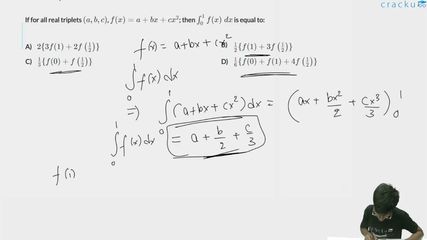
If for all real triplets $$(a, b, c)$$, $$f(x) = a + bx + cx^2$$; then $$\int_0^1 f(x) \; dx$$ is equal to:
We start with the quadratic polynomial defined for every real choice of the triplet $$(a,b,c)$$:
$$f(x)=a+bx+cx^{2}$$
We have to evaluate the definite integral from $$0$$ to $$1$$:
$$\int_{0}^{1}f(x)\,dx=\int_{0}^{1}\bigl(a+bx+cx^{2}\bigr)\,dx$$
First, we recall the basic antiderivative formulas:
$$\int a\,dx = ax,\qquad \int bx\,dx = \frac{b\,x^{2}}{2},\qquad \int cx^{2}\,dx = \frac{c\,x^{3}}{3}.$$
Applying these one by one to each term and then combining them, we obtain
$$\int_{0}^{1}f(x)\,dx=\Bigl[\,ax+\frac{b\,x^{2}}{2}+\frac{c\,x^{3}}{3}\Bigr]_{0}^{1}.$$
Now we substitute the upper limit $$x=1$$ and the lower limit $$x=0$$:
At $$x=1$$: $$ax+\frac{b\,x^{2}}{2}+\frac{c\,x^{3}}{3}=a+\frac{b}{2}+\frac{c}{3}.$$ At $$x=0$$: $$a(0)+\frac{b(0)^{2}}{2}+\frac{c(0)^{3}}{3}=0.$$
Hence,
$$\int_{0}^{1}f(x)\,dx=\bigl(a+\frac{b}{2}+\frac{c}{3}\bigr)-0 =a+\frac{b}{2}+\frac{c}{3}.$$
To relate this result to the function values listed in the options, we explicitly compute $$f(0)$$, $$f\!\left(\tfrac12\right)$$ and $$f(1)$$.
Function at $$x=0$$: $$f(0)=a+ b(0)+c(0)^{2}=a.$$
Function at $$x=\tfrac12$$: $$f\!\left(\frac12\right)=a+b\!\left(\frac12\right)+c\!\left(\frac12\right)^{2} =a+\frac{b}{2}+\frac{c}{4}.$$
Function at $$x=1$$: $$f(1)=a+b(1)+c(1)^{2}=a+b+c.$$
Now we examine the specific weighted combination suggested in option D:
$$\frac16\{\,f(0)+4\,f\!\left(\frac12\right)+f(1)\,\}.$$
First add the terms inside the braces:
$$$ \begin{aligned} f(0)+4f\!\left(\tfrac12\right)+f(1) &=a+4\Bigl(a+\frac{b}{2}+\frac{c}{4}\Bigr)+\bigl(a+b+c\bigr)\\ &=a+4a+2b+c+a+b+c\\ &=(a+4a+a)+(2b+b)+(c+c)\\ &=6a+3b+2c. \end{aligned} $$$
Next, multiply this sum by the factor $$\tfrac16$$ placed in front:
$$\frac16\,(6a+3b+2c)=a+\frac{3b}{6}+\frac{2c}{6}=a+\frac{b}{2}+\frac{c}{3}.$$
This expression is exactly the result we obtained for the integral:
$$\int_{0}^{1}f(x)\,dx=a+\frac{b}{2}+\frac{c}{3}.$$
So the integral equals $$\dfrac16\{f(0)+f(1)+4f\!\left(\tfrac12\right)\}$$, which matches option D.
Hence, the correct answer is Option D.
Was this solution helpful?
Click on the Email ☝️ to Watch the Video Solution
Create a FREE account and get:
_1.webp)

Educational materials for JEE preparation

Ask our AI anything

AI can make mistakes. Please verify important information.
AI can make mistakes. Please verify important information.
