
Join Our JEE Preparation Group
Prep with like-minded aspirants; Get access to free daily tests and study material.
Sign in
Please select an account to continue using cracku.in
↓ →
Join Our JEE Preparation Group
Prep with like-minded aspirants; Get access to free daily tests and study material.
Let $$z$$ be a complex number such that $$\left|\frac{z-i}{z+2i}\right| = 1$$ and $$|z| = \frac{5}{2}$$. Then, the value of $$|z + 3i|$$ is:
We are given two conditions on the complex number $$z$$.
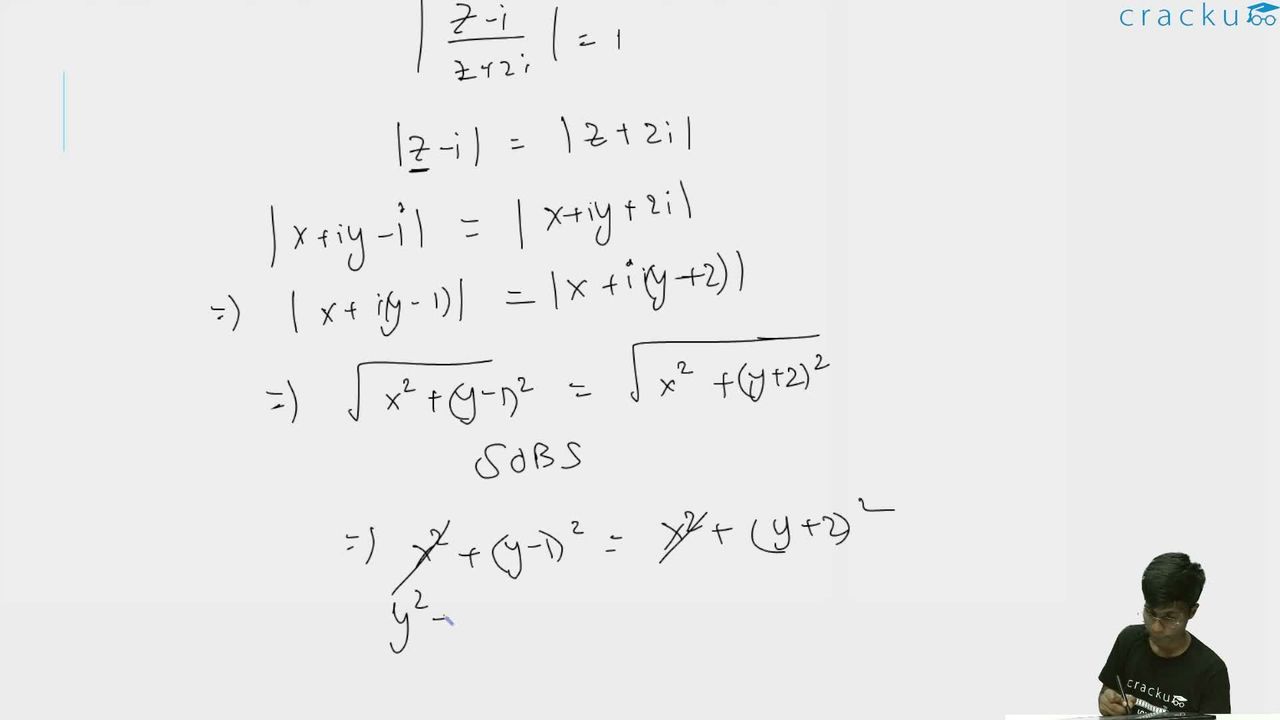
First, we know that $$\left|\dfrac{z-i}{\,z+2i\,}\right| = 1$$. For any two complex numbers $$a$$ and $$b$$ we have the property $$\left|\dfrac{a}{b}\right| = \dfrac{|a|}{|b|}$$. So the given relation immediately gives
$$\dfrac{|\,z-i\,|}{|\,z+2i\,|} = 1 \;\;\Longrightarrow\;\; |\,z-i\,| = |\,z+2i\,|.$$
Let us write $$z$$ in its Cartesian form $$z = x + iy$$, where $$x$$ and $$y$$ are real numbers.
Then $$z - i = x + i(y-1)$$ and $$z + 2i = x + i(y+2).$$
The modulus of a complex number $$u + iv$$ is $$\sqrt{u^{2}+v^{2}}$$, so
$$|\,z-i\,| = \sqrt{x^{2} + (y-1)^{2}},\qquad |\,z+2i\,| = \sqrt{x^{2} + (y+2)^{2}}.$$
Because the moduli are equal, we have
$$\sqrt{x^{2} + (y-1)^{2}} = \sqrt{x^{2} + (y+2)^{2}}.$$
Both sides are non-negative, so we can square without changing the equality:
$$x^{2} + (y-1)^{2} = x^{2} + (y+2)^{2}.$$
The $$x^{2}$$ terms cancel, leaving
$$(y-1)^{2} = (y+2)^{2}.$$
Expanding both squares,
$$y^{2} - 2y + 1 = y^{2} + 4y + 4.$$
Subtracting $$y^{2}$$ from both sides and gathering like terms,
$$-2y + 1 = 4y + 4 \;\;\Longrightarrow\;\; -6y = 3 \;\;\Longrightarrow\;\; y = -\dfrac{1}{2}.$$
So the imaginary part of $$z$$ is fixed at $$y = -\dfrac{1}{2}$$.
Secondly, we are told that $$|z| = \dfrac{5}{2}.$$ Using $$|x + iy| = \sqrt{x^{2} + y^{2}}$$, we get
$$\sqrt{x^{2} + y^{2}} = \dfrac{5}{2} \;\;\Longrightarrow\;\; x^{2} + y^{2} = \left(\dfrac{5}{2}\right)^{2} = \dfrac{25}{4}.$$
Substituting $$y = -\dfrac{1}{2}$$, we find
$$x^{2} + \left(-\dfrac{1}{2}\right)^{2} = \dfrac{25}{4} \;\;\Longrightarrow\;\; x^{2} + \dfrac{1}{4} = \dfrac{25}{4}.$$
Isolating $$x^{2}$$,
$$x^{2} = \dfrac{25}{4} - \dfrac{1}{4} = \dfrac{24}{4} = 6.$$
Thus $$x = \pm\sqrt{6}.$$ So the two possible numbers are $$z = \sqrt{6} - \dfrac{i}{2}$$ and $$z = -\sqrt{6} - \dfrac{i}{2}.$$
We now compute $$|\,z + 3i\,|$$. For either value of $$z$$ we have
$$z + 3i = x + iy + 3i = x + i\bigl(y + 3\bigr).$$
Because $$y = -\dfrac{1}{2}$$, we get
$$y + 3 = -\dfrac{1}{2} + 3 = \dfrac{5}{2},$$
so
$$z + 3i = x + i\left(\dfrac{5}{2}\right).$$
The modulus is therefore
$$|\,z + 3i\,| = \sqrt{x^{2} + \left(\dfrac{5}{2}\right)^{2}}.$$
Substituting $$x^{2} = 6$$,
$$|\,z + 3i\,| = \sqrt{6 + \dfrac{25}{4}} = \sqrt{\dfrac{24}{4} + \dfrac{25}{4}} = \sqrt{\dfrac{49}{4}} = \dfrac{7}{2}.$$
Both possible values of $$z$$ give the same modulus, so the required value is $$\dfrac{7}{2}$$.
Hence, the correct answer is Option B.
Was this solution helpful?
Click on the Email ☝️ to Watch the Video Solution
Create a FREE account and get:
_1.webp)

Educational materials for JEE preparation

Ask our AI anything

AI can make mistakes. Please verify important information.
AI can make mistakes. Please verify important information.
