
Join Our JEE Preparation Group
Prep with like-minded aspirants; Get access to free daily tests and study material.
Sign in
Please select an account to continue using cracku.in
↓ →
Join Our JEE Preparation Group
Prep with like-minded aspirants; Get access to free daily tests and study material.
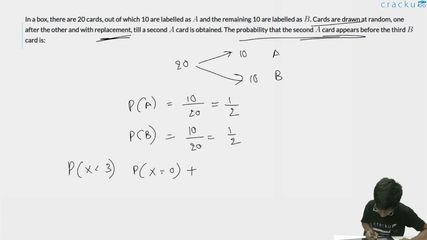
In a box, there are 20 cards, out of which 10 are labelled as $$A$$ and the remaining 10 are labelled as $$B$$. Cards are drawn at random, one after the other and with replacement, till a second $$A$$ card is obtained. The probability that the second $$A$$ card appears before the third $$B$$ card is:
We begin by noting that at every draw the probability of getting an $$A$$ is $$\dfrac{10}{20}= \dfrac12$$ and, similarly, the probability of getting a $$B$$ is also $$\dfrac12$$. Because the card is replaced after each draw, each trial is independent and the two probabilities remain constant throughout the experiment.
We have to keep drawing cards until the second $$A$$ appears. During this process a third $$B$$ may or may not appear. We are asked to find the probability that the second $$A$$ comes before the third $$B$$. In other words, we must calculate the probability that two $$A$$’s are obtained earlier than three $$B$$’s in an infinite sequence of independent trials with $$P(A)=P(B)=\dfrac12$$.
To attack such “race” problems systematically, we introduce a state variable. Let
$$$P(i,j)=\text{Probability that the second }A\text{ beats the third }B\text{ when }i\text{ $$$A$$’s and }j\text{ $$B$$’s have already been drawn.}$$
At the start of the experiment no card has been recorded, so we ultimately want $$P(0,0)$$.
There are obvious boundary states:
• If we ever reach $$i=2$$ (two $$A$$’s) we have already succeeded, so $$P(2,j)=1\quad\text{for }j=0,1,2.$$
• If we ever reach $$j=3$$ (three $$B$$’s) before the second $$A$$, we have failed, so $$P(i,3)=0\quad\text{for }i=0,1.$$
For an interior state $$(i,j)$$ with $$i\lt 2$$ and $$j\lt 3$$, the next draw can be either $$A$$ or $$B$$. Using the Law of Total Probability we write the recursion
$$$P(i,j)=\dfrac12\;P(i+1,\,j)\;+\;\dfrac12\;P(i,\,j+1).$$$
Now we solve these equations step by step, beginning with states closest to the boundaries and working backwards to $$(0,0).$$
1. State $$(1,2)$$
Exactly one $$A$$ and two $$B$$’s have already appeared.
Next draw:
• $$A$$ with probability $$\dfrac12$$ $$\Longrightarrow$$ state $$(2,2)$$ (success).
• $$B$$ with probability $$\dfrac12$$ $$\Longrightarrow$$ state $$(1,3)$$ (failure).
Hence $$P(1,2)=\dfrac12(1)+\dfrac12(0)=\dfrac12.$$
2. State $$(0,2)$$
No $$A$$ yet, two $$B$$’s so far.
Next draw:
• $$A$$ $$\Longrightarrow$$ $$(1,2)$$.
• $$B$$ $$\Longrightarrow$$ $$(0,3)$$ (failure).
Thus $$$P(0,2)=\dfrac12\,P(1,2)+\dfrac12\,(0)=\dfrac12\left(\dfrac12\right)=\dfrac14.$$$
3. State $$(1,1)$$
One $$A$$ and one $$B$$ so far.
Next draw:
• $$A$$ $$\Longrightarrow$$ $$(2,1)$$ (success).
• $$B$$ $$\Longrightarrow$$ $$(1,2)$$.
Hence $$$P(1,1)=\dfrac12(1)+\dfrac12\left(\dfrac12\right)=\dfrac12+\dfrac14=\dfrac34.$$$
4. State $$(0,1)$$
No $$A$$ and one $$B$$ so far.
Next draw:
• $$A$$ $$\Longrightarrow$$ $$(1,1)$$.
• $$B$$ $$\Longrightarrow$$ $$(0,2)$$.
Therefore $$$P(0,1)=\dfrac12\left(\dfrac34\right)+\dfrac12\left(\dfrac14\right)=\dfrac38+\dfrac18=\dfrac12.$$$
5. State $$(1,0)$$
One $$A$$ and no $$B$$ yet.
Next draw:
• $$A$$ $$\Longrightarrow$$ $$(2,0)$$ (success).
• $$B$$ $$\Longrightarrow$$ $$(1,1)$$.
Thus $$$P(1,0)=\dfrac12(1)+\dfrac12\left(\dfrac34\right)=\dfrac12+\dfrac38=\dfrac78.$$$
6. Starting state $$(0,0)$$
No $$A$$ and no $$B$$ have been drawn yet.
Next draw:
• $$A$$ $$\Longrightarrow$$ $$(1,0)$$.
• $$B$$ $$\Longrightarrow$$ $$(0,1)$$.
Therefore $$$P(0,0)=\dfrac12\left(\dfrac78\right)+\dfrac12\left(\dfrac12\right)=\dfrac{7}{16}+\dfrac{4}{16}=\dfrac{11}{16}.$$$
So the probability that the second $$A$$ appears before the third $$B$$ is $$\dfrac{11}{16}$$.
Hence, the correct answer is Option B.
Was this solution helpful?
Click on the Email ☝️ to Watch the Video Solution
Create a FREE account and get:
_1.webp)

Educational materials for JEE preparation

Ask our AI anything

AI can make mistakes. Please verify important information.
AI can make mistakes. Please verify important information.
