
Join Our JEE Preparation Group
Prep with like-minded aspirants; Get access to free daily tests and study material.
Sign in
Please select an account to continue using cracku.in
↓ →
Join Our JEE Preparation Group
Prep with like-minded aspirants; Get access to free daily tests and study material.
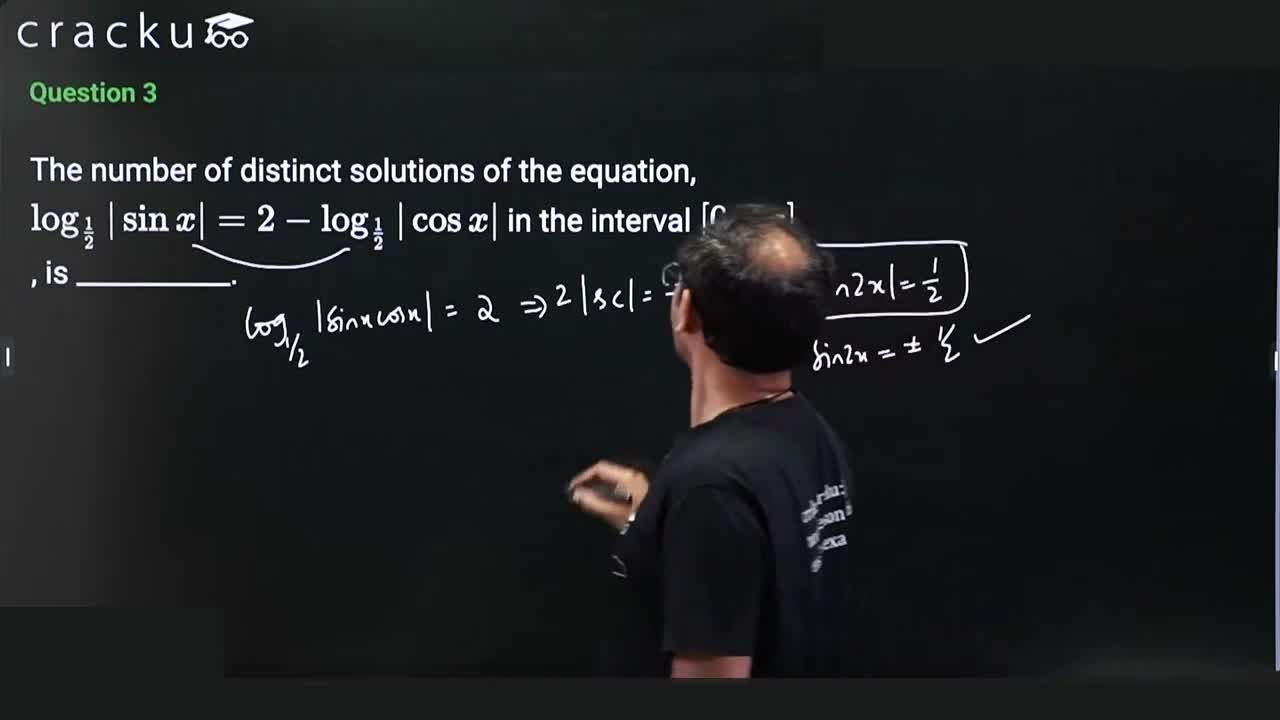
The number of distinct solutions of the equation, $$\log_{\frac{1}{2}}|\sin x| = 2 - \log_{\frac{1}{2}}|\cos x|$$ in the interval $$[0, 2\pi]$$, is ___________.
Correct Answer: 8
We start with the given transcendental equation
$$\log_{\frac12}\!\bigl|\sin x\bigr| \;=\; 2 \;-\; \log_{\frac12}\!\bigl|\cos x\bigr|$$
in the interval $$[0,\,2\pi]$$. Here the base of every logarithm is $$\dfrac12,$$ which lies between 0 and 1, so all logarithms are well-defined only when their arguments are positive; that already guarantees $$\sin x\neq0$$ and $$\cos x\neq0$$ for each admissible solution.
First we transpose the term $$-\log_{\frac12}\!\bigl|\cos x\bigr|$$ to the left side:
$$\log_{\frac12}\!\bigl|\sin x\bigr| \;+\; \log_{\frac12}\!\bigl|\cos x\bigr| \;=\; 2.$$
Now we invoke the well-known product rule for logarithms, stated as
$$\log_b m + \log_b n \;=\; \log_b(mn)\quad\text{for the same base }b.$$
Applying this rule with $$b=\dfrac12,\;m=|\sin x|,\;n=|\cos x|,$$ we obtain
$$\log_{\frac12}\!\bigl(|\sin x|\,|\cos x|\bigr) \;=\; 2.$$
Next we convert this logarithmic statement to its equivalent exponential form. For any base $$b\;(0<b\neq1)$$ we have the definition
$$\log_b A = C \;\Longleftrightarrow\; A = b^{\,C}.$$
Hence
$$|\sin x|\,|\cos x| \;=\; \Bigl(\tfrac12\Bigr)^{2} \;=\; \tfrac14.$$
Because the left-hand side contains the product of absolute values, we rewrite it through the double‐angle identity. We recall the formula
$$\sin 2x \;=\; 2\sin x\cos x,$$
and from it we find
$$|\sin x|\,|\cos x| \;=\; \tfrac12\,|2\sin x\cos x| \;=\; \tfrac12\,|\sin 2x|.$$
Substituting this expression into the equation $$|\sin x|\,|\cos x|=\tfrac14$$ gives
$$\tfrac12\,|\sin 2x| \;=\; \tfrac14,$$
and multiplying both sides by 2 yields the simpler condition
$$|\sin 2x| \;=\; \tfrac12.$$
Thus our task reduces to solving
$$\bigl|\sin 2x\bigr| = \frac12$$
for $$x$$ in the original domain $$[0,\,2\pi].$$ Set $$\theta = 2x;$$ then $$\theta$$ runs through the interval $$[0,\,4\pi]$$ while $$x$$ runs through $$[0,\,2\pi].$$ Therefore we must find all $$\theta\in[0,\,4\pi]$$ such that
$$|\sin\theta| = \frac12.$$
We know that $$\sin\theta = \pm\dfrac12$$ at the angles
$$\theta = \frac{\pi}{6},\;\frac{5\pi}{6},\;\frac{7\pi}{6},\;\frac{11\pi}{6}$$
within the first full cycle $$[0,\,2\pi].$$ Since the sine function has period $$2\pi,$$ the same four angles recur once more when we add $$2\pi,$$ giving in the second cycle
$$\theta = \frac{\pi}{6}+2\pi,\;\frac{5\pi}{6}+2\pi,\;\frac{7\pi}{6}+2\pi,\;\frac{11\pi}{6}+2\pi.$$
Altogether, in the whole interval $$[0,\,4\pi]$$ we therefore obtain eight distinct solutions for $$\theta.$$ Explicitly, they are
$$\theta = \frac{\pi}{6},\;\frac{5\pi}{6},\;\frac{7\pi}{6},\;\frac{11\pi}{6},\; \frac{13\pi}{6},\;\frac{17\pi}{6},\;\frac{19\pi}{6},\;\frac{23\pi}{6}.$$
Since $$\theta = 2x,$$ each such $$\theta$$ corresponds to a unique $$x=\dfrac{\theta}{2}$$ lying in $$[0,\,2\pi].$$ None of these $$x$$-values makes $$\sin x$$ or $$\cos x$$ equal to zero, so all are admissible for the original logarithmic equation. Consequently there are exactly eight distinct $$x$$ satisfying the given equation in the stated interval.
So, the answer is $$8$$.
Was this solution helpful?
Click on the Email ☝️ to Watch the Video Solution
Create a FREE account and get:
_1.webp)

Educational materials for JEE preparation

Ask our AI anything

AI can make mistakes. Please verify important information.
AI can make mistakes. Please verify important information.
