
Join Our JEE Preparation Group
Prep with like-minded aspirants; Get access to free daily tests and study material.
Sign in
Please select an account to continue using cracku.in
↓ →
Join Our JEE Preparation Group
Prep with like-minded aspirants; Get access to free daily tests and study material.
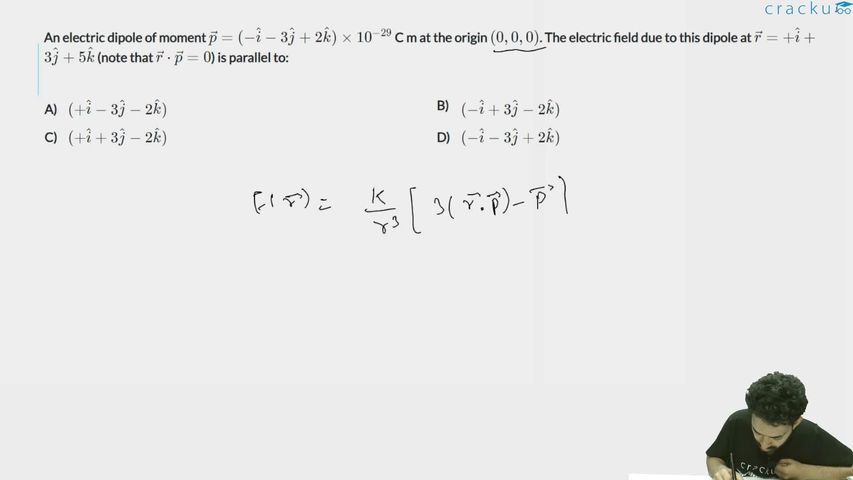
An electric dipole of moment $$\vec{p} = (-\hat{i} - 3\hat{j} + 2\hat{k}) \times 10^{-29}$$ C m at the origin $$(0,0,0)$$. The electric field due to this dipole at $$\vec{r} = +\hat{i} + 3\hat{j} + 5\hat{k}$$ (note that $$\vec{r} \cdot \vec{p} = 0$$) is parallel to:
We are given an electric dipole located at the origin whose dipole moment is
$$\vec p = (-\hat i - 3\hat j + 2\hat k)\; \times 10^{-29}\; \text{C m}.$$
We want the electric field at the point whose position vector is
$$\vec r = +\hat i + 3\hat j + 5\hat k.$$
It is also told that $$\vec p \cdot \vec r = 0,$$ which means the dipole moment is perpendicular to the position vector.
For a point dipole placed at the origin, the electric field at position $$\vec r$$ in free space is given by the standard dipole-field formula
$$\vec E(\vec r)=\frac{1}{4\pi\varepsilon_0}\,\frac{1}{r^{3}}\Bigl[\,3(\vec p\cdot\hat r)\,\hat r-\vec p\Bigr],$$
where $$r=\lVert\vec r\rVert$$ and $$\hat r=\dfrac{\vec r}{r}$$ is the unit vector along $$\vec r.$$
First we note that $$\vec p\cdot\hat r=\dfrac{\vec p\cdot\vec r}{r}=0$$ because $$\vec p\cdot\vec r=0.$$
Hence the first term inside the bracket vanishes, leaving
$$\vec E(\vec r)=\frac{1}{4\pi\varepsilon_0}\,\frac{1}{r^{3}}\,(0-\vec p)= -\;\frac{1}{4\pi\varepsilon_0}\,\frac{\vec p}{r^{3}}.$$
Thus the electric field is directed opposite to $$\vec p,$$ i.e. parallel to $$-\vec p.$$
We now write $$-\vec p$$ explicitly:
$$-\vec p = -\bigl(-\hat i - 3\hat j + 2\hat k\bigr)\times 10^{-29} =(+\hat i + 3\hat j - 2\hat k)\times 10^{-29}.$$
All constant numerical factors (such as $$\tfrac{1}{4\pi\varepsilon_0}$$ and $$\tfrac{1}{r^{3}}$$) merely scale the magnitude and do not affect the direction. Therefore the field is parallel to the vector
$$+\hat i + 3\hat j - 2\hat k.$$
This matches exactly with the vector given in Option C.
Hence, the correct answer is Option C.
Was this solution helpful?
Click on the Email ☝️ to Watch the Video Solution
Create a FREE account and get:
_1.webp)

Educational materials for JEE preparation

Ask our AI anything

AI can make mistakes. Please verify important information.
AI can make mistakes. Please verify important information.
