
Join Our JEE Preparation Group
Prep with like-minded aspirants; Get access to free daily tests and study material.
Sign in
Please select an account to continue using cracku.in
↓ →
Join Our JEE Preparation Group
Prep with like-minded aspirants; Get access to free daily tests and study material.
The distance $$x$$ covered by a particle in one dimensional motion varies with time $$t$$ as $$x^2 = at^2 + 2bt + c$$. If the acceleration of the particle depends on $$x$$ as $$x^{-n}$$, where $$n$$ is an integer, the value of $$n$$ is ___________.
Correct Answer: 3
We are told that the displacement of the particle is connected to time through the equation
$$x^{2}=a\,t^{2}+2\,b\,t+c\,.$$
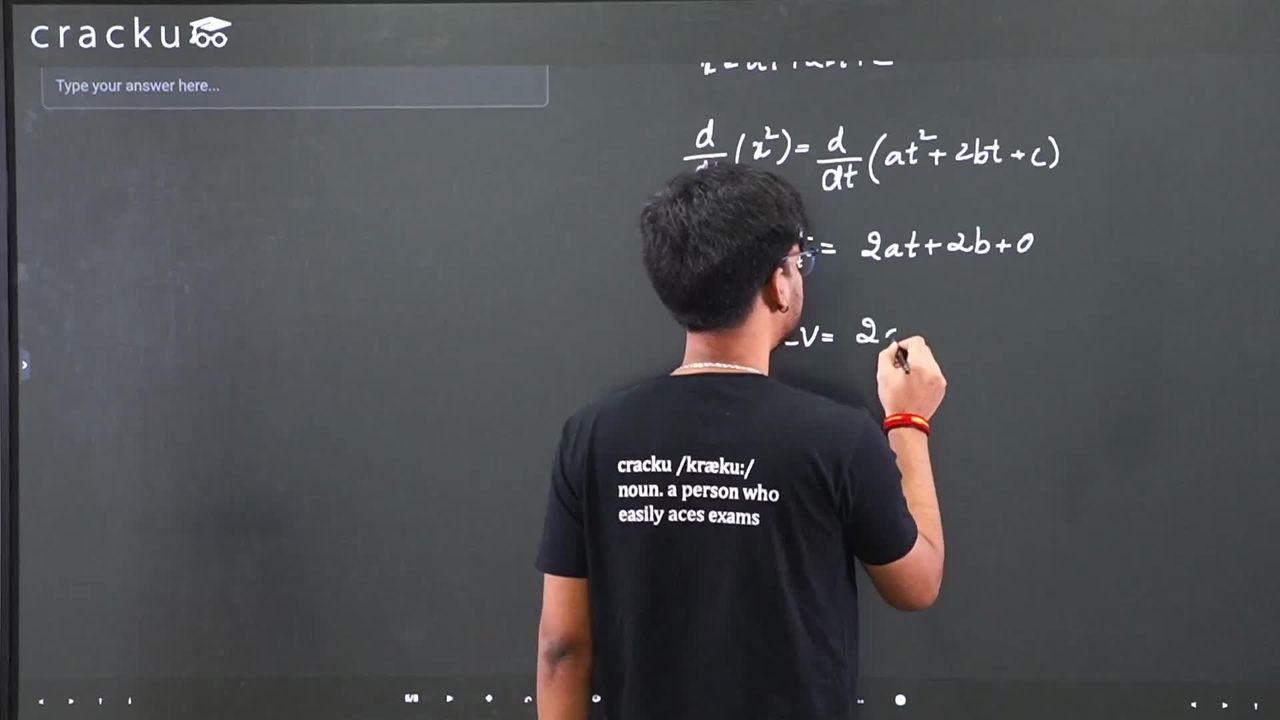
To reach the acceleration we must differentiate twice with respect to time. First we take the derivative of the given relation. Using the rule “if $$F=x^{2}$$ then $$\dfrac{dF}{dt}=2x\dfrac{dx}{dt}$$” we have
$$2\,x\,\dfrac{dx}{dt}=2\,a\,t+2\,b\,.$$
Cancelling the factor 2 gives
$$x\,\dfrac{dx}{dt}=a\,t+b\,.$$
The quantity $$\dfrac{dx}{dt}$$ is the velocity $$v$$, so
$$v=\dfrac{a\,t+b}{x}\quad\text{and}\quad a\,t+b=x\,v.$$
Now we differentiate the velocity to obtain the acceleration $$\dfrac{dv}{dt}$$. Treating $$v=\dfrac{a\,t+b}{x}$$ as a quotient, the derivative is
$$\dfrac{dv}{dt}=\dfrac{a}{x}+(a\,t+b)\,\dfrac{d}{dt}\!\left(\dfrac{1}{x}\right).$$
Since $$\dfrac{d}{dt}\!\left(\dfrac{1}{x}\right)=-\dfrac{1}{x^{2}}\dfrac{dx}{dt}=-\dfrac{v}{x^{2}},$$ we substitute and obtain
$$\dfrac{dv}{dt}=\dfrac{a}{x}-(a\,t+b)\,\dfrac{v}{x^{2}}.$$
Replacing $$a\,t+b$$ by $$x\,v$$ (from the earlier relation) gives
$$\dfrac{dv}{dt}=\dfrac{a}{x}-\dfrac{x\,v^{2}}{x^{2}}=\dfrac{a}{x}-\dfrac{v^{2}}{x}.$$
Thus the acceleration is
$$\boxed{a_{\text{particle}}=\dfrac{a-v^{2}}{x}}.$$
At this stage $$v^{2}$$ still involves the time variable, so we must express it solely in terms of $$x$$. Square the earlier velocity expression:
$$v^{2}=\dfrac{(a\,t+b)^{2}}{x^{2}}.$$
To remove $$t$$, start again from the original displacement relation. Let $$y=a\,t+b$$; then $$t=\dfrac{y-b}{a}$$, and substituting into $$x^{2}=a\,t^{2}+2\,b\,t+c$$ gives
$$x^{2}=a\left(\dfrac{y-b}{a}\right)^{2}+2\,b\left(\dfrac{y-b}{a}\right)+c.$$
Simplifying the numerator inside the brackets, we find
$$(y-b)^{2}+2\,b(y-b)=y^{2}-b^{2},$$
so
$$x^{2}=\dfrac{y^{2}-b^{2}+a\,c}{a}\quad\Longrightarrow\quad y^{2}=a\,x^{2}+b^{2}-a\,c.$$
But $$y=a\,t+b,$$ hence
$$(a\,t+b)^{2}=a\,x^{2}+b^{2}-a\,c.$$
Substituting this into the expression for $$v^{2}$$ gives
$$v^{2}=\dfrac{a\,x^{2}+b^{2}-a\,c}{x^{2}}=a+\dfrac{b^{2}-a\,c}{x^{2}}.$$
Now place this result back into the formula for acceleration:
$$a_{\text{particle}}=\dfrac{a-\left(a+\dfrac{b^{2}-a\,c}{x^{2}}\right)}{x}=\dfrac{-\dfrac{b^{2}-a\,c}{x^{2}}}{x}=-\dfrac{\,b^{2}-a\,c\,}{x^{3}}.$$
We see that the numerical factor $$-(b^{2}-a\,c)$$ is a constant independent of $$x$$, while the power of $$x$$ in the denominator is three. Therefore, apart from the constant coefficient, the acceleration varies with position as
$$a_{\text{particle}}\propto x^{-3}.$$
The required exponent is an integer
$$n=3.$$
So, the answer is $$3$$.
Was this solution helpful?
Click on the Email ☝️ to Watch the Video Solution
Create a FREE account and get:
_1.webp)

Educational materials for JEE preparation

Ask our AI anything

AI can make mistakes. Please verify important information.
AI can make mistakes. Please verify important information.
