
Join Our JEE Preparation Group
Prep with like-minded aspirants; Get access to free daily tests and study material.
Sign in
Please select an account to continue using cracku.in
↓ →
Join Our JEE Preparation Group
Prep with like-minded aspirants; Get access to free daily tests and study material.
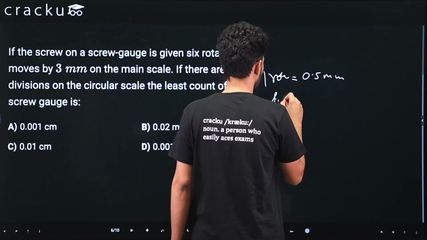
If the screw on a screw-gauge is given six rotations, it moves by $$3 \; mm$$ on the main scale. If there are 50 divisions on the circular scale the least count of the screw gauge is:
First, we recall what the pitch of a screw is. The pitch is defined as the linear distance moved by the tip of the screw for one complete rotation of the circular head.
According to the data given, six complete rotations of the screw make the tip advance through a distance of $$3\; \text{mm}$$ on the main scale. Hence, the pitch can be found by dividing the total linear movement by the number of rotations:
$$\text{Pitch} \;=\; \frac{\text{Total linear advance}}{\text{Number of rotations}}$$
Substituting the numbers, we get
$$\text{Pitch} \;=\; \frac{3\;\text{mm}}{6}$$
Simplifying the fraction,
$$\text{Pitch} \;=\; 0.5\;\text{mm}$$
Now we state the formula for the least count (L.C.) of a screw-gauge. The least count is the smallest length that can be measured with the instrument and is given by
$$\text{Least Count} \;=\; \frac{\text{Pitch}}{\text{Number of divisions on the circular scale}}$$
We have already found the pitch to be $$0.5\;\text{mm}$$, and we are told that the circular scale possesses $$50$$ equal divisions. Substituting these values into the formula, we obtain
$$\text{Least Count} \;=\; \frac{0.5\;\text{mm}}{50}$$
Carrying out the division gives
$$\text{Least Count} \;=\; 0.01\;\text{mm}$$
Usually, we may also wish to express the least count in centimetres for comparison with the answers listed. Since $$1\;\text{mm} \;=\; 0.1\;\text{cm},$$ we multiply $$0.01\;\text{mm}$$ by $$0.1$$ to convert the unit:
$$0.01\;\text{mm} \;=\; 0.01 \times 0.1\;\text{cm} \;=\; 0.001\;\text{cm}$$
Looking at the options, the value $$0.001\;\text{cm}$$ matches Option A.
Hence, the correct answer is Option A.
Was this solution helpful?
Click on the Email ☝️ to Watch the Video Solution
Create a FREE account and get:
_1.webp)

Educational materials for JEE preparation

Ask our AI anything

AI can make mistakes. Please verify important information.
AI can make mistakes. Please verify important information.
