
Join Our JEE Preparation Group
Prep with like-minded aspirants; Get access to free daily tests and study material.
Sign in
Please select an account to continue using cracku.in
↓ →
Join Our JEE Preparation Group
Prep with like-minded aspirants; Get access to free daily tests and study material.
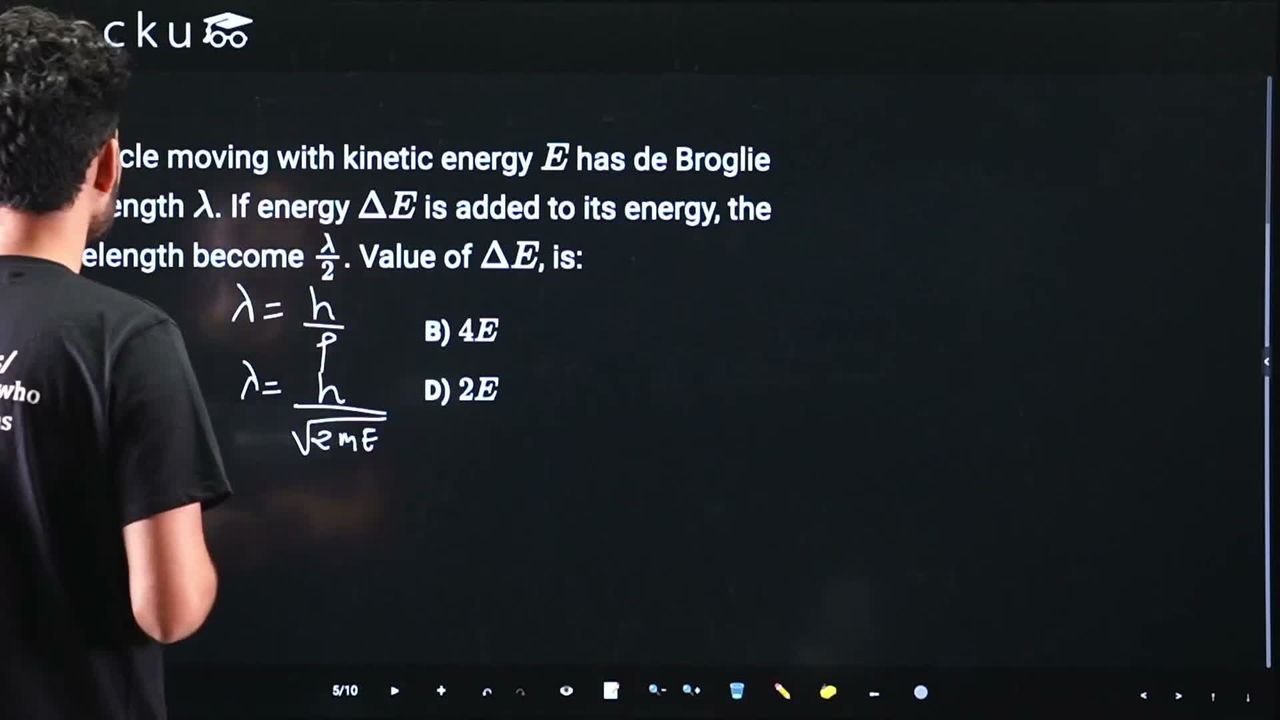
A particle moving with kinetic energy $$E$$ has de Broglie wavelength $$\lambda$$. If energy $$\Delta E$$ is added to its energy, the wavelength become $$\frac{\lambda}{2}$$. Value of $$\Delta E$$, is:
We start with the de Broglie relation for a non-relativistic particle
$$\lambda=\frac{h}{p},$$
where $$h$$ is Planck’s constant and $$p$$ is the linear momentum of the particle.
The kinetic energy $$E$$ of a non-relativistic particle of mass $$m$$ and momentum $$p$$ is given by the usual formula
$$E=\frac{p^{2}}{2m}.$$
From the de Broglie relation we can express the momentum in terms of the wavelength:
$$p=\frac{h}{\lambda}.$$
Substituting this value of $$p$$ into the kinetic-energy expression, we obtain
$$E=\frac{1}{2m}\left(\frac{h}{\lambda}\right)^{2} =\frac{h^{2}}{2m\lambda^{2}}.$$
Now extra energy $$\Delta E$$ is supplied so that the new de Broglie wavelength becomes
$$\lambda'=\frac{\lambda}{2}.$$
Using the same de Broglie relation, the new momentum $$p'$$ is
$$p'=\frac{h}{\lambda'}=\frac{h}{\lambda/2}=2\,\frac{h}{\lambda}=2p.$$
The new kinetic energy $$E'$$ corresponding to this momentum is
$$E'=\frac{{p'}^{2}}{2m} =\frac{(2p)^{2}}{2m} =\frac{4p^{2}}{2m} =2\left(\frac{p^{2}}{m}\right) =4\left(\frac{p^{2}}{2m}\right) =4E.$$
The additional energy supplied is therefore
$$\Delta E = E' - E = 4E - E = 3E.$$
Hence, the correct answer is Option C.
Was this solution helpful?
Click on the Email ☝️ to Watch the Video Solution
Create a FREE account and get:
_1.webp)

Educational materials for JEE preparation

Ask our AI anything

AI can make mistakes. Please verify important information.
AI can make mistakes. Please verify important information.
