
Join Our JEE Preparation Group
Prep with like-minded aspirants; Get access to free daily tests and study material.
Sign in
Please select an account to continue using cracku.in
↓ →
Join Our JEE Preparation Group
Prep with like-minded aspirants; Get access to free daily tests and study material.
$$[Pd(F)(Cl)(Br)(I)]^{2-}$$ has $$n$$ number of geometrical isomers. Then, the spin-only magnetic moment and crystal field stabilization energy [CFSE] of $$[Fe(CN)_6]^{n-6}$$, respectively, are:
[Note: Ignore the pairing energy]
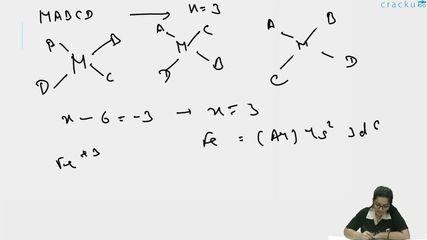
We begin with the square-planar complex $$[Pd(F)(Cl)(Br)(I)]^{2-}$$. In a square plane the four positions are equivalent by rotation, so one ligand may be fixed at the “north” position without loss of generality.
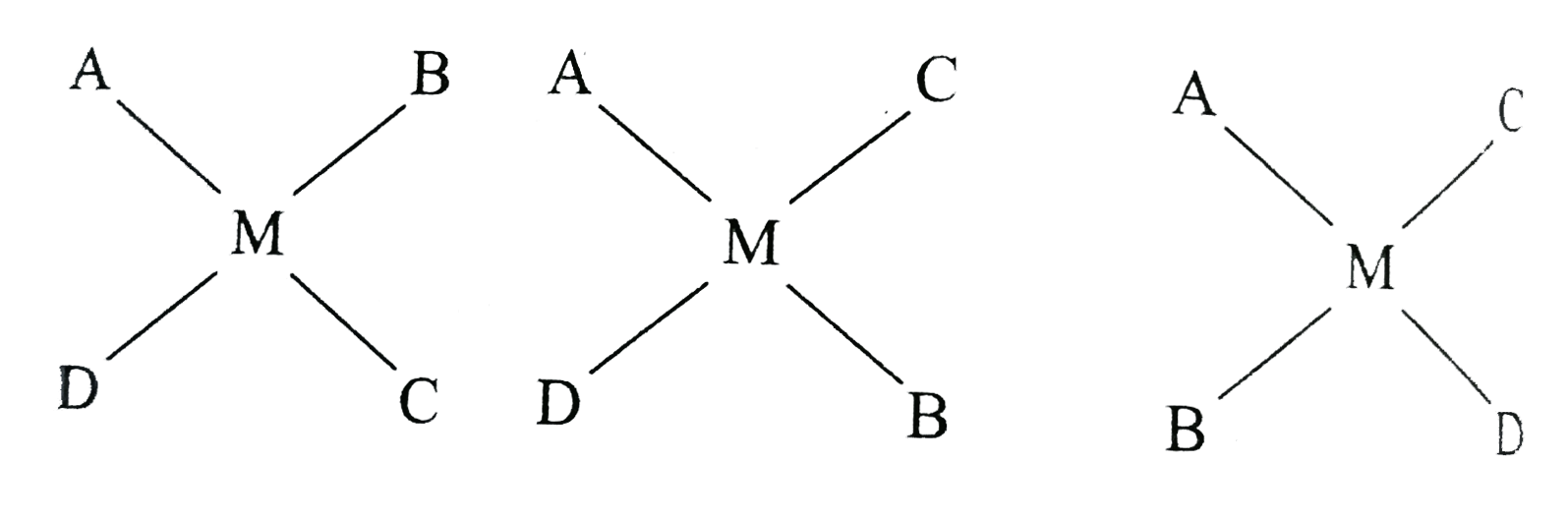
Hence the number of geometrical isomers is
$$n = 3.$$
The same symbol $$n$$ now appears in the charge of the next complex:
$$[Fe(CN)_6]^{\,n-6}.$$
Substituting $$n = 3$$ obtained above, we have
$$[Fe(CN)_6]^{\,3-},$$
so the oxidation state of iron is
$$x + 6(-1) = -3 \;\;\Longrightarrow\;\; x = +3.$$
Thus we are dealing with $$Fe^{3+}$$, which has the electronic configuration $$3d^5$$. Because the ligand $$CN^-$$ is a strong-field (spectrochemical series) ligand, the octahedral complex will be low spin, giving the distribution
$$t_{2g}^{\,5}\;e_g^{\,0}.$$
Number of unpaired electrons:
The five electrons fill the three $$t_{2g}$$ orbitals pairwise as far as possible, leaving only one orbital with a single electron. Therefore
$$n_{\text{unpaired}} = 1.$$
We now calculate the spin-only magnetic moment.
Formula stated first:
$$\mu_{\text{spin only}} = \sqrt{n(n+2)}\;\text{BM},$$
where $$n$$ is the number of unpaired electrons. Substituting $$n = 1$$ gives
$$\mu = \sqrt{1(1+2)} = \sqrt{3} \;\text{BM} \approx 1.73 \;\text{BM}.$$
Next, we evaluate the crystal-field stabilisation energy (CFSE) in an octahedral field, ignoring pairing energy as instructed.
General CFSE expression:
$$\text{CFSE} = (-0.4\Delta_0)\times N_{t_{2g}} + (+0.6\Delta_0)\times N_{e_g}.$$
For the configuration $$t_{2g}^{\,5}e_g^{\,0}$$,
$$\text{CFSE} = (-0.4\Delta_0)\times 5 + (+0.6\Delta_0)\times 0 = -2.0\Delta_0.$$
Thus, the spin-only magnetic moment is $$\approx 1.73\;\text{BM}$$ and the CFSE is $$-2.0\Delta_0$$.
Hence, the correct answer is Option C.
Was this solution helpful?
Click on the Email ☝️ to Watch the Video Solution
Create a FREE account and get:
Educational materials for JEE preparation

Ask our AI anything

AI can make mistakes. Please verify important information.
AI can make mistakes. Please verify important information.

_1.webp)
