
Join Our JEE Preparation Group
Prep with like-minded aspirants; Get access to free daily tests and study material.
Sign in
Please select an account to continue using cracku.in
↓ →
Join Our JEE Preparation Group
Prep with like-minded aspirants; Get access to free daily tests and study material.
Complex X of composition $$Cr(H_2O)_6Cl_n$$ has a spin only magnetic moment of 3.83 B.M. It reacts with $$AgNO_3$$ and shows geometrical isomerism. The IUPAC nomenclature of X is:
We are told that the complex has the empirical composition $$Cr(H_2O)_6Cl_n$$. Such a formula merely lists everything present in one “mole” of the salt; it does not tell us which chlorides are coordinated and which are present as free (counter-ion) chloride. To make this explicit, we write
$$Cr(H_2O)_6Cl_n \;=\;[Cr(H_2O)_{6-x}Cl_x]Cl_{\,n-x}$$
where
$$x=$$ number of chloride ions coordinated to chromium,
$$n-x=$$ number of chloride ions lying outside the coordination sphere.
The problem gives three qualitative facts that will let us fix both $$x$$ and the oxidation state of chromium.
(1) The complex precipitates $$AgCl$$ on treatment with $$AgNO_3$$. Silver ion will react only with free chloride, so $$n-x>0$$. Hence at least one chloride must be outside the coordination sphere.
(2) The complex shows geometrical (cis-trans) isomerism. For an octahedral complex this isomerism is possible only when at least two ligands of one kind and at least two of another kind occupy the six coordination sites. With water and chloride the minimum requirement is $$x\ge 2.$$ (The ion $$[Cr(H_2O)_5Cl]^{(3-n)}$$ would have only one chloride inside; such a species cannot give a cis-trans pair.) We therefore choose the smallest value consistent with this condition, namely $$x=2$$.
With $$x=2$$ the inner-sphere formula is $$[Cr(H_2O)_4Cl_2]^{z+}$$ where $$z$$ is the charge on the complex cation. Charge balance for the whole salt is obtained from
$$\bigl(z\bigr)+\bigl(-1\bigr)(n-x)=0 \;\;\Longrightarrow\;\; z=n-x.$$
But we have already decided that $$x=2$$, so
$$z=n-2 \qquad\text{and}\qquad \text{oxidation state of }Cr=\;z+2$$ (the +2 compensates the two coordinated $$Cl^-$$ ions).
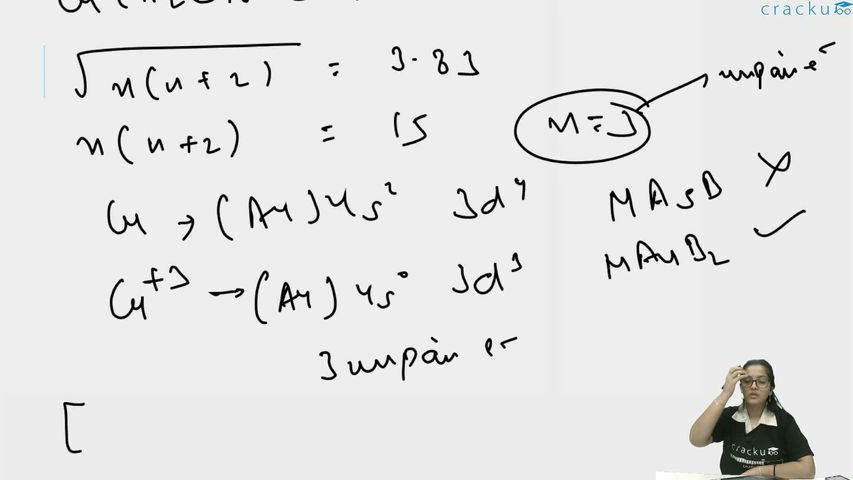
(3) The spin-only magnetic moment is $$\mu_{\text{obs}} = 3.83\; \text{B.M.}$$ For a first-row transition ion the spin-only formula is
$$\mu_{\text{so}} = \sqrt{n_u(n_u+2)}\; \text{B.M.},$$
where $$n_u$$ is the number of unpaired d electrons. Putting $$\mu_{\text{so}} = 3.83$$ we have
$$3.83 \approx \sqrt{n_u(n_u+2)}.$$
Trying successive integer values:
$$n_u=2\;:\;\sqrt{2(2+2)}=\sqrt{8}=2.83 \text{ B.M. (too low)}$$
$$n_u=3\;:\;\sqrt{3(3+2)}=\sqrt{15}=3.87 \text{ B.M. (matches)}$$
Therefore $$n_u=3$$. In octahedral fields high-spin $$d^3$$ gives three unpaired electrons, so chromium must be in the $$+3$$ oxidation state.
Hence $$z = +3$$ and from $$z = n-2$$ we obtain $$n = 3$$.
Summarising the deductions:
Number of coordinated chlorides $$x = 2$$ (gives cis-trans isomers),
Oxidation state of Cr $$= +3,$$
Total chlorides present $$n = 3,$$ of which one is outside the sphere.
The complete formula, still containing the six water molecules mentioned in the analysis, is therefore
$$[Cr(H_2O)_4Cl_2]Cl\cdot 2H_2O.$$
According to the IUPAC rules:
Consequently the IUPAC name is
tetraaquadichloridochromium(III) chloride dihydrate.
Was this solution helpful?
Click on the Email ☝️ to Watch the Video Solution
Create a FREE account and get:
_1.webp)

Educational materials for JEE preparation

Ask our AI anything

AI can make mistakes. Please verify important information.
AI can make mistakes. Please verify important information.
