
Join Our JEE Preparation Group
Prep with like-minded aspirants; Get access to free daily tests and study material.
Sign in
Please select an account to continue using cracku.in
↓ →
Join Our JEE Preparation Group
Prep with like-minded aspirants; Get access to free daily tests and study material.
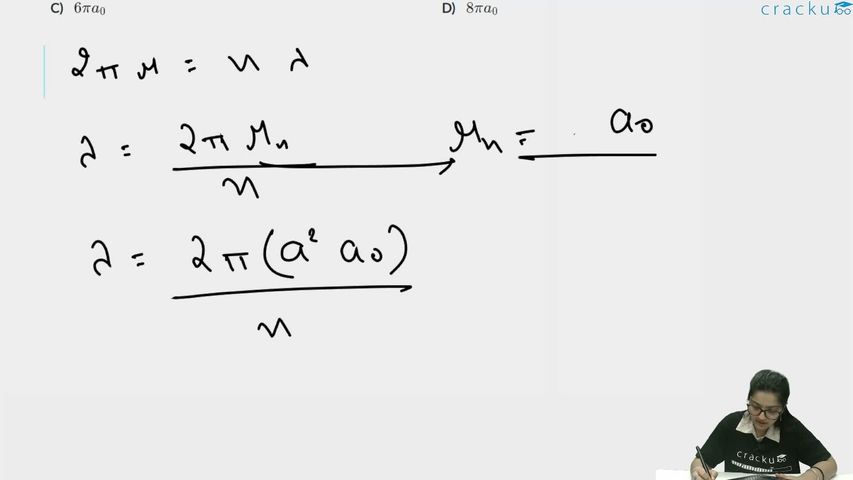
For an electron moving in a Bohr orbit, the de Broglie hypothesis tells us that its orbital circumference must accommodate an integral number of wavelengths. Mathematically, this statement is written as $$2\pi r_n = n\lambda,$$ where $$r_n$$ is the radius of the $$n^{\text{th}}$$ orbit, $$\lambda$$ is the de Broglie wavelength, and $$n$$ is the principal quantum number.
We want an explicit expression for $$\lambda,$$ so we solve the above equation for $$\lambda$$ by dividing both sides by $$n$$:
$$\lambda = \frac{2\pi r_n}{n}.$$
Next, we must substitute the Bohr‐model formula for the radius of the $$n^{\text{th}}$$ orbit of a hydrogen-like atom. That formula is $$r_n = n^2 a_0,$$ where $$a_0$$ is the Bohr radius (a universal constant for hydrogen).
Substituting $$r_n = n^2 a_0$$ into the wavelength expression, we obtain
$$\lambda = \frac{2\pi(n^2 a_0)}{n}.$$
We simplify the fraction by cancelling one factor of $$n$$ in the numerator and the denominator:
$$\lambda = 2\pi n a_0.$$
Now we place the electron specifically in the $$4^{\text{th}}$$ Bohr orbit, which means we set $$n = 4.$$ Putting this value into the simplified formula gives
$$\lambda = 2\pi(4)a_0 = 8\pi a_0.$$
Thus the de Broglie wavelength of an electron in the fourth Bohr orbit is $$8\pi a_0.$$
Hence, the correct answer is Option D.
Was this solution helpful?
Click on the Email ☝️ to Watch the Video Solution
Create a FREE account and get:
_1.webp)

Educational materials for JEE preparation

Ask our AI anything

AI can make mistakes. Please verify important information.
AI can make mistakes. Please verify important information.
