
Join Our JEE Preparation Group
Prep with like-minded aspirants; Get access to free daily tests and study material.
Sign in
Please select an account to continue using cracku.in
↓ →
Join Our JEE Preparation Group
Prep with like-minded aspirants; Get access to free daily tests and study material.
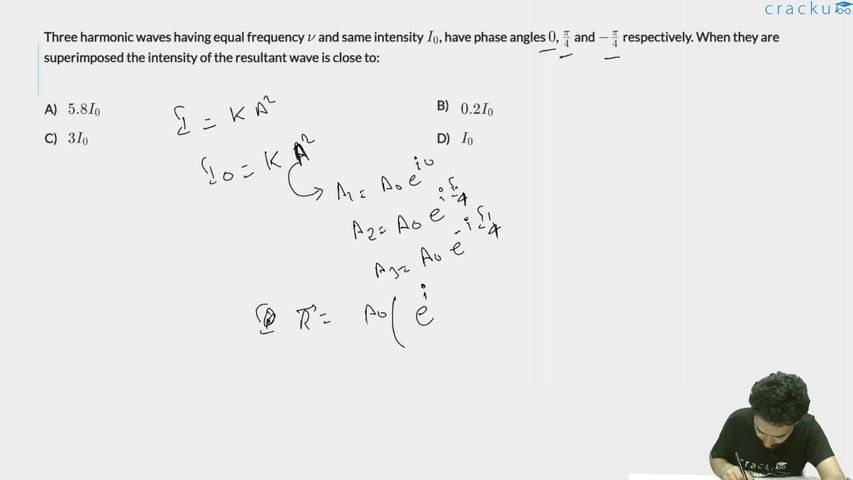
Three harmonic waves having equal frequency $$\nu$$ and same intensity $$I_0$$, have phase angles $$0$$, $$\frac{\pi}{4}$$ and $$-\frac{\pi}{4}$$ respectively. When they are superimposed the intensity of the resultant wave is close to:
We are given three simple harmonic waves that all have the same angular frequency, the same amplitude and therefore the same individual intensity $$I_0$$. Let the displacement (or electric field, sound pressure, etc.) of each wave be represented by a complex phasor of magnitude $$A$$.
The standard relation between intensity and amplitude for a monochromatic wave is
$$I = kA^{2},$$
where $$k$$ is a positive constant that depends on the properties of the medium. Because all three waves possess the same intensity $$I_0$$, we must have
$$I_0 = kA^{2}\; \Longrightarrow\; A = \sqrt{\dfrac{I_0}{k}}.$$
We now list the three phasors with their respective phase angles:
$$\begin{aligned} \text{Wave 1:}\;&\;A e^{i0},\\[4pt] \text{Wave 2:}\;&\;A e^{i\pi/4},\\[4pt] \text{Wave 3:}\;&\;A e^{-i\pi/4}. \end{aligned}$$
The resultant phasor $$\vec{R}$$ is obtained by vector (phasor) addition:
$$\vec{R} = A\Bigl(e^{i0}+e^{i\pi/4}+e^{-i\pi/4}\Bigr).$$
We evaluate the parenthesis by using Euler’s identity $$e^{i\theta}+e^{-i\theta}=2\cos\theta.$$ Hence,
$$\begin{aligned} e^{i\pi/4}+e^{-i\pi/4} &= 2\cos\!\left(\dfrac{\pi}{4}\right)\\[6pt] &= 2\left(\dfrac{\sqrt{2}}{2}\right)\\[6pt] &= \sqrt{2}. \end{aligned}$$
Substituting this result we find
$$\begin{aligned} \vec{R} &= A\Bigl(1+\sqrt{2}\Bigr),\\[6pt] |\vec{R}| &= A(1+\sqrt{2}). \end{aligned}$$
The intensity of the resultant wave, denoted $$I$$, is once again related to the square of the resultant amplitude:
$$I = k|\vec{R}|^{2} = k\Bigl[A(1+\sqrt{2})\Bigr]^{2}.$$
Now substitute $$A^{2} = \dfrac{I_0}{k}$$:
$$\begin{aligned} I &= kA^{2}(1+\sqrt{2})^{2}\\[6pt] &= k\left(\dfrac{I_0}{k}\right)\bigl(1+\sqrt{2}\bigr)^{2}\\[6pt] &= I_0\,(1+\sqrt{2})^{2}. \end{aligned}$$
We expand the square:
$$\begin{aligned} (1+\sqrt{2})^{2} &= 1^{2} + 2\cdot1\cdot\sqrt{2} + (\sqrt{2})^{2}\\[4pt] &= 1 + 2\sqrt{2} + 2\\[4pt] &= 3 + 2\sqrt{2}. \end{aligned}$$
Because $$\sqrt{2}\approx 1.414$$, we have
$$2\sqrt{2} \approx 2\times 1.414 = 2.828,$$
and therefore
$$I \approx I_0\,(3 + 2.828) = 5.828\,I_0 \approx 5.8\,I_0.$$
Hence, the correct answer is Option A.
Was this solution helpful?
Click on the Email ☝️ to Watch the Video Solution
Create a FREE account and get:
_1.webp)

Educational materials for JEE preparation

Ask our AI anything

AI can make mistakes. Please verify important information.
AI can make mistakes. Please verify important information.
