
Join Our JEE Preparation Group
Prep with like-minded aspirants; Get access to free daily tests and study material.
Sign in
Please select an account to continue using cracku.in
↓ →
Join Our JEE Preparation Group
Prep with like-minded aspirants; Get access to free daily tests and study material.
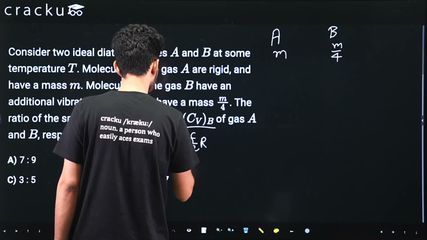
Consider two ideal diatomic gases $$A$$ and $$B$$ at some temperature $$T$$. Molecules of the gas $$A$$ are rigid, and have a mass $$m$$. Molecules of the gas $$B$$ have an additional vibrational mode and have a mass $$\frac{m}{4}$$. The ratio of the specific heats $$(C_V)_A$$ and $$(C_V)_B$$ of gas $$A$$ and $$B$$, respectively is:
For any ideal gas, the law of equipartition of energy tells us that each quadratic degree of freedom contributes an average energy of $$\frac{1}{2}kT$$ per molecule, where $$k$$ is Boltzmann’s constant and $$T$$ is the absolute temperature. If a molecule has a total of $$f$$ quadratic degrees of freedom, the average internal energy per molecule is $$\frac{f}{2}kT$$ and, per mole, the internal energy is $$\frac{f}{2}RT$$, because $$R = N_Ak$$.
The molar specific heat at constant volume is the derivative of the internal energy with respect to temperature, so the formula we use is
$$C_V = \left(\frac{\partial U}{\partial T}\right)_V = \frac{f}{2}R.$$
We now count the degrees of freedom for the two gases.
Gas $$A$$ is a rigid diatomic molecule. A rigid diatomic has
There are no vibrational degrees of freedom because the molecule is stated to be rigid. Hence
$$f_A = 3 + 2 = 5.$$
Using the formula, the molar specific heat of gas $$A$$ is
$$ (C_V)_A = \frac{f_A}{2}R = \frac{5}{2}R. $$
Gas $$B$$ is also diatomic, but it possesses one additional vibrational mode that is fully active. A single vibrational mode contributes two quadratic degrees of freedom: one kinetic and one potential. Therefore, the count for gas $$B$$ is
This gives
$$f_B = 3 + 2 + 2 = 7.$$
So the molar specific heat of gas $$B$$ is
$$ (C_V)_B = \frac{f_B}{2}R = \frac{7}{2}R. $$
We are asked for the ratio $$(C_V)_A : (C_V)_B$$. Substituting the expressions we have just obtained,
$$ (C_V)_A : (C_V)_B = \frac{5}{2}R : \frac{7}{2}R. $$
The common factors $$\frac{1}{2}R$$ cancel out, leaving
$$ (C_V)_A : (C_V)_B = 5 : 7. $$
Hence, the correct answer is Option D.
Was this solution helpful?
Click on the Email ☝️ to Watch the Video Solution
Create a FREE account and get:
_1.webp)

Educational materials for JEE preparation

Ask our AI anything

AI can make mistakes. Please verify important information.
AI can make mistakes. Please verify important information.
