
Join Our JEE Preparation Group
Prep with like-minded aspirants; Get access to free daily tests and study material.
Sign in
Please select an account to continue using cracku.in
↓ →
Join Our JEE Preparation Group
Prep with like-minded aspirants; Get access to free daily tests and study material.
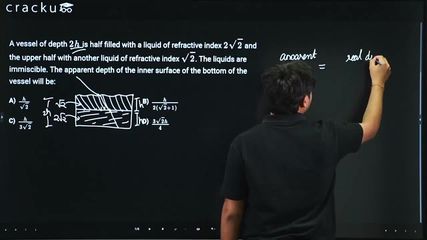
A vessel of depth $$2h$$ is half filled with a liquid of refractive index $$2\sqrt{2}$$ and the upper half with another liquid of refractive index $$\sqrt{2}$$. The liquids are immiscible. The apparent depth of the inner surface of the bottom of the vessel will be:
The vessel has total depth $$2h$$. We are told that the lower half, whose real thickness is $$h$$, is filled with a denser liquid of refractive index $$2\sqrt{2}$$, while the upper half, also of real thickness $$h$$, contains a lighter liquid of refractive index $$\sqrt{2}$$. We observe the bottom from directly above, so the incidence of the viewing rays at the upper surface of the top liquid is normal.
For normal incidence, the formula that links real thickness and apparent thickness through a single transparent layer (with the observer in air of refractive index nearly $$1$$) is stated first:
$$\text{apparent thickness} \;=\; \frac{\text{real thickness}}{\text{refractive index of the layer}}.$$
When there are several immiscible horizontal layers, each one shifts the image separately, and the total apparent depth of the object equals the sum of the apparent thicknesses of all the individual layers. Hence, if an object lies beneath consecutive layers of thicknesses $$t_1,\,t_2,\ldots$$ and refractive indices $$\mu_1,\,\mu_2,\ldots$$, we have
$$\text{total apparent depth} \;=\; \frac{t_1}{\mu_1} + \frac{t_2}{\mu_2} + \cdots.$$
Applying this statement to our two-layer vessel, we designate
$$t_1 = h,\;\; \mu_1 = 2\sqrt{2},$$ $$t_2 = h,\;\; \mu_2 = \sqrt{2}.$$
We now substitute these numerical values:
$$\text{apparent depth} = \frac{h}{2\sqrt{2}} + \frac{h}{\sqrt{2}}.$$ We simplify term by term. The first fraction stays as $$\dfrac{h}{2\sqrt{2}}$$, while the second is written with a common denominator $$2\sqrt{2}$$ to combine the two:
$$\frac{h}{\sqrt{2}} = \frac{h}{\sqrt{2}}\times \frac{2}{2} = \frac{2h}{2\sqrt{2}}.$$
Adding the two fractions gives
$$\text{apparent depth} = \frac{h}{2\sqrt{2}} + \frac{2h}{2\sqrt{2}} = \frac{3h}{2\sqrt{2}}.$$
To remove the radical from the denominator, we multiply numerator and denominator by $$\sqrt{2}$$:
$$\frac{3h}{2\sqrt{2}}\times \frac{\sqrt{2}}{\sqrt{2}} = \frac{3h\sqrt{2}}{2\cdot 2} = \frac{3\sqrt{2}\,h}{4}.$$
Therefore, the inner surface of the bottom is seen from above at an apparent depth
$$d_{\text{apparent}} = \frac{3\sqrt{2}\,h}{4}.$$
This value exactly matches Option D.
Hence, the correct answer is Option D.
Was this solution helpful?
Click on the Email ☝️ to Watch the Video Solution
Create a FREE account and get:
_1.webp)

Educational materials for JEE preparation

Ask our AI anything

AI can make mistakes. Please verify important information.
AI can make mistakes. Please verify important information.
