
Join Our JEE Preparation Group
Prep with like-minded aspirants; Get access to free daily tests and study material.
Sign in
Please select an account to continue using cracku.in
↓ →
Join Our JEE Preparation Group
Prep with like-minded aspirants; Get access to free daily tests and study material.
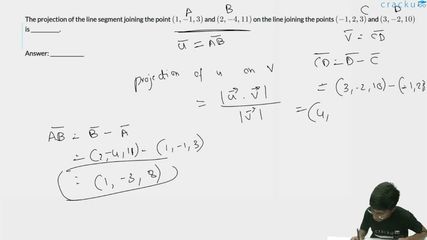
The projection of the line segment joining the point $$(1, -1, 3)$$ and $$(2, -4, 11)$$ on the line joining the points $$(-1, 2, 3)$$ and $$(3, -2, 10)$$ is ___________.
Correct Answer: 8
We begin by translating the given points into vectors. For the line segment whose projection we have to find, let us denote the first point by $$A(1,-1,3)$$ and the second point by $$B(2,-4,11)$$. The vector joining these points is obtained by subtracting the coordinates of $$A$$ from those of $$B$$:
$$ \vec{AB}= \langle\,2-1,\; -4-(-1),\; 11-3\,\rangle = \langle\,1,\; -3,\; 8\,\rangle . $$
Next, we need the direction of the line on which we are projecting. Let that line pass through the points $$C(-1,2,3)$$ and $$D(3,-2,10)$$. Its direction vector is obtained in the same way:
$$ \vec{CD}= \langle\,3-(-1),\; -2-2,\; 10-3\,\rangle = \langle\,4,\; -4,\; 7\,\rangle . $$
Now, the scalar (length) of the projection of one vector on another is given by the well-known formula
$$ \text{Projection of }\vec{u}\text{ on }\vec{v} = \dfrac{\vec{u}\cdot\vec{v}}{\lvert\vec{v}\rvert}, $$
where $$\vec{u}\cdot\vec{v}$$ is the dot product and $$\lvert\vec{v}\rvert$$ is the magnitude of $$\vec{v}$$. Here $$\vec{u} = \vec{AB}$$ and $$\vec{v} = \vec{CD}$$.
First we evaluate the dot product $$\vec{AB}\cdot\vec{CD}$$:
$$ \vec{AB}\cdot\vec{CD} = (1)(4) \;+\; (-3)(-4) \;+\; (8)(7) \\ = 4 \;+\; 12 \;+\; 56 \\ = 72 . $$
Next we find the magnitude of $$\vec{CD}$$:
$$ \lvert\vec{CD}\rvert = \sqrt{4^{2} + (-4)^{2} + 7^{2}} \\ = \sqrt{16 + 16 + 49} \\ = \sqrt{81} \\ = 9 . $$
Substituting these values into the projection formula, we obtain
$$ \text{Projection length} = \dfrac{72}{9} = 8 . $$
So, the answer is $$8$$.
Was this solution helpful?
Click on the Email ☝️ to Watch the Video Solution
Create a FREE account and get:
_1.webp)

Educational materials for JEE preparation

Ask our AI anything

AI can make mistakes. Please verify important information.
AI can make mistakes. Please verify important information.
