
Join Our JEE Preparation Group
Prep with like-minded aspirants; Get access to free daily tests and study material.
Sign in
Please select an account to continue using cracku.in
↓ →
Join Our JEE Preparation Group
Prep with like-minded aspirants; Get access to free daily tests and study material.
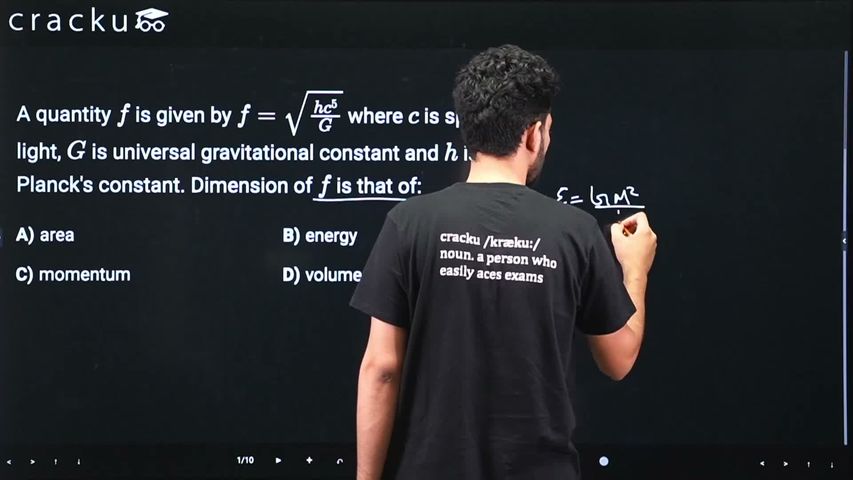
A quantity $$f$$ is given by $$f = \sqrt{\frac{hc^5}{G}}$$ where $$c$$ is speed of light, $$G$$ is universal gravitational constant and $$h$$ is the Planck's constant. Dimension of $$f$$ is that of:
We are given a physical quantity
$$f = \sqrt{\dfrac{h\,c^{5}}{G}}$$
To find the dimension of $$f$$, we first write the dimensional symbols of each constant in terms of the fundamental quantities mass $$M$$, length $$L$$ and time $$T$$.
• Planck’s constant $$h$$ has the dimension of action. By definition,
$$[h] = M\,L^{2}\,T^{-1}.$$
• The speed of light $$c$$ is a speed, so
$$[c] = L\,T^{-1}.$$
• The universal gravitational constant $$G$$ appears in Newton’s law $$F = G\dfrac{m_{1}m_{2}}{r^{2}}$$. Therefore, recalling that force has dimension $$M\,L\,T^{-2}$$, we can write
$$[G] = \dfrac{F\,r^{2}}{M^{2}} = \dfrac{(M\,L\,T^{-2})\,L^{2}}{M^{2}} = M^{-1}\,L^{3}\,T^{-2}.$$
Now we construct the dimension of the expression under the square root.
First, the fifth power of $$c$$:
$$[c^{5}] = (L\,T^{-1})^{5} = L^{5}\,T^{-5}.$$
Multiplying by $$h$$:
$$[h\,c^{5}] = (M\,L^{2}\,T^{-1})\,(L^{5}\,T^{-5}) = M\,L^{7}\,T^{-6}.$$
Next, we divide by $$G$$. Dividing by a quantity is equivalent to multiplying by its reciprocal, so we use
$$[G]^{-1} = (M^{-1}\,L^{3}\,T^{-2})^{-1} = M\,L^{-3}\,T^{2}.$$
Thus,
$$\left[\dfrac{h\,c^{5}}{G}\right] = (M\,L^{7}\,T^{-6})\,(M\,L^{-3}\,T^{2}) = M^{2}\,L^{4}\,T^{-4}.$$
Finally, we take the square root because $$f$$ is the square root of that product:
$$[f] = \sqrt{M^{2}\,L^{4}\,T^{-4}} = M^{1}\,L^{2}\,T^{-2}.$$
The dimension $$M\,L^{2}\,T^{-2}$$ is precisely the dimension of energy (or work), since work $$= \text{force}\times\text{distance} = (M\,L\,T^{-2})\times L$$.
Hence, the correct answer is Option 2.
Was this solution helpful?
Click on the Email ☝️ to Watch the Video Solution
Create a FREE account and get:
_1.webp)

Educational materials for JEE preparation

Ask our AI anything

AI can make mistakes. Please verify important information.
AI can make mistakes. Please verify important information.
