
Join Our JEE Preparation Group
Prep with like-minded aspirants; Get access to free daily tests and study material.
Sign in
Please select an account to continue using cracku.in
↓ →
Join Our JEE Preparation Group
Prep with like-minded aspirants; Get access to free daily tests and study material.
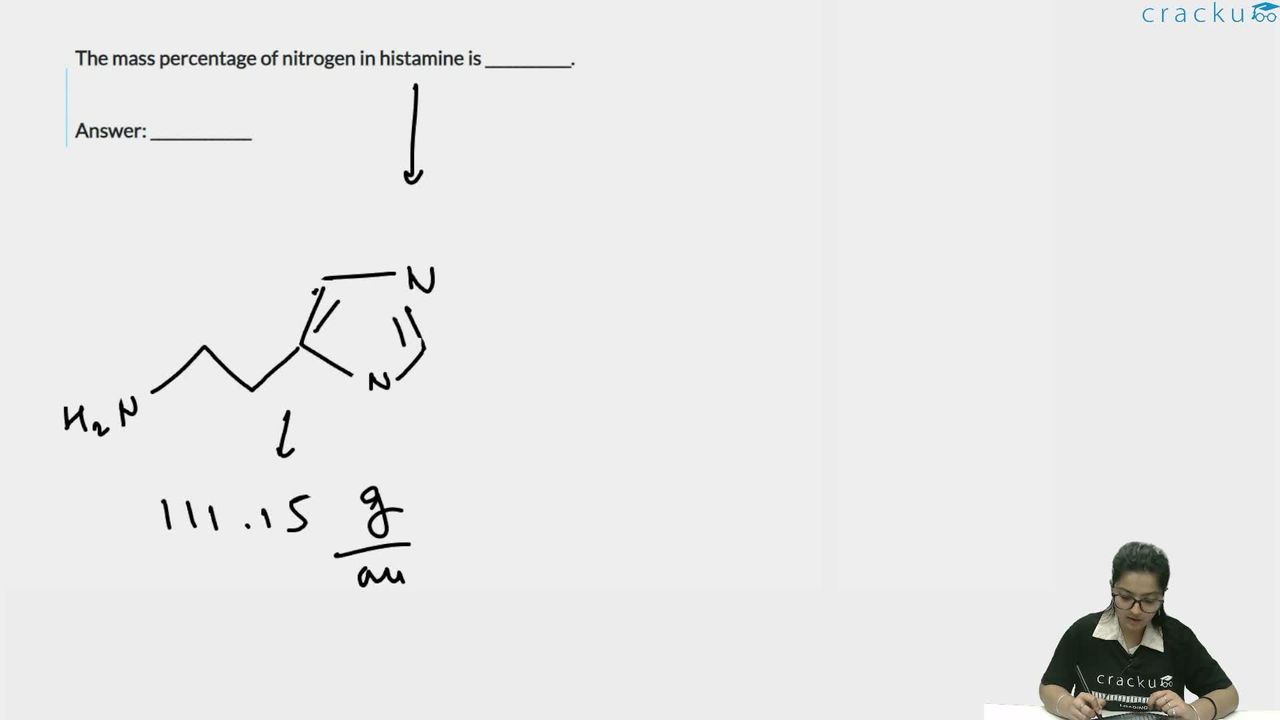
We start by recalling the molecular formula of histamine. Histamine is known to be $$\mathrm{C_5H_9N_3}$$, that is, each molecule contains 5 carbon atoms, 9 hydrogen atoms and 3 nitrogen atoms.
Now, to find the mass percentage of nitrogen, we first need the molar mass of histamine. We list the atomic masses (in g mol−1) that will be used:
$$\text{Atomic mass of C}=12.01,\qquad\text{Atomic mass of H}=1.008,\qquad\text{Atomic mass of N}=14.01$$
We next calculate the total mass contributed by each element in one mole of histamine.
For carbon we have 5 atoms, so
$$m_{\text{C}} = 5 \times 12.01 = 60.05$$
For hydrogen we have 9 atoms, so
$$m_{\text{H}} = 9 \times 1.008 = 9.072$$
For nitrogen we have 3 atoms, so
$$m_{\text{N}} = 3 \times 14.01 = 42.03$$
The molar mass of histamine is obtained by adding these three contributions:
$$M_{\mathrm{C_5H_9N_3}} = 60.05 + 9.072 + 42.03 = 111.152\;\text{g mol}^{-1}$$
We now apply the general formula for percentage composition of an element in a compound:
$$\text{Mass percentage of an element} = \frac{\text{Total mass of that element in one mole of compound}}{\text{Molar mass of the compound}}\times 100$$
Substituting the values for nitrogen we get
$$\%\ \text{N} = \frac{42.03}{111.152}\times 100$$
Carrying out the division first,
$$\frac{42.03}{111.152} \approx 0.378$$
and then multiplying by 100,
$$0.378 \times 100 = 37.8$$
So, the answer is $$37.8\%$$.
Was this solution helpful?
Click on the Email ☝️ to Watch the Video Solution
Create a FREE account and get:
_1.webp)

Educational materials for JEE preparation

Ask our AI anything

AI can make mistakes. Please verify important information.
AI can make mistakes. Please verify important information.
