
Join Our JEE Preparation Group
Prep with like-minded aspirants; Get access to free daily tests and study material.
Sign in
Please select an account to continue using cracku.in
↓ →
Join Our JEE Preparation Group
Prep with like-minded aspirants; Get access to free daily tests and study material.
A charged particle of mass 'm' and charge 'q' moving under the influence of uniform electric field $$E\hat{i}$$ and a uniform magnetic field $$B\hat{k}$$ follows a trajectory from point P to Q as shown in figure. The velocities at P and Q are respectively, $$v\hat{i}$$ and $$-2v\hat{j}$$. Then which of the following statements (A, B, C, D) are the correct? (Trajectory shown is schematic and not to scale)
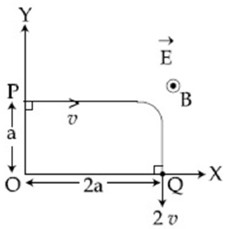
(A) $$E = \frac{3}{4}\left(\frac{mv^2}{qa}\right)$$
(B) Rate of work done by the electric field at P is $$\frac{3}{4}\left(\frac{mv^3}{a}\right)$$
(C) Rate of work done by both the fields at Q is zero
(D) The difference between the magnitude of angular momentum of the particle at P and Q is $$2mav$$.
(A) By work energy theorem:
$$W_{\text{mg}} + W_{\text{ele}} = \frac{1}{2}m(2v)^2 - \frac{1}{2}m(v)^2$$
$$0 + qE_0 \cdot 2a = \frac{3}{2}mv^2$$
$$E_0 = \frac{3}{4}\frac{mv^2}{qa}$$
(B) Rate of work done at P = power of electric force:
$$\text{Power} = qE_0 v = \frac{3}{4}\frac{mv^3}{a}$$
(C) At Q, $$\vec{F} \perp \vec{v}$$ for both fields:
$$\frac{dW}{dt} = 0$$
(D) Change in angular momentum vector:
$$\Delta \vec{L} = (-m \cdot 2v \cdot 2a \hat{k}) - (-m \cdot v \cdot a \hat{k})$$
$$|\Delta \vec{L}| = 3mva$$
Was this solution helpful?
Create a FREE account and get:
_1.webp)

Educational materials for JEE preparation

Ask our AI anything

AI can make mistakes. Please verify important information.
AI can make mistakes. Please verify important information.
