
Join Our JEE Preparation Group
Prep with like-minded aspirants; Get access to free daily tests and study material.
Sign in
Please select an account to continue using cracku.in
↓ →
Join Our JEE Preparation Group
Prep with like-minded aspirants; Get access to free daily tests and study material.
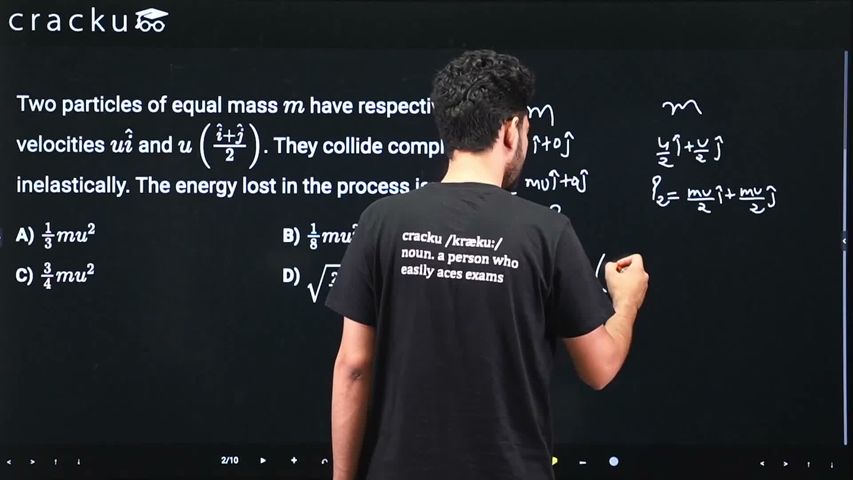
Two particles of equal mass $$m$$ have respective initial velocities $$u\hat{i}$$ and $$u\left(\frac{\hat{i}+\hat{j}}{2}\right)$$. They collide completely inelastically. The energy lost in the process is:
We have two particles, each of mass $$m$$. Their initial velocity vectors are given as
$$\vec{u}_1 = u\,\hat{i}$$
and
$$\vec{u}_2 = u\left(\frac{\hat{i}+\hat{j}}{2}\right).$$
It is convenient to write the second velocity in component form. Distributing the factor $$u$$ inside the bracket, we obtain
$$\vec{u}_2 = \frac{u}{2}\,\hat{i} + \frac{u}{2}\,\hat{j}.$$
Because the collision is completely inelastic, the two particles stick together. Momentum is conserved, so we equate the total initial momentum to the total final momentum.
Total initial momentum:
$$\vec{p}_{\text{initial}} = m\vec{u}_1 + m\vec{u}_2 = m\left(u\,\hat{i}\right) + m\left(\frac{u}{2}\,\hat{i} + \frac{u}{2}\,\hat{j}\right) = mu\left(1 + \frac12\right)\hat{i} + mu\left(\frac12\right)\hat{j} = \frac{3}{2}mu\,\hat{i} + \frac{1}{2}mu\,\hat{j}.$$
Let the common final velocity after sticking together be $$\vec{v}$$, and note that the combined mass is $$2m$$. Conservation of linear momentum gives
$$\frac{3}{2}mu\,\hat{i} + \frac{1}{2}mu\,\hat{j} = 2m\,\vec{v}.$$
Dividing both sides by $$2m$$, we obtain the final velocity vector:
$$\vec{v} = \frac{3}{4}u\,\hat{i} + \frac{1}{4}u\,\hat{j}.$$
Next we compute the initial kinetic energy. The formula for translational kinetic energy is $$K = \frac12 m v^2$$, where $$v$$ is the magnitude of the velocity.
For particle 1, the speed is simply $$u$$, so
$$K_{1i} = \frac12 m u^2.$$
For particle 2, the magnitude of its velocity is
$$\left|\vec{u}_2\right| = \sqrt{\left(\frac{u}{2}\right)^2 + \left(\frac{u}{2}\right)^2} = \sqrt{\frac{u^2}{4} + \frac{u^2}{4}} = \sqrt{\frac{u^2}{2}} = \frac{u}{\sqrt{2}}.$$
Therefore
$$K_{2i} = \frac12 m \left(\frac{u}{\sqrt{2}}\right)^2 = \frac12 m \left(\frac{u^2}{2}\right) = \frac14 m u^2.$$
The total initial kinetic energy is then
$$K_i = K_{1i} + K_{2i} = \frac12 m u^2 + \frac14 m u^2 = \frac34 m u^2.$$
We now calculate the final kinetic energy of the combined mass. First we need the magnitude squared of the final velocity:
$$|\vec{v}|^2 = \left(\frac{3u}{4}\right)^2 + \left(\frac{u}{4}\right)^2 = \frac{9u^2}{16} + \frac{u^2}{16} = \frac{10u^2}{16} = \frac{5u^2}{8}.$$
The final kinetic energy (with total mass $$2m$$) is
$$K_f = \frac12 (2m) |\vec{v}|^2 = m\,|\vec{v}|^2 = m\left(\frac{5u^2}{8}\right) = \frac{5}{8} m u^2.$$
The loss in kinetic energy during the collision is the difference between the initial and final values:
$$\Delta K = K_i - K_f = \frac34 m u^2 - \frac58 m u^2.$$ Converting the fractions to a common denominator, $$\frac34 = \frac68,$$ so
$$\Delta K = \frac68 m u^2 - \frac58 m u^2 = \frac{1}{8} m u^2.$$
Thus the energy lost in the completely inelastic collision is $$\frac{1}{8}mu^2$$.
Hence, the correct answer is Option B.
Was this solution helpful?
Click on the Email ☝️ to Watch the Video Solution
Create a FREE account and get:
_1.webp)

Educational materials for JEE preparation

Ask our AI anything

AI can make mistakes. Please verify important information.
AI can make mistakes. Please verify important information.
