
Join Our JEE Preparation Group
Prep with like-minded aspirants; Get access to free daily tests and study material.
Sign in
Please select an account to continue using cracku.in
↓ →
Join Our JEE Preparation Group
Prep with like-minded aspirants; Get access to free daily tests and study material.
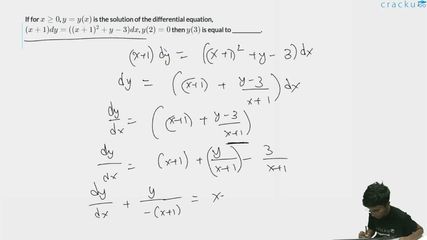
If for $$x \ge 0$$, $$y = y(x)$$ is the solution of the differential equation,
$$(x + 1)dy = ((x + 1)^2 + y - 3)dx$$, $$y(2) = 0$$ then $$y(3)$$ is equal to ___________.
Correct Answer: 3
We have the differential equation
$$ (x+1)\,dy \;=\; \bigl((x+1)^2 + y - 3\bigr)\,dx,\qquad x \ge 0. $$
Dividing both sides by $$dx$$ and by $$(x+1)$$ we obtain the first-order ODE
$$ \frac{dy}{dx} \;=\; \frac{(x+1)^2 + y - 3}{x+1}. $$
Now we split the right-hand side:
$$ \frac{(x+1)^2 + y - 3}{x+1} \;=\; (x+1) + \frac{y-3}{x+1}. $$
So the equation becomes
$$ \frac{dy}{dx} - \frac{y-3}{x+1} \;=\; x+1. $$
Expanding the second term yields
$$ \frac{dy}{dx} - \frac{y}{x+1} + \frac{3}{x+1} \;=\; x+1, $$
and therefore
$$ \frac{dy}{dx} - \frac{y}{x+1} \;=\; x+1 - \frac{3}{x+1}. $$
This is a linear equation of the standard form $$\dfrac{dy}{dx} + P(x)\,y = Q(x)$$ with
$$ P(x) = -\frac{1}{\,x+1\,}, \qquad Q(x) = x+1 - \frac{3}{x+1}. $$
For a linear ODE we first write the integrating factor. The integrating factor (I.F.) is defined by
$$ \text{I.F.} \;=\; e^{\;\int P(x)\,dx}. $$
Here
$$ \int P(x)\,dx \;=\; \int -\frac{1}{x+1}\,dx \;=\; -\ln|x+1|, $$
so, since $$x\ge 0 \implies x+1>0,$$ we have
$$ \text{I.F.} \;=\; e^{-\ln(x+1)} \;=\; \frac{1}{x+1}. $$
Multiplying the whole differential equation by this integrating factor gives
$$ \frac{1}{x+1}\,\frac{dy}{dx} - \frac{y}{(x+1)^2} \;=\; \Bigl(x+1 - \frac{3}{x+1}\Bigr)\frac{1}{x+1}. $$
The left side is now the derivative of $$\dfrac{y}{x+1}$$ because
$$ \frac{d}{dx}\!\Bigl(\frac{y}{x+1}\Bigr) = \frac{1}{x+1}\,\frac{dy}{dx} + y\,\Bigl(-\frac{1}{(x+1)^2}\Bigr) = \frac{1}{x+1}\,\frac{dy}{dx} - \frac{y}{(x+1)^2}. $$
Therefore we can rewrite the equation as
$$ \frac{d}{dx}\!\Bigl(\frac{y}{x+1}\Bigr) \;=\; 1 - \frac{3}{(x+1)^2}. $$
Next we integrate both sides with respect to $$x$$:
$$ \frac{y}{x+1} \;=\; \int\!\Bigl(1 - \frac{3}{(x+1)^2}\Bigr)dx + C. $$
We integrate term by term:
$$ \int 1\,dx = x, $$
and
$$ \int \!-\frac{3}{(x+1)^2}\,dx = -3\int (x+1)^{-2}\,dx = -3 \bigl(-(x+1)^{-1}\bigr) = \frac{3}{x+1}. $$
So we get
$$ \frac{y}{x+1} = x + \frac{3}{x+1} + C. $$
Multiplying by $$(x+1)$$ to isolate $$y$$ gives
$$ y = (x+1)\Bigl(x + \frac{3}{x+1} + C\Bigr) = (x+1)\,x + 3 + C(x+1). $$
Simplifying,
$$ y = x^2 + x + 3 + Cx + C. $$
Group the terms:
$$ y = x^2 + (1 + C)\,x + (3 + C). $$
We are told that $$y(2) = 0$$, so we substitute $$x = 2, y = 0$$:
$$ 0 = (2)^2 + (1 + C)(2) + (3 + C). $$
That is
$$ 0 = 4 + 2(1 + C) + 3 + C = 4 + 2 + 2C + 3 + C = 9 + 3C. $$
Hence
$$ C = -3. $$
Substituting this value of $$C$$ back gives
$$ y = x^2 + (1 - 3)\,x + (3 - 3) = x^2 - 2x. $$
Finally, we evaluate $$y(3)$$:
$$ y(3) = (3)^2 - 2(3) = 9 - 6 = 3. $$
So, the answer is $$3$$.
Was this solution helpful?
Click on the Email ☝️ to Watch the Video Solution
Create a FREE account and get:
_1.webp)

Educational materials for JEE preparation

Ask our AI anything

AI can make mistakes. Please verify important information.
AI can make mistakes. Please verify important information.
