Join Our JEE Preparation Group
Prep with like-minded aspirants; Get access to free daily tests and study material.
Sign in
Please select an account to continue using cracku.in
↓ →
Join Our JEE Preparation Group
Prep with like-minded aspirants; Get access to free daily tests and study material.
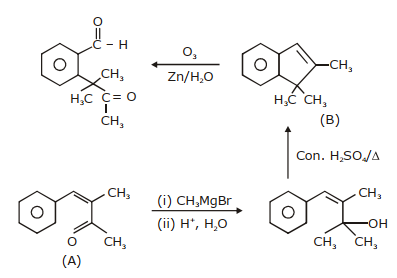
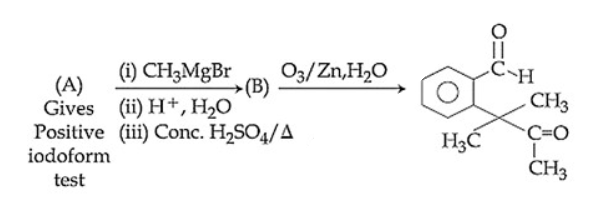
Step 1: Grignard Addition to Ketone (A → Tertiary Alcohol)
Compound A contains both an alkene group and a methyl ketone group ($$\text{--C}(=\text{O})\text{CH}_3$$). When treated with methylmagnesium bromide ($$\text{CH}_3\text{MgBr}$$) followed by acid workup ($$\text{H}^+/\text{H}_2\text{O}$$), the nucleophilic Grignard reagent selectively attacks the carbonyl carbon of the ketone to yield a tertiary alcohol containing a $$-\text{C}(\text{OH})(\text{CH}_3)_2$$ group.
Step 2: Acid-Catalyzed Cyclization / Dehydration (Formation of B)
Treating the tertiary alcohol intermediate with concentrated sulfuric acid and heat ($$\text{Con. H}_2\text{SO}_4/\Delta$$) leads to protonation of the hydroxyl group followed by the loss of water ($$-\text{H}_2\text{O}$$) to form a stable carbocation. This carbocation undergoes an intramolecular electrophilic aromatic substitution (Friedel-Crafts alkylation-type cyclization) with the adjacent alkene/aromatic network, closing into a stable indene-like fused five-membered ring structure B.
Step 3: Reductive Ozonolysis Verification
Subjecting the cyclic alkene B to ozonolysis ($$\text{O}_3, \text{Zn}/\text{H}_2\text{O}$$) oxidatively cleaves the newly formed ring double bond, generating the dicarbonyl compound shown at the top left containing both a formyl ($$-\text{CHO}$$) and an acetyl ($$-\text{COCH}_3$$) group, fully validating the carbon skeleton of A.
Compound A is an ortho-substituted benzene derivative containing a 1-propenyl side chain and a methyl ketone side chain, which undergoes nucleophilic addition followed by dehydration-cyclization.
Answer: Structure (A) as shown in the reaction scheme.
Was this solution helpful?
Click on the Email ☝️ to Watch the Video Solution
Create a FREE account and get:
_1.webp)

Educational materials for JEE preparation

Ask our AI anything

AI can make mistakes. Please verify important information.
AI can make mistakes. Please verify important information.