
Join Our JEE Preparation Group
Prep with like-minded aspirants; Get access to free daily tests and study material.
Sign in
Please select an account to continue using cracku.in
↓ →
Join Our JEE Preparation Group
Prep with like-minded aspirants; Get access to free daily tests and study material.
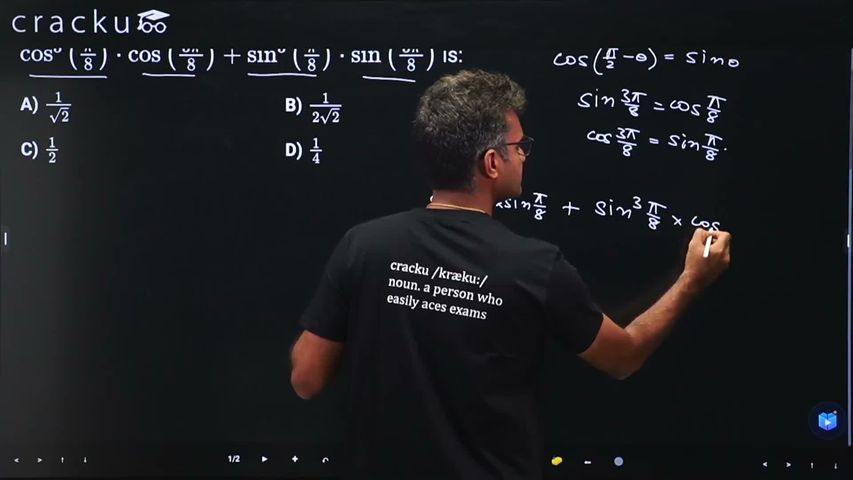
The value of $$\cos^3\left(\frac{\pi}{8}\right) \cdot \cos\left(\frac{3\pi}{8}\right) + \sin^3\left(\frac{\pi}{8}\right) \cdot \sin\left(\frac{3\pi}{8}\right)$$ is:
Step 1: Apply Complementary Angle Transformations
Notice that the angles $$\frac{\pi}{8}$$ and $$\frac{3\pi}{8}$$ are complementary because they add up to $$\frac{\pi}{2}$$.
Therefore, we can establish the following relationships:
Step 2: Substitute and Factor the Expression
The original given expression is:
$$E = \cos^3\left(\frac{\pi}{8}\right) \cos\left(\frac{3\pi}{8}\right) + \sin^3\left(\frac{\pi}{8}\right) \sin\left(\frac{3\pi}{8}\right)$$
Now, substitute the transformed values from Step 1 into this expression:
$$E = \cos^3\left(\frac{\pi}{8}\right) \sin\left(\frac{\pi}{8}\right) + \sin^3\left(\frac{\pi}{8}\right) \cos\left(\frac{\pi}{8}\right)$$
Notice that both terms share a common factor of $$\sin\left(\frac{\pi}{8}\right) \cos\left(\frac{\pi}{8}\right)$$. Let us factor that out:
$$E = \sin\left(\frac{\pi}{8}\right) \cos\left(\frac{\pi}{8}\right) \left[ \cos^2\left(\frac{\pi}{8}\right) + \sin^2\left(\frac{\pi}{8}\right) \right]$$
Step 3: Simplify using Trigonometric Identities
Apply the fundamental Pythagorean identity $$\cos^2 \theta + \sin^2 \theta = 1$$ to the terms inside the bracket:
$$E = \sin\left(\frac{\pi}{8}\right) \cos\left(\frac{\pi}{8}\right) \times 1$$
$$E = \sin\left(\frac{\pi}{8}\right) \cos\left(\frac{\pi}{8}\right)$$
To proceed, multiply and divide the entire expression by $$2$$ to create the standard double angle formula $$\sin(2\theta) = 2 \sin \theta \cos \theta$$:
$$E = \frac{1}{2} \left[ 2 \sin\left(\frac{\pi}{8}\right) \cos\left(\frac{\pi}{8}\right) \right]$$
$$E = \frac{1}{2} \sin\left(2 \times \frac{\pi}{8}\right)$$
$$E = \frac{1}{2} \sin\left(\frac{\pi}{4}\right)$$
Step 4: Final Calculation
We know the standard value for $$\sin\left(\frac{\pi}{4}\right)$$ is $$\frac{1}{\sqrt{2}}$$.
$$E = \frac{1}{2} \times \frac{1}{\sqrt{2}}$$
$$E = \frac{1}{2\sqrt{2}}$$
The correct answer is Option B.
Was this solution helpful?
Click on the Email ☝️ to Watch the Video Solution
Create a FREE account and get:
_1.webp)

Educational materials for JEE preparation

Ask our AI anything

AI can make mistakes. Please verify important information.
AI can make mistakes. Please verify important information.
