

 Group
Group
 Group
Group


 Preferred Source

 Google Discover

JEE Electric Charges & Fields PYQs
JEE Electric Charges & Fields PYQs are an important part of the JEE Physics syllabus. Practising these questions helps you check how well you understand key ideas such as electric charge, Coulomb’s law, electric field, electric field lines, electric flux, electric dipoles, continuous charge distributions, and Gauss’s law.
Questions from Electric Charges & Fields can appear in JEE as direct numericals, concept-based problems, or questions that combine more than one idea. This chapter may feel a little challenging at first because you need to work with both the magnitude and direction of electric forces and fields. Once the basic concepts are clear, however, the questions become much easier to solve.
Instead of memorising every result, try to understand how charges interact and how an electric field changes from one point to another. Regular revision and steady practice with JEE Electric Charges & Fields Questions can improve both your accuracy and confidence. Solving chapter-wise JEE Questions, attempting a JEE Mains Mock Test, and practising from a JEE Mains Previous Papers can also help you become familiar with the actual exam pattern.
In this blog, you will find an Electric Charges & Fields Formula Sheet, important JEE Electric Charges & Fields PYQs in downloadable format, practice questions with answers, and a few extra problems for self-practice. You will also learn about common mistakes students make in this chapter and simple ways to avoid them while solving questions.
JEE Electric Charges & Fields Important PYQs PDF
This PDF can include some of the most useful previous-year questions from Electric Charges & Fields. The questions may cover Coulomb’s law, the principle of superposition, electric fields due to point charges, electric dipoles, electric flux, Gauss’s law, and fields due to symmetric charge distributions.
Practising these questions will help you understand the types of problems commonly asked in JEE. It can also improve your calculation speed, conceptual clarity, and ability to choose the right method. Solving problems from a JEE Mains Previous Paper is especially useful because it gives you a better idea of the actual exam level and question style.
Important Electric Charges & Fields Formula Sheet for JEE
You only need a limited number of important formulas to solve most questions from this chapter. These formulas are mainly used to calculate electric force, electric field, electric flux, dipole moment, and the field due to different charge distributions.
You can download the complete Electric Charges & Fields Formula Sheet from the link above. It can also be added to your JEE Mains Formula Sheet for quick revision before practice sessions and mock tests.
| Concept | Formula |
|---|---|
| Coulomb’s Law | $$F = \frac{kq_1q_2}{r^2}$$ |
| Electric Field | $$E = \frac{F}{q}$$ |
| Field Due to a Point Charge | $$E = \frac{kQ}{r^2}$$ |
| Electric Dipole Moment | $$p = qd$$ |
| Torque on a Dipole | $$\tau = pE\sin\theta$$ |
| Electric Flux | $$\Phi = EA\cos\theta$$ |
| Gauss’s Law | $$\Phi = \frac{Q_{\text{enclosed}}}{\varepsilon_0}$$ |
| Field Due to an Infinite Line Charge | $$E = \frac{\lambda}{2\pi\varepsilon_0r}$$ |
| Field Due to an Infinite Plane Sheet | $$E = \frac{\sigma}{2\varepsilon_0}$$ |
| Field Inside a Conductor | $$E = 0$$ |
These formulas are frequently used in JEE Questions based on point charges, electric dipoles, field lines, electric flux, and Gauss’s law. Revising them along with reliable JEE Study Material can help you remember the correct relationships and avoid small calculation mistakes.
Top 5 Common Mistakes to Avoid in JEE Electric Charges & Fields PYQs
Many students lose marks in this chapter because of small conceptual or calculation errors. Here are some common mistakes you should watch out for:
Ignoring the direction of the electric field
Electric field is a vector quantity. When several charges are involved, you must consider both the magnitude and direction of each field before adding them.
Forgetting the square in the distance term
In Coulomb’s law and the electric field formula, force and field vary inversely with the square of the distance. Missing the square can lead to a completely wrong answer.
Using Gauss’s law without checking symmetry
Gauss’s law is always valid, but it is most useful for calculating electric fields when the charge distribution has enough symmetry. Always choose the Gaussian surface carefully.
Confusing electric force with electric field
Electric force depends on the test charge, while the electric field depends only on the source charge. Check what the question is asking before selecting the formula.
Making sign and direction mistakes
Positive and negative charges produce electric fields in opposite directions. Marking the charge signs and field directions clearly in the diagram can help you avoid confusion.
Regular practice with JEE Electric Charges & Fields Questions, a JEE Mains Mock Test, and chapter-wise problems can help you identify these mistakes early and improve your accuracy.
List of JEE Electric Charges & Fields PYQs
Below is a test-style set of questions based on Coulomb’s law, electric field, electric dipoles, electric flux, Gauss’s law, and charge distributions. Try to solve each question on your own before checking the answer.
Question 1
Two point dipoles of dipole moment $$\vec{p_1}$$ and $$\vec{p_2}$$ are at a distance x from each other and $$\vec{p_1} \| \vec{p_2}$$. The force between the dipoles is :
correct answer:- 3
Question 2
Three concentric metal shells A, B and C of respective radii a, b and c (a < b < c) have surface charge densities $$+\sigma$$, $$-\sigma$$ and $$+\sigma$$ respectively. The potential of shell B is:
correct answer:- 3
Question 3
There is a uniform spherically symmetric surface charge density at a distance $$R_0$$ from the origin. The charge distribution is initially at rest and starts expanding because of mutual repulsion. The figure that represents best the speed $$V(R(t))$$ of the distribution as a function of its instantaneous radius $$R(t)$$ is:
correct answer:- 1
Question 4
Sixty four conducting drops each of radius $$0.02$$ m and each carrying a charge of $$5$$ $$\mu$$C are combined to form a bigger drop. The ratio of surface density of bigger drop to the smaller drop will be
correct answer:- 2
Question 5
Two electric dipoles, A, B with respective dipole moments $$\vec{d_A} = -4qa\hat{i}$$ and $$\vec{d_B} = -2qa\hat{i}$$ are placed on the $$x$$-axis with a separation $$R$$, as shown in the figure.
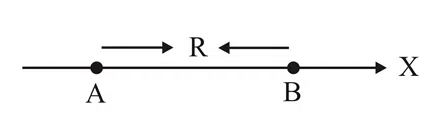
The distance from A at which both of them produce the same potential is:
correct answer:- 2

Question 6
An infinite number of point charges, each carrying $$1 \mu C$$ charge, are placed along the y-axis at $$y = 1$$ m, 2 m, 4 m, 8 m .....
The total force on a 1 C point charge, placed at the origin, is $$x \times 10^3$$ N. The value of $$x$$, to the nearest integer, is ___.
[Take $$\frac{1}{4\pi\varepsilon_0} = 9 \times 10^9$$ N m$$^2$$ C$$^{-2}$$]
correct answer:- 12
Question 7
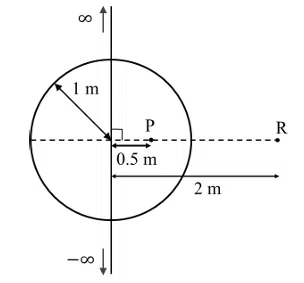
An infinitely long thin wire, having a uniform charge density per unit length of 5 nC/m, is passing through a spherical shell of radius 1 m, as shown in the figure. A 10 nC charge is distributed uniformly over the spherical shell. If the configuration of the charges remains static, the magnitude of the potential difference between points $$P$$ and $$R$$, in Volt, is ________.
[Given: In SI units $$\dfrac{1}{4\pi \varepsilon_0} = 9 \times 10^9$$, ln 2 = 0.7. Ignore the area pierced by the wire.]
correct answer:- 171
Question 8
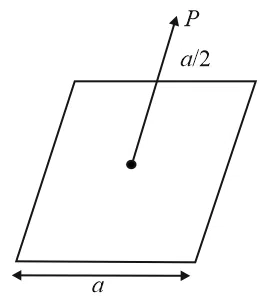
A charge Q is placed at a distance $$\frac{a}{2}$$ above the centre of a square surface of edge a as shown in the figure. The electric flux through the square surface is:
correct answer:- 1
Question 9
A stream of positively charged particles having $$\frac{q}{m} = 2 \times 10^{11}$$ C kg$$^{-1}$$ and velocity $$\vec{v_0} = 3 \times 10^7 \hat{i}$$ m s$$^{-1}$$ is deflected by an electric field $$1.8\hat{j}$$ kV m$$^{-1}$$. The electric field exists in a region of 10 cm along $$x$$ direction. Due to the electric field, the deflection of the charge particles in the $$y$$ direction is _____ mm.
correct answer:- 2
Question 10
An infinite plane sheet of charge having uniform surface charge density $$+\sigma_s\ C/m^2$$ is placed on x−y plane. Another infinitely long line charge having uniform linear charge density $$+\lambda_e\ C/m$$ is placed at z = 4 m plane and parallel to y-axis. If the magnitude values $$|\sigma_s| = 2|\lambda_e|$$, then at point (0, 0, 2), the ratio of magnitudes of electric field values due to sheet charge to that of line charge is $$\pi\sqrt{n} : 1$$. The value of n is _____.
correct answer:- 16

Question 11
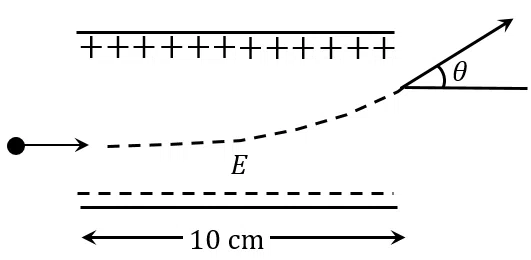
A uniform electric field of 10 N C$$^{-1}$$ is created between two parallel charged plates (as shown in figure). An electron enters the field symmetrically between the plates with a kinetic energy 0.5 eV. The length of each plate is 10 cm. The angle ($$\theta$$) of deviation of the path of electron as it comes out of the field is _____ (in degree).
correct answer:- 45
Question 12
A point charge $$2 \times 10^{-2}$$ C is moved from $$P$$ to $$S$$ in a uniform electric field of $$30$$ N C$$^{-1}$$ directed along positive $$x$$-axis. If coordinates of $$P$$ and $$S$$ are $$(1, 2, 0)$$ m and $$(0, 0, 0)$$ m respectively, the work done by electric field will be
correct answer:- 3
Question 13
Four point charges -q, +q, +q and -q are placed on y-axis at y = -2d, y = -d, and y = +2d, respectively. The magnitude of the electric field E at a point on the x-axis at x = D, with D >> d, will behave as:
correct answer:- 1
Question 14
A cubical volume is bounded by the surfaces $$x = 0, x = a, y = 0, y = a, z = 0, z = a$$. The electric field in the region is given by $$\vec{E} = E_0 x\hat{i}$$. Where $$E_0 = 4 \times 10^4 \text{ NC}^{-1} \text{ m}^{-1}$$. If $$a = 2$$ cm, the charge contained in the cubical volume is $$Q \times 10^{-14}$$ C. The value of $$Q$$ is ______.
(Take $$\epsilon_0 = 9 \times 10^{-12} \text{ C}^2 \text{ N}^{-1}\text{m}^{-2}$$)
correct answer:- 288
Question 15
Two isolated conducting spheres $$S_1$$ and $$S_2$$ of radius $$\frac{2}{3}R$$ and $$\frac{1}{3}R$$ have 12 $$\mu C$$ and $$-3$$ $$\mu C$$ charges, respectively, and are at a large distance from each other. They are now connected by a conducting wire. A long time after this is done the charges on $$S_1$$ and $$S_2$$ are respectively:
correct answer:- 4

Question 16
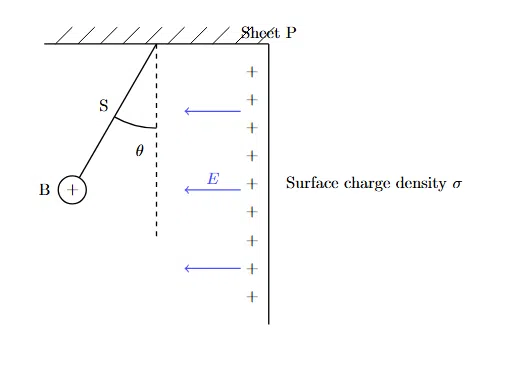
A charged ball $$B$$ hangs from a silk thread $$S$$ which makes an angle $$\theta$$ with a large charged conducting sheet $$P$$, as show in the figure. The surface charge density $$\sigma$$ of the sheet is proportional to
correct answer:- 4
Question 17
An oil drop of the radius 2 mm with a density 3 g cm$$^{-3}$$ is held stationary under a constant electric field $$3.55 \times 10^5$$ V m$$^{-1}$$ in the Millikan's oil drop experiment. What is the number of excess electrons that the oil drop will possess? (consider $$g = 9.81$$ m s$$^{-2}$$).
correct answer:- 2
Question 18
A thin half ring of radius 35 cm is uniformly charged with a total charge of $$Q$$ coulomb. If the magnitude of the electric field at centre of the half ring is 100 V/m, then the value of $$Q$$ is _______ nC.
$$(\varepsilon_0 = 8.85 \times 10^{-12}$$ C$$^2$$/Nm$$^2$$ and $$\pi = 3.14)$$
correct answer:- 1
Question 19
Two equal positive point charges are separated by a distance $$2a$$. The distance of a point from the centre of the line joining two charges on the equatorial line (perpendicular bisector) at which force experienced by a test charge $$q_0$$ becomes maximum is $$\frac{a}{\sqrt{x}}$$. The value of $$x$$ is _____.
correct answer:- 2
Question 20
Four closed surfaces and corresponding charge distributions are shown below.
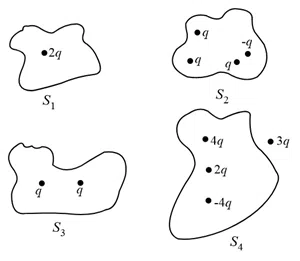
Let the respective electric fluxes through the surfaces be $$\phi_1$$, $$\phi_2$$, $$\phi_3$$ and $$\phi_4$$. Then:
correct answer:- 4

Question 21
A positive charge particle of 100 mg is thrown in opposite direction to a uniform electric field of strength $$1 \times 10^5$$ N C$$^{-1}$$. If the charge on the particle is 40 $$\mu$$C and the initial velocity is 200 m s$$^{-1}$$, how much distance it will travel before coming to the rest momentarily
correct answer:- 1
Question 22
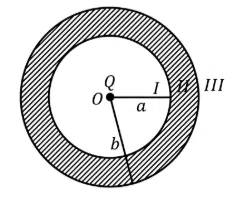
As shown in the figure, a point charge $$Q$$ is placed at the centre of conducting spherical shell of inner radius $$a$$ and outer radius $$b$$. The electric field due to charge $$Q$$ in three different regions I, II and III is given by:
(I: $$r < a$$, II: $$a < r < b$$, III: $$r > b$$)
correct answer:- 2
Question 23
An electron with kinetic energy $$K_1$$ enters between parallel plates of a capacitor at an angle $$\alpha$$ with the plates. It leaves the plates at angle $$\beta$$ with kinetic energy $$K_2$$. Then the ratio of kinetic energies $$K_1 : K_2$$ will be:
correct answer:- 4
Question 24
Given below two statements : One is labelled as Assertion (A) and other is labelled as Reason (R).
Assertion (A):
Non-polar materials do not have any permanent dipole moment.
Reason (R):
When a non-polar material is placed in an electric field, the centre of the positive charge distribution of it's individual atom or molecule coincides with the centre of the negative charge distribution.
In the light of above statements, choose the most appropriate answer from the options given below.
correct answer:- 3
Question 25
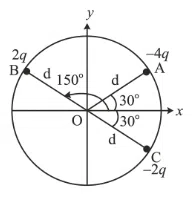
Three charged particles A, B and C with charges $$-4q$$, $$2q$$ and $$-2q$$ are present on the circumference of a circle of radius $$d$$. The charged particles A, C and centre O of the circle formed an equilateral triangle as shown in the figure. The electric field at the point O is
correct answer:- 1

Question 26
Consider a circular loop that is uniformly charged and has a radius $$a\sqrt{2}$$. Find the position along the positive z-axis of the cartesian coordinate system where the electric field is maximum if the ring was assumed to be placed in xy-plane at the origin :
correct answer:- 3
Question 27
Find out the surface charge density at the intersection of point $$x = 3$$ m plane and $$x$$-axis, in the region of uniform line charge of 8 nC m$$^{-1}$$ lying along the $$z$$-axis in free space.
correct answer:- 1
Question 28
Given below are two statements: one is labelled as
Assertion A
and the other is labelled as
Reason R
Assertion A :
Work done in moving a test charge between two points inside a uniformly charged spherical shell is zero, no matter which path is chosen.
Reason R :
Electrostatic potential inside a uniformly charged spherical shell is constant and is same as that on the surface of the shell.
Choose the correct answer :
correct answer:- 2
Question 29
In the figure, the inner (shaded) region A represents a sphere of radius $$r_A = 1$$, within which the electrostatic charge density varies with the radial distance $$r$$ from the center as $$\rho_A = kr$$, where $$k$$ is positive. In the spherical shell B of outer radius $$r_B$$, the electrostatic charge density varies as $$\rho_B = \dfrac{2k}{r}$$. Assume that dimensions are taken care of. All physical quantities are in their SI units.
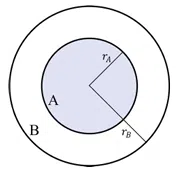
Which of the following statement(s) is(are) correct?
correct answer:- 2
Question 30
Given below are two statements
Statement I: An electric dipole is placed at the centre of a hollow sphere. The flux of electric field through the sphere is zero, but the electric field is not zero anywhere in the sphere.
Statement II: If $$R$$ is the radius of a solid metallic sphere and $$Q$$ be the total charge on it. The electric field at any point on the spherical surface of radius $$r (< R)$$ is zero but the electric flux passing through this closed spherical surface of radius $$r$$ is not.
In the light of the above statements, choose the correct answer from the options given below:
correct answer:- 3
Question 31
A particle of charge $$q$$ and mass $$m$$ is subjected to an electric field $$E = E_0(1 - ax^2)$$ in the $$x$$-direction, where $$a$$ and $$E_0$$ are constants. Initially the particle was at rest at $$x = 0$$. Other than the initial position the kinetic energy of the particle becomes zero when the distance of the particle from the origin is:
correct answer:- 3