
Join Our JEE Preparation Group
Prep with like-minded aspirants; Get access to free daily tests and study material.
Sign in
Please select an account to continue using cracku.in
↓ →
Join Our JEE Preparation Group
Prep with like-minded aspirants; Get access to free daily tests and study material.
Two electric dipoles, A, B with respective dipole moments $$\vec{d_A} = -4qa\hat{i}$$ and $$\vec{d_B} = -2qa\hat{i}$$ are placed on the $$x$$-axis with a separation $$R$$, as shown in the figure.
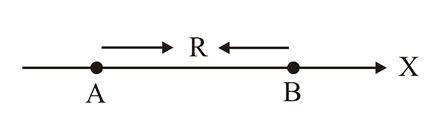
The distance from A at which both of them produce the same potential is:
Let a point lie to the right of B at a distance $$x$$ from A.
$$\text{Distance from A } = x \implies \theta_A = 180^\circ$$
$$\text{Distance from B } = x - R \implies \theta_B = 180^\circ$$
Equating potentials ($$V_A = V_B$$): $$\frac{k(-4qa)}{x^2} = \frac{k(-2qa)}{(x-R)^2}$$
$$\frac{2}{x^2} = \frac{1}{(x-R)^2} \implies \frac{\sqrt{2}}{x} = \frac{1}{x-R}$$
$$\sqrt{2}x - \sqrt{2}R = x \implies x(\sqrt{2}-1) = \sqrt{2}R \implies x = \frac{\sqrt{2}R}{\sqrt{2}-1}$$
Was this solution helpful?
Create a FREE account and get:
_1.webp)

Educational materials for JEE preparation

Ask our AI anything

AI can make mistakes. Please verify important information.
AI can make mistakes. Please verify important information.
