Group
Group
 Group
Group


 Preferred Source

 Google Discover

JEE Atoms and Nuclei PYQs
JEE Atoms and Nuclei PYQs are an important part of the modern physics section of the JEE syllabus. The chapter brings together two closely connected ideas: how electrons behave inside atoms and how protons and neutrons behave inside the nucleus.
At first, the chapter may seem full of formulas. You may need to calculate the radius or energy of an electron orbit, find the wavelength of a spectral line, determine the binding energy of a nucleus, or calculate how much radioactive material remains after a given time.
However, most questions become manageable once you understand the basic physical idea behind each formula. In atomic physics, electrons move between fixed energy levels by absorbing or emitting energy. In nuclear physics, stability depends mainly on mass defect and binding energy.
Regular practice with JEE Atoms and Nuclei Questions can help you recognise these patterns quickly. It also improves your ability to handle small but important details, such as the atomic number, mass number, energy units, and direction of an electronic transition.
In this chapter guide, you will find important PYQs, a useful formula sheet, common mistakes, and a practical method for solving questions with better speed and accuracy.
JEE Atoms and Nuclei Important PYQs PDF
The PYQ PDF can include frequently asked questions from Bohr’s atomic model, hydrogen-like atoms, atomic spectra, energy-level transitions, nuclear radius, mass defect, binding energy, radioactivity, nuclear fission, and nuclear fusion.
Working through previous-year questions helps you understand how the same concept can be tested in different ways. For example, one question may directly ask for the energy of an electron in the third orbit, while another may ask for the wavelength of light emitted when the electron moves from one orbit to another.
Nuclear physics questions may ask you to calculate mass defect or total binding energy. In some cases, you may need to compare the stability of two nuclei using binding energy per nucleon.
Solving JEE Mains Previous papers is especially helpful because it gives you a clear idea of the language, difficulty level, and calculation style used in the actual examination. It also helps you identify which concepts are repeated more often.
Important Atoms and Nuclei Formula Sheet for JEE
Most questions from Atoms and Nuclei can be solved using a small set of standard formulas. The main challenge is not memorising them but knowing where each one should be applied.
Before selecting a formula, identify whether the question is based on Bohr’s model, an energy transition, nuclear size, binding energy, or radioactive decay.
You can add this formula sheet to your JEE Study Material and use it for quick revision before chapter tests, practice sessions, and full-length examinations.
| Concept | Formula |
|---|---|
| Radius of the nth Bohr Orbit | $$r_n = \frac{n^2a_0}{Z}$$ |
| Energy of an Electron in the nth Orbit | $$E_n = -\frac{13.6Z^2}{n^2}\text{ eV}$$ |
| Speed of an Electron in the nth Orbit | $$v_n = \frac{2.18\times10^6Z}{n}\text{ m/s}$$ |
| Angular Momentum of an Electron | $$mvr = \frac{nh}{2\pi}$$ |
| Energy of a Photon | $$E = h\nu = \frac{hc}{\lambda}$$ |
| Rydberg Formula | $$\frac{1}{\lambda} = RZ^2\left(\frac{1}{n_1^2}-\frac{1}{n_2^2}\right)$$ |
| Nuclear Radius | $$R = R_0A^{1/3}$$ |
| Mass Defect | $$\Delta m = Zm_p+(A-Z)m_n-M$$ |
| Binding Energy | $$B.E. = \Delta mc^2$$ |
| Radioactive Decay Law | $$N = N_0e^{-\lambda t}$$ |
| Half-Life | $$T_{1/2} = \frac{0.693}{\lambda}$$ |
| Mean Life | $$\tau = \frac{1}{\lambda}$$ |
| Activity of a Radioactive Sample | $$A = \lambda N$$ |
| Nuclei Remaining After (n) Half-Lives | $$N = \frac{N_0}{2^n}$$ |
These formulas are commonly used in questions related to hydrogen-like atoms, spectral lines, nuclear stability, and radioactive decay.
Common Mistakes to Avoid in JEE Atoms and Nuclei PYQs
Many students understand the concept but still lose marks because of a sign error, the wrong energy level, or an incorrect unit conversion. The following mistakes are especially common.
Confusing absorption with emission
An electron absorbs energy when it moves from a lower orbit to a higher orbit. It emits energy when it falls from a higher orbit to a lower orbit.
Before starting the calculation, clearly write the initial and final energy levels. This makes it easier to decide whether energy is being absorbed or released.
Forgetting what the negative energy sign means
The energy of an electron in a bound state is negative. This does not mean that the electron has negative kinetic energy. It simply shows that energy must be supplied to remove the electron completely from the atom.
When calculating photon energy, use the positive magnitude of the difference between the two energy levels.
Ignoring the atomic number in hydrogen-like ions
The standard Bohr formulas are not limited to hydrogen. They also apply to one-electron ions such as He⁺ and Li²⁺.
However, the atomic number (Z) must be included. Missing the (Z^2) term in the energy formula can change the answer completely.
Mixing up atomic number and mass number
The atomic number (Z) represents the number of protons. The mass number (A) represents the total number of protons and neutrons.
Therefore, the number of neutrons is:
[
N=A-Z
]
This distinction is especially important in mass-defect and nuclear-reaction questions.
Comparing total binding energy instead of binding energy per nucleon
Total binding energy tells you how much energy is needed to separate the entire nucleus. Binding energy per nucleon is more useful when comparing the stability of different nuclei.
In general, a nucleus with a higher binding energy per nucleon is more stable.
Treating radioactive decay as a linear process
A radioactive sample does not lose the same number of nuclei during every equal time interval. Radioactive decay is exponential, which means the same fraction of nuclei decays during each half-life.
For example, after one half-life, half the nuclei remain. After two half-lives, one-fourth remain, and after three half-lives, one-eighth remain.
Ignoring conservation laws in nuclear reactions
In every nuclear reaction, the total mass number and total atomic number must be balanced on both sides.
Before doing a detailed calculation, check these two quantities. They often help you identify an unknown particle immediately.
How to Solve Atoms and Nuclei Questions Faster
Begin by deciding whether the question belongs to atomic physics or nuclear physics.
Atomic physics questions usually involve Bohr orbits, energy levels, photons, or spectra. Nuclear physics questions are more likely to involve mass defect, binding energy, radioactivity, fission, or fusion.
For an energy-transition question, write the energy of the initial and final states separately. Then calculate the difference:
[
\Delta E=E_{\text{final}}-E_{\text{initial}}
]
Use the magnitude of this difference when finding photon frequency or wavelength.
For radioactive-decay problems, first calculate how many half-lives have passed:
[
n=\frac{t}{T_{1/2}}
]
Then use:
[
N=\frac{N_0}{2^n}
]
This is usually faster than applying the exponential form when the total time is an exact multiple of the half-life.
For binding-energy questions, write down the masses of the protons, neutrons, and nucleus separately. Then calculate the mass defect carefully before converting it into energy.
While attempting a JEE Mains Mock Test, try to solve direct Atoms and Nuclei questions early. These questions are often shorter than lengthy mechanics or circuit problems and can help you secure marks without taking too much time.
Before marking the final answer, check whether the question asks for energy, wavelength, frequency, half-life, activity, binding energy, or the number of nuclei remaining.
List of JEE Atoms and Nuclei PYQs
Below is a test-style set of questions based on Bohr’s atomic model, hydrogen spectrum, energy-level transitions, nuclear radius, mass defect, binding energy, radioactivity, nuclear fission, and nuclear fusion.
Try to solve each question on your own before checking the answer. Write the relevant formula first, substitute the values with the correct units, and then check whether your final answer makes physical sense.
For atomic-spectrum questions, confirm whether the electron is moving to a higher or lower energy level. For nuclear-reaction questions, always verify that the mass number and atomic number are conserved.
Following this approach regularly can help you build stronger concepts and improve your accuracy in both JEE Main and JEE Advanced.
Question 1
A particle of mass $$200\,\text{MeV c}^{-2}$$ collides with a hydrogen atom at rest. Soon after the collision, the particle comes to rest, and the atom recoils and goes to its first excited state. The initial kinetic energy of the particle (in eV) is $$\frac{N}{4}$$. The value of $$N$$ is: (Given the mass of the hydrogen atom to be $$1\,\text{GeV c}^{-2}$$)........
correct answer:- 51
Question 2
In a hydrogen atom the electron makes a transition from $$(n + 1)^{th}$$ level to the $$n^{th}$$ level. If $$n >> 1$$, the frequency of radiation emitted is proportional to:
correct answer:- 3
Question 3
The energy levels of an atom is shown in figure.
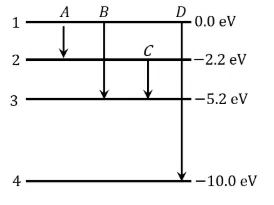
Which one of these transitions will result in the emission of a photon of wavelength 124.1 nm?
Given ($$h = 6.62 \times 10^{-34}$$ J s)
correct answer:- 4
Question 4
According to Bohr's theory, the time averaged magnetic field at the centre (i.e., nucleus) of a hydrogen atom due to the motion of electrons in the $$n^{th}$$ orbit is proportional to: ($$n$$ = principal quantum number)
correct answer:- 4
Question 5
In the given figure, the energy levels of hydrogen atom have been shown along with some transitions marked A, B, C, D and E. The transitions A, B and C respectively represent
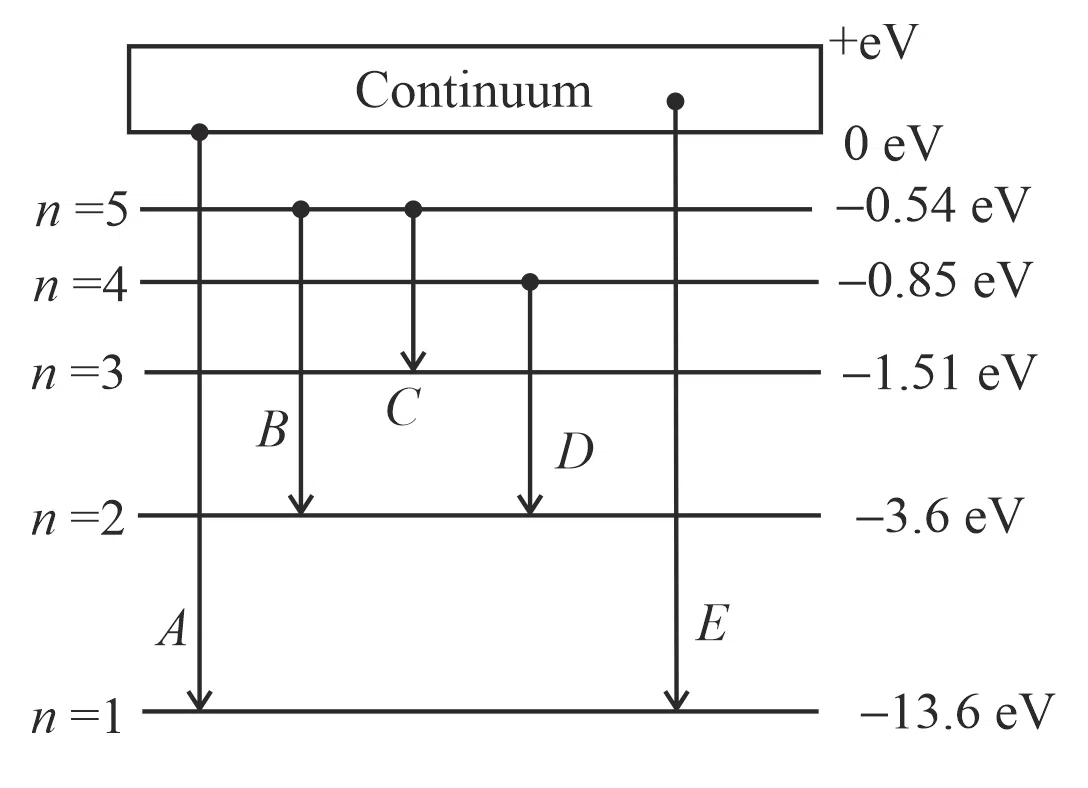
correct answer:- 3

Question 6
A beam of monochromatic light is used to excite the electron in $$Li^{++}$$ from the first orbit to the third orbit. The wavelength of monochromatic light is found to be $$x \times 10^{-10}$$ m. The value of $$x$$ is ______.
[Given $$hc = 1242$$ eV nm]
correct answer:- 114
Question 7
A hydrogen atom in its ground state absorbs $$10.2$$ eV of energy. The angular momentum of electron of the hydrogen atom will increase by the value of (Given, Planck's constant $$= 6.6 \times 10^{-34}$$ Js).
correct answer:- 2
Question 8
Assuming the experimental mass of $$^{12}_{6}C$$ as 12 u, The mass defect of $${}^{12}\text{C}$$ atom is (in MeV/$$c^2$$) :
(Mass of proton = 1.00727 u, mass of neutron = 1.00866 u, 1 u = 931.5$$ $$MeV/$$c^2$$ and c is the speed of the light in vacuum).
correct answer:- 2
Question 9
The ratio of momentum of the photons of the 1$$^{st}$$ and 2$$^{nd}$$ line of Balmer series of Hydrogen atoms is $$\alpha/\beta$$. The possible values of $$\alpha$$ and $$\beta$$ are:
correct answer:- 4
Question 10
What is the half-life period of a radioactive material if its activity drops to $$\dfrac{1}{16^{th}}$$ of its initial value of $$30$$ years?
correct answer:- 3

Question 11
When a metallic surface is illuminated with radiation of wavelength $$\lambda$$, the stopping potential for the photoelectric current is $$V_0$$. If the same surface is illuminated with radiation of wavelength $$2\lambda$$, the stopping potential becomes $$\frac{V_0}{4}$$. The threshold wavelength ($$\lambda_{th}$$) for this metallic surface is:
correct answer:- 1
Question 12
For a nucleus $$^A_Z X$$ having mass number A and atomic number Z
A. The surface energy per nucleon $$(b_s) = -a_1 A^{2/3}$$.
B. The Coulomb contribution to the binding energy $$b_c = -a_2 \dfrac{Z(Z-1)}{A^{1/3}}$$.
C. The volume energy $$b_v = a_3 A$$
D. Decrease in the binding energy is proportional to surface area.
E. While estimating the surface energy, it is assumed that each nucleon interacts with 12 nucleons.
($$a_1, a_2$$ and $$a_3$$ are constants)
Choose the most appropriate answer from the options given below:
correct answer:- 2
Question 13
Binding energy of a certain nucleus is $$18 \times 10^8 \text{ J}$$. How much is the difference between total mass of all the nucleons and nuclear mass of the given nucleus:
correct answer:- 2
Question 14
The half life period of a radioactive element $$x$$ is same as the mean life time of another radioactive element $$y$$. Initially they have the same number of atoms. Then:
correct answer:- 3
Question 15
Imagine that a reactor converts all the given mass into energy and that it operates at a power level of $$10^9$$ Watt. The mass of the fuel consumed per hour, in the reactor, will be: (velocity of light, $$c$$ is $$3 \times 10^8$$ m s$$^{-1}$$)
correct answer:- 3

Question 16
A radioactive nucleus $$A$$ with a half-life $$T$$, decays into a nucleus $$B$$. At $$t = 0$$, there is no nucleus $$B$$. At some time $$t$$, the ratio of the number of $$B$$ to that of $$A$$ is 0.3. Then, $$t$$ is given by: (Consider $$\log_{e} x = \log x$$)
correct answer:- 3
Question 17
Two deuterons undergo nuclear fusion to form a Helium nucleus. The energy released in this process is (given binding energy per nucleon for deuteron = 1.1 MeV and for helium = 7.0 MeV):
correct answer:- 1
Question 18
The acceleration of an electron in the first orbit of the hydrogen atom ($$n = 1$$) is:
correct answer:- 4
Question 19
A diatomic gas ($$\gamma = 1.4$$) does 100 J of work in an isobaric expansion. The heat given to the gas is :
correct answer:- 3
Question 20
Half lives of two radioactive nuclei A and B are 10 minutes and 20 minutes, respectively. If, initially a sample has equal number of nuclei, then after 60 minutes, the ratio of decayed numbers of nuclei A and B will be:
correct answer:- 4

Question 21
Muon ($$\mu^{-1}$$) is negatively charged (|q| = |e|) with a mass m$$_\mu$$ = 200 m$$_e$$, where m$$_e$$ is the mass of the electron and e is the electronic charge. If $$\mu^{-1}$$ is bound to a proton to form a hydrogen like atom, identify the correct statements:
(A) Radius of the muonic orbit is 200 times smaller than that of the electron
(B) The speed of the $$\mu^{-1}$$ in the nth orbit is $$\frac{1}{200}$$ times that of the electron in the nth orbit
(C) The ionization energy of muonic atom is 200 times more than that of an hydrogen atom
(D) The momentum of the muon in the nth orbit is 200 times more than that of the electron
correct answer:- 4
Question 22
An unstable heavy nucleus at rest breaks into two nuclei which move away with velocities in the ratio of 8 : 27. The ratio of the radii of the nuclei (assumed to be spherical) is:
correct answer:- 3
Question 23
A solution containing active cobalt $$^{60}_{27}$$Co having an activity of 0.8 $$\mu$$Ci and decay constant $$\lambda$$ is injected in an animal's body. If 1 cm$$^3$$ blood is drawn from the animal's body after 10 h of injection, the activity found was 300 decays per minute.What is the volume of blood that is flowing in the body? [1 Ci = $$3.7 \times 10^{10}$$ dps (decays per second) and at $$t = 10hrs^{- \lambda t}$$ = 0.84]
correct answer:- 3
Question 24
The de-Broglie wavelength ($$\lambda_B$$) associated with the electron orbiting in the second excited state of hydrogen atom is related to that in the ground state ($$\lambda_G$$) by:
correct answer:- 1
Question 25
At some instant, a radioactive sample S$$_1$$ having an activity 5$$\mu$$Ci has twice the number of nuclei as another sample S$$_2$$ which has an activity of 10$$\mu$$Ci. The half lives of S$$_1$$ and S$$_2$$ are:
correct answer:- 1

Question 26
An electron in a hydrogen atom undergoes a transition from an excited state with principal quantum number $$n_2$$ to the ground state ($$n_1 = 1$$). If the wavelength of the emitted photon is equal to $$\frac{4}{3R}$$, where $$R$$ is the Rydberg constant, then the value of the principal quantum number $$n_2$$ of the initial excited state is:
correct answer:- 1
Question 27
The minimum kinetic energy needed by an alpha particle to cause the nuclear reaction $$^{16}_7N + ^4_2He \to ^1_1H + ^{19}_8O$$ in a laboratory frame is $$n$$ (in MeV). Assume that $$^{16}_7N$$ is at rest in the laboratory frame. The masses of $$^{16}_7N$$, $$^4_2He$$, $$^1_1H$$ and $$^{19}_8O$$ can be taken to be 16.006 $$u$$, 4.003 $$u$$, 1.008 $$u$$ and 19.003 $$u$$, respectively, where 1 $$u$$ = 930 MeV$$c^{-2}$$. The value of $$n$$ is ______.
correct answer:- 2.32
Question 28
A common example of alpha decay is $$^{238}_{92}$$U $$\to ^{234}_{90}$$Th $$+ _2$$He$$^4 + Q$$
Given:
$$^{238}_{92}$$U $$= 238.05060$$ u
$$^{234}_{90}$$Th $$= 234.04360$$ u
$$^4_2$$He $$= 4.00260$$ u and $$1$$u $$= 931.5$$ $$\frac{\text{MeV}}{c^2}$$
The energy released $$(Q)$$ during the alpha decay of $$^{238}_{92}$$U is _____ MeV.
correct answer:- 4
Question 29
The radius R of a nucleus of mass number A can be estimated by the formula $$R = (1.3 \times 10^{-15})A^{1/3}$$ m. It follows that the mass density of n nucleus is of the order of: $$(M_{prot} \cong M_{neut} \simeq 1.67 \times 10^{-27}$$ kg)
correct answer:- 4
Question 30
A radioactive sample has a half-life of $$10\text{ days}$$. If the initial activity of the sample is $$A_0$$, the time required for the activity to reduce to $$\frac{A_0}{8}$$ is:
correct answer:- 2
.webp)