

 Group
Group
 Group
Group


 Preferred Source

 Google Discover

JEE Magnetic Effects of Current PYQs
JEE Magnetic Effects of Current PYQs are an important part of the JEE Physics syllabus. This chapter explains how electric current produces a magnetic field and how that field affects moving charges, current-carrying wires, loops, and coils.
The questions in this chapter often mix concepts, formulas, and direction-based reasoning. You may be asked to find the magnetic field around a wire, the force on a charged particle, the radius of a circular path, or the torque on a current loop. Many students find these questions confusing at first, especially when several directions are involved. A simple diagram usually makes the situation much clearer.
Rather than memorising every result, try to understand what is creating the magnetic field and how the charge or conductor is placed inside it. Regular practice with JEE Magnetic Effects of Current Questions can improve your accuracy and make direction-based problems less intimidating. Solving chapter-wise JEE Questions, attempting a JEE Mains Mock Test, and working through JEE Mains Previous Papers can also help you become familiar with the patterns commonly seen in the exam.
This page includes a downloadable PYQ set, important formulas, common mistakes, and a short strategy for solving questions more efficiently. You can use it alongside your regular JEE Study Material for focused chapter revision.
JEE Magnetic Effects of Current Important PYQs PDF
The PYQ PDF can include questions from the most frequently tested parts of the chapter. These may cover the magnetic field due to a straight wire, circular loop, arc, or solenoid, along with force on a moving charge, force on a current-carrying conductor, motion in a magnetic field, and torque on a coil.
Practising these questions helps you understand how one concept can appear in several different forms. In some questions, the main task is to calculate the magnitude. In others, the direction is more important than the calculation itself. Solving both types regularly can help you read the question carefully and choose the right approach without wasting time.
Magnetic Effects of Current Formula Sheet for JEE
This chapter has several important formulas, but they become much easier to remember when you connect them with the correct physical situation. Before using a formula, check the shape of the conductor, the direction of current, the angle involved, and the point where the magnetic field is required.
| Concept | Formula |
|---|---|
| Magnetic Force on a Charge | $$F = qvB\sin\theta$$ |
| Force on a Current-Carrying Wire | $$F = BI\ell\sin\theta$$ |
| Magnetic Field Due to a Long Wire | $$B = \frac{\mu_0I}{2\pi r}$$ |
| Field at the Centre of a Circular Loop | $$B = \frac{\mu_0I}{2R}$$ |
| Field Inside a Long Solenoid | $$B = \mu_0nI$$ |
| Force Between Parallel Wires | $$\frac{F}{\ell} = \frac{\mu_0I_1I_2}{2\pi d}$$ |
| Radius of Circular Path | $$r = \frac{mv}{qB}$$ |
| Time Period of Charged Particle | $$T = \frac{2\pi m}{qB}$$ |
| Torque on a Current Loop | $$\tau = NIAB\sin\theta$$ |
| Magnetic Dipole Moment | $$M = NIA$$ |
These formulas are commonly used in questions involving charged particles, current-carrying wires, coils, solenoids, and magnetic forces. While revising, pay special attention to the direction of vectors and the angle used in each expression.
Common Mistakes to Avoid in JEE Magnetic Effects of Current PYQs
Most mistakes in this chapter happen because of an incorrect direction, a missing angle, or the use of the wrong formula.
Mixing up the direction rules
The right-hand thumb rule, Fleming’s left-hand rule, and the rule for magnetic force are used in different situations. First identify whether the question is asking for the direction of the field, the force on a wire, or the force on a moving charge.
Ignoring the angle in the force formula
Magnetic force depends on the angle between velocity and magnetic field. The force is maximum when they are perpendicular and zero when they are parallel.
Using the same field formula for every conductor
The magnetic field depends on the shape of the conductor. A straight wire, a circular loop, an arc, and a solenoid do not use the same expression.
Assuming magnetic force changes the speed
A magnetic force changes the direction of motion, not the speed of the particle. That is why a charged particle can move in a circular path without gaining or losing kinetic energy.
Forgetting the number of turns
In coil-based questions, the number of turns affects the magnetic field, torque, and magnetic moment. Missing the factor N can change the final answer completely.
Drawing a clear diagram and marking all directions before starting the calculation can help you avoid most of these mistakes.
How to Solve Magnetic Effects of Current Questions Faster
Start by identifying the source of the magnetic field. It may be a straight wire, a circular loop, a solenoid, or an external magnetic field. Then mark the directions of current, velocity, force, and magnetic field wherever required.
Next, decide what the question is asking for: field, force, radius, time period, torque, or magnetic moment. This simple step helps prevent random formula selection. In questions involving more than one wire or loop, calculate the contribution of each source separately and then combine the results carefully.
List of JEE Magnetic Effects of Current PYQs
Below is a test-style set of questions based on magnetic fields, moving charges, current-carrying conductors, circular motion, solenoids, and current loops. Try to solve each question on your own before checking the answer.
Question 1
A metal sample carrying a current along X-axis with density $$J_x$$ is subjected to a magnetic field $$B_z$$ (along z-axis). The electric field $$E_y$$ developed along Y-axis is directly proportional to $$J_x$$ as well as $$B_z$$. The constant of proportionality has SI unit.
correct answer:- 2
Question 2
Choose the correct sketch of the magnetic field lines of a circular current loop shown by the dot and the cross $$\otimes$$.
correct answer:- 1
Question 3
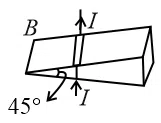
As shown in the figure, a metallic rod of linear density 0.45 kg m$$^{-1}$$ is lying horizontally on a smooth incline plane which makes an angle of 45° with the horizontal. The minimum current flowing in the rod required to keep it stationary, when 0.15 T magnetic field is acting on it in the vertical upward direction, will be (Use $$g = 10$$ m s$$^{-2}$$)
correct answer:- 1
Question 4
A beam of protons with speed $$4 \times 10^5$$ m s$$^{-1}$$ enters a uniform magnetic field of 0.3 T at an angle of 60$$°$$ to the magnetic field, the pitch of the resulting helical path of protons is close to: (Mass of the proton $$= 1.67 \times 10^{-27}$$ kg, charge of the proton $$= 1.69 \times 10^{-19}$$ C)
correct answer:- 4
Question 5
An electric current is flowing through a circular coil of radius R. The ratio of the magnetic field at the centre of the coil and that at a distance $$2\sqrt{2}R$$ from the centre of the coil and on its axis is :
correct answer:- 2

Question 6
A proton and an alpha particle of the same velocity enter in a uniform magnetic field which is acting perpendicular to their direction of motion. The ratio of the radii of the circular paths described by the alpha particle and proton is
correct answer:- 2
Question 7
A current carrying solenoid is placed vertically and a particle of mass m with charge Q is released from rest. The particle moves along the axis of solenoid. lf g is acceleration due to gravity then the acceleration (n) of the charged particle will satisfy :
correct answer:- 4
Question 8
A charge of $$4.0 \;\mu$$C is moving with a velocity of $$4.0 \times 10^6 \text{ m s}^{-1}$$ along the positive $$y$$-axis under a magnetic field $$B$$ of strength $$\left(2\hat{k}\right)$$ T. The force acting on the charge is $$x\hat{i}$$ N. The value of $$x$$ is ______.
correct answer:- 32
Question 9
A proton, a deuteron and an $$\alpha$$ particle are moving with same momentum in a uniform magnetic field. The ratio of magnetic forces acting on them is ______ and their speed is ______ in the ratio.
correct answer:- 1
Question 10
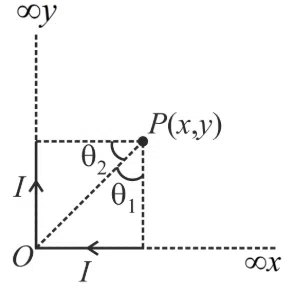
There are two infinitely long straight current-carrying conductors and they are held at right angles to each other so that their common ends meet at the origin as shown in the figure given below. The ratio of current in both conductors is 1:1. The magnetic field at point P is:
correct answer:- 3

Question 11
The electric current in a circular coil of four turns produces a magnetic induction $$32$$ T at its centre. The coil is unwound and is rewound into a circular coil of single turn, the magnetic induction at the centre of the coil by the same current will be:
correct answer:- 3
Question 12
A moving coil galvanometer of resistance $$100\Omega$$ shows a full scale deflection for a current of 1 mA. The value of resistance required to convert this galvanometer into an ammeter, showing full scale deflection for a current of 5 mA, is ____ $$\Omega$$
correct answer:- 3
Question 13
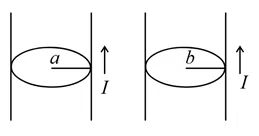
Figure A and B shown two long straight wires of circular cross-section ($$a$$ and $$b$$ with $$a < b$$), carrying current $$I$$ which is uniformly distributed across the cross-section. The magnitude of magnetic field $$B$$ varies with radius $$r$$ and can be represented as:
correct answer:- 3
Question 14
The current sensitivity of a galvanometer can be increased by:
(A) decreasing the number of turns
(B) increasing the magnetic field
(C) decreasing the area of the coil
(D) decreasing the torsional constant of the spring
Choose the most appropriate answer from the options given below:
correct answer:- 4
Question 15
The magnetic field at the centre of a current carrying circular loop of radius R is $$16\mu T$$. The magnetic field at a distance $$x = \sqrt{3}R$$ on its axis from the centre is______$$\mu T$$.
correct answer:- 3

Question 16
A rectangular loop of sides 10 cm and 5 cm, carrying a current $$I$$ of 12 A, is placed in different orientations as shown in the figures below.
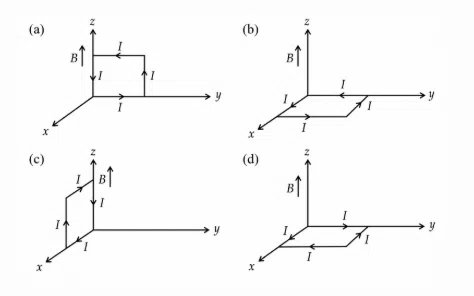
If there is a uniform magnetic field of 0.3 T in the positive z direction, in which orientations the loop would be in (i) stable equilibrium and (ii) unstable equilibrium?
correct answer:- 4
Question 17
1 $$\mu$$C charge moving with velocity $$\vec{v} = \left(\hat{i} - 2\hat{j} + 3\hat{k}\right)$$ m/s in the region of magnetic field $$\vec{B} = \left(2\hat{i} + 3\hat{j} - 5\hat{k}\right)$$ T. The magnitude of force acting on it is $$\sqrt{\alpha} \times 10^{-6}$$ N. The value of $$\alpha$$ is __________.
correct answer:- 171
Question 18
This question has
Statement I
and
Statement II
. Of the four choices given after the Statements, choose the one that best describes the two Statements.
Statement - I :
Higher the range, greater is the resistance of ammeter.
Statement - II :
To increase the range of ammeter, additional shunt needs to be used across it.
correct answer:- 2
Question 19
A deuteron and a proton moving with equal kinetic energy enter into a uniform magnetic field at right angle to the field. If $$r_d$$ and $$r_p$$ are the radii of their circular paths respectively, then the ratio $$\frac{r_d}{r_p}$$ will be $$\sqrt{x} : 1$$ where $$x$$ is ______
correct answer:- 2
Question 20
A particle having the same charge as of electron moves in a circular path of radius 0.5 cm under the influence of a magnetic field of 0.5 T. If an electric field of 100 V/m makes it to move in a straight path, then the mass of the particle is (Given charge of electron $$= 1.6 \times 10^{-19}$$ C)
correct answer:- 3

Question 21
Six infinitely large and thin non-conducting sheets are fixed in configurations I and II. As shown in the figure, the sheets carry uniform surface charge densities which are indicated in terms of $$\sigma_0$$. The separation between any two consecutive sheets is $$1 \, \mu$$m. The various regions between the sheets are denoted as 1, 2, 3, 4 and 5. If $$\sigma_0 = 9 \, \mu$$C/m$$^2$$, then which of the following statements is/are correct:
(Take permittivity of free space $$\epsilon_0 = 9 \times 10^{-12}$$ F/m)
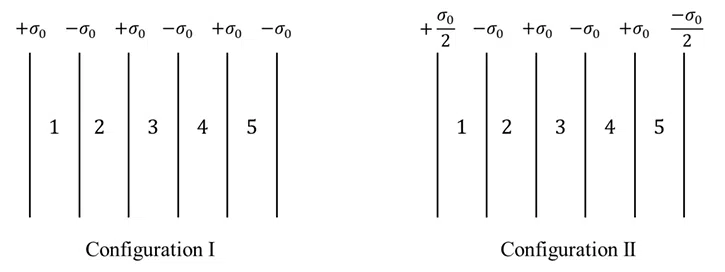
correct answer:- 1
Question 22
Consider a long thin conducting wire carrying a uniform current I. A particle having mass "M" and charge "q" is released at a distance "a" from the wire with a speed $$\epsilon_{\circ}$$ along the direction of current in the wire. The particle gets attracted to the wire due to magnetic force. The particle turns round when it is at distance x from the wire. The value of x is [$$\mu_{\circ}$$ is vacuum permeability]
correct answer:- 1
Question 23
A loop ABCDEFA of straight edges has six corner points A(0, 0, 0), B(5, 0, 0), C(5, 5, 0), D(0, 5, 0), E(0, 5, 5) and F(0, 0, 5). The magnetic field in this region is $$\vec{B} = (3\hat{i} + 4\hat{k})$$ T. The quantity of flux through the loop ABCDEFA (in Wb) is
correct answer:- 175
Question 24
A charge q is spread uniformly over an insulated loop of radius r. If it is rotated with an angular velocity $$\omega$$ with respect to normal axis then magnetic moment of the loop is:
correct answer:- 2
Question 25
Two long parallel conductors $$S_1$$ and $$S_2$$ are separated by a distance $$10$$ cm and carrying currents of $$4$$ A and $$2$$ A respectively. The conductors are placed along $$x$$-axis in $$X-Y$$ plane. There is a point $$P$$ located between the conductors (as shown in figure).
A charge particle of $$3\pi$$ coulomb is passing through the point $$P$$ with velocity $$\vec{v} = (2\hat{i} + 3\hat{j})$$ m s$$^{-1}$$.
The force acting on the charge particle is $$4\pi \times 10^{-5}(-x\hat{i} + 2\hat{j})$$ N. The value of $$x$$ is
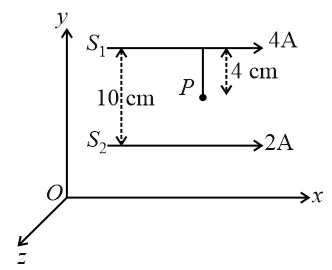
correct answer:- 3

Question 26
A rectangular loop of wire, supporting a mass m, hangs with one end in a uniform magnetic field $$\vec{B}$$ pointing out of the plane of the paper. A clockwise current is set up such that $$i > mg/Ba$$, where a is the width of the loop. Then :
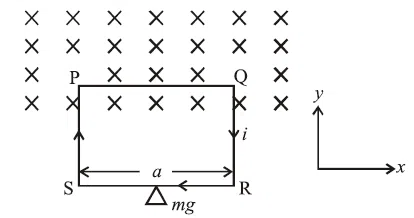
correct answer:- 3
Question 27
Two insulated circular loop $$A$$ and $$B$$ radius $$a$$ carrying a current of $$I$$ in the anti clockwise direction as shown in figure. The magnitude of the magnetic induction at the centre will be:
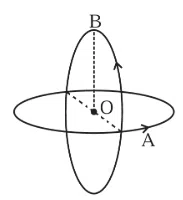
correct answer:- 3
Question 28
In a co-axial straight cable, the central conductor and the outer conductor carry equal currents in opposite directions. The magnetic field is zero :
correct answer:- 1
Question 29
An electron moves through a uniform magnetic field $$\vec{B} = B_0\hat{i} + 2B_0\hat{j}$$ T. At a particular instant of time, the velocity of electron is $$\vec{u} = 3\hat{i} + 5\hat{j} \text{ m s}^{-1}$$. If the magnetic force acting on electron is $$\vec{F} = 5e\hat{k}$$ N, where $$e$$ is the charge of electron, then the value of $$B_0$$ is ____ T.
correct answer:- 5
Question 30
A square loop of edge length $$2$$ m carrying current of $$2$$ A is placed with its edges parallel to the $$x$$-$$y$$ axis. A magnetic field is passing through the $$x - y$$ plane and expressed as $$\vec{B} = B_0(1 + 4x)\hat{k}$$, where $$B_0 = 5$$ T. The net magnetic force experienced by the loop is _______ N.
correct answer:- 160