
Join Our JEE Preparation Group
Prep with like-minded aspirants; Get access to free daily tests and study material.
Sign in
Please select an account to continue using cracku.in
↓ →
Join Our JEE Preparation Group
Prep with like-minded aspirants; Get access to free daily tests and study material.
A rectangular loop of sides 10 cm and 5 cm, carrying a current $$I$$ of 12 A, is placed in different orientations as shown in the figures below.
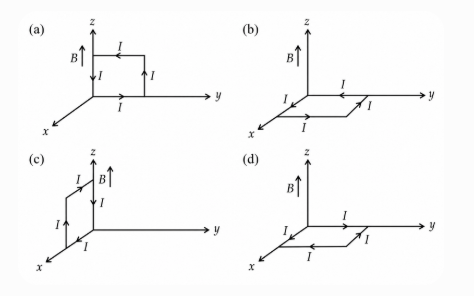
If there is a uniform magnetic field of 0.3 T in the positive z direction, in which orientations the loop would be in (i) stable equilibrium and (ii) unstable equilibrium?
First we recall that a current-carrying planar loop behaves like a magnetic dipole. Its magnetic moment $$\vec m$$ is defined by the right-hand rule and is given in magnitude by
$$m = I\,A,$$
where $$I$$ is the current and $$A$$ is the geometrical area of the loop. The torque acting on the loop when it is kept in a uniform magnetic field $$\vec B$$ is obtained from the vector product
$$\vec \tau = \vec m \times \vec B.$$
If $$\theta$$ is the angle between $$\vec m$$ and $$\vec B$$, the magnitude of the torque becomes
$$\tau = mB\sin\theta.$$
We also need the expression for the potential energy of the magnetic dipole in the field; the formula is
$$U = -\vec m\cdot\vec B = -mB\cos\theta.$$
Equilibrium positions occur when the torque is zero, i.e. when $$\sin\theta = 0$$, or equivalently when $$\theta = 0^{\circ}$$ (parallel) or $$\theta = 180^{\circ}$$ (antiparallel). The nature of the equilibrium follows from the potential energy:
Let us calculate the magnetic moment of the given loop so that we can identify its direction in each drawing. The sides are 10 cm and 5 cm, so
$$A = 0.10\;\text{m}\times0.05\;\text{m}=0.005\;\text{m}^2.$$
The current is 12 A, hence
$$m = IA = 12\times0.005 = 0.06\;\text{A m}^2.$$
The external magnetic field is $$\vec B = 0.3\;\text{T}\,\hat k$$, i.e. in the positive $$z$$ direction. The direction of $$\vec m$$ for each sketch (a), (b), (c) and (d) follows from curling the right hand around the sense of current shown in that sketch. Making that inspection we find:
Thus the loop is in
(i) stable equilibrium in orientation (b), and
(ii) unstable equilibrium in orientation (d).
Among the given choices only Option D lists “(b) and (d), respectively.” Hence, the correct answer is Option D.
Was this solution helpful?
Create a FREE account and get:
_1.webp)

Educational materials for JEE preparation

Ask our AI anything

AI can make mistakes. Please verify important information.
AI can make mistakes. Please verify important information.


