For the following questions answer them individually
The period of oscillation of a simple pendulum is $$T = 2\pi\sqrt{\frac{L}{g}}$$. Measured value of $$l$$ is 20.0 cm, known to 1 mm accuracy and time for 100 oscillations of the pendulum is found to be 90 s using a wristwatch of 1 s resolution. The accuracy in the determination of $$g$$ is
Two stones are thrown up simultaneously from the edge of a cliff 240 m high with an initial speed of 10 m s$$^{-1}$$ and 40 m s$$^{-1}$$ respectively. Which of the following graph best represents the time variation of the relative position of the second stone with respect to the first? (Assume stones do not rebound after hitting the ground and neglect air resistance, take $$g = 10$$ ms$$^{-2}$$)(the figures are schematic and not drawn to scale)
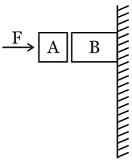
Given in the figure are two blocks A and B of weight 20 N and 100 N, respectively. These are being pressed against a wall by a force F and kept in equilibrium as shown. If the coefficient of friction between the blocks is 0.1 and between block B and the wall is 0.15, the frictional force applied by the wall on block B is:
Distance of the centre of mass of a solid uniform cone from its vertex is $$z_0$$. If the radius of its base is $$R$$ and its height is $$h$$ then $$z_0$$ is equal to
A particle of mass $$m$$ moving in the $$x$$ direction with speed $$2v$$ is hit by another particle of mass $$2m$$ moving in the $$y$$ direction with speed $$v$$. If the collision is perfectly inelastic, the percentage loss in the energy during the collision is close to
From a solid sphere of mass $$M$$ and radius $$R$$, a cube of the maximum possible volume is cut. Moment of inertia of cube about an axis passing through its centre and perpendicular to one of its faces is:
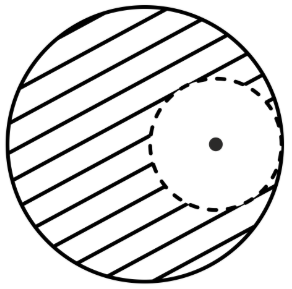
From a solid sphere of mass $$M$$ and radius $$R$$, a spherical portion of radius $$\left(\frac{R}{2}\right)$$ is removed as shown in the figure. Taking gravitational potential $$V = 0$$ at $$r = \infty$$, the potential at the centre of the cavity thus formed is ($$G$$ = gravitational constant)
A pendulum made of a uniform wire of cross sectional area A has time period T. When an additional mass M is added to its bob, the time period changes to $$T_M$$. If the Young's modulus of the material of the wire is $$Y$$, then $$\frac{1}{Y}$$ is equal to: ($$g$$ = gravitational acceleration)
Consider an ideal gas confined in an isolated closed chamber. As the gas undergoes an adiabatic expansion, the average time of collision between molecules increases as $$V^q$$, where $$V$$ is the volume of the gas. The value of $$q$$ is $$\left(\gamma = \frac{C_p}{C_v}\right)$$
Consider a spherical shell of radius R at temperature T. The black body radiation inside it can be considered as an ideal gas of photons with internal energy per unit volume $$u = \frac{U}{V} \propto T^4$$ and pressure $$p = \frac{1}{3}\left(\frac{U}{V}\right)$$. If the shell now undergoes an adiabatic expansion the relation between T and R is: