NTA JEE Main 4th April 2015 Offline
For the following questions answer them individually
NTA JEE Main 4th April 2015 Offline - Question 11
A solid body of constant heat capacity 1 J ($$^\circ$$C)$$^{-1}$$ is being heated by keeping it in contact with reservoirs in two ways: (i) Sequentially keeping in contact with 2 reservoirs such that each reservoir supplies the same amount of heat. (ii) Sequentially keeping in contact with 8 reservoirs such that each reservoir supplies the same amount of heat. In both cases the body is brought from initial temperature 100 K to final temperature 200 K. Entropy change of the body in the two cases respectively is: Note: This question was awarded as a bonus since temperatures were given in centigrade instead of in Kelvin. Proper corrections are made in the question to avoid it.
NTA JEE Main 4th April 2015 Offline - Question 12
For a simple pendulum, a graph is plotted between its kinetic energy (K.E.) and potential energy (P.E.) against its displacement d. Which one of the following represents these correctly? (graphs are schematic and not drawn to scale)
NTA JEE Main 4th April 2015 Offline - Question 13
A train is moving on a straight track with speed 20 m s$$^{-1}$$. It is blowing its whistle at the frequency of 1000 Hz. The percentage change in the frequency heard by a person standing near the track as the train passes him is (speed of sound = 320 m s$$^{-1}$$) close to:

NTA JEE Main 4th April 2015 Offline - Question 14
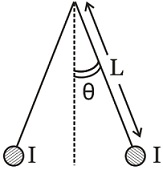
Two long currents carrying thin wires, both with current $$I$$, are held by insulating threads of length L and are in equilibrium as shown in the figure, with threads making an angle $$\theta$$ with the vertical. If wires have a mass $$\lambda$$ per unit length then the value of I is: ($$g$$ = gravitational acceleration)
NTA JEE Main 4th April 2015 Offline - Question 15
A uniformly charged solid sphere of radius R has potential $$V_0$$ (measured with respect to $$\infty$$) on its surface. For this sphere the equipotential surfaces with potential $$\frac{3V_0}{2}$$, $$\frac{5V_0}{4}$$, $$\frac{3V_0}{4}$$ and $$\frac{V_0}{4}$$ have radius $$R_1$$, $$R_2$$, $$R_3$$ and $$R_4$$ respectively. Then
Note: This question had two options correct at the time of examination. Proper corrections are made in the question to avoid it.
NTA JEE Main 4th April 2015 Offline - Question 16
A long cylindrical shell carries positive surface charge $$\sigma$$ in the upper half and negative surface charge $$-\sigma$$ in the lower half. The electric field lines around the cylinder will look like figure given in: (figures are schematic and not drawn to scale)
NTA JEE Main 4th April 2015 Offline - Question 17
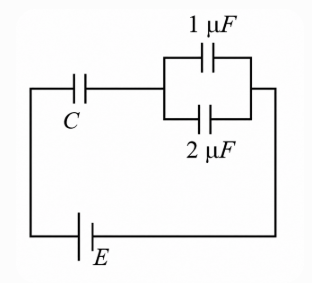
In the given circuit, charge $$Q_2$$ on the 2 $$\mu$$F capacitor changes as C is varied from 1 $$\mu$$F to 3 $$\mu$$F. $$Q_2$$ as a function of 'C' is given properly by: (figures are drawn schematically and are not to scale)
NTA JEE Main 4th April 2015 Offline - Question 18
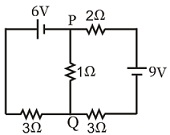
In the circuit shown, the current in the 1 $$\Omega$$ resistor is:
NTA JEE Main 4th April 2015 Offline - Question 19
When 5 V potential difference is applied across a wire of length 0.1 m, the drift speed of electrons is $$2.5 \times 10^{-4}$$ m s$$^{-1}$$. If the electron density in the wire is $$8 \times 10^{28}$$ m$$^{-3}$$, the resistivity of the material is close to:
NTA JEE Main 4th April 2015 Offline - Question 20
A rectangular loop of sides 10 cm and 5 cm, carrying a current $$I$$ of 12 A, is placed in different orientations as shown in the figures below.
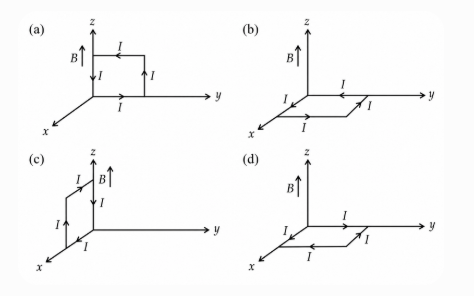
If there is a uniform magnetic field of 0.3 T in the positive z direction, in which orientations the loop would be in (i) stable equilibrium and (ii) unstable equilibrium?