NTA JEE Main 4th April 2015 Offline
For the following questions answer them individually
NTA JEE Main 4th April 2015 Offline - Question 21
Two coaxial solenoids of different radii carry current $$I$$ in the same direction. Let $$\vec{F_1}$$ be the magnetic force on the inner solenoid due to the outer one and $$\vec{F_2}$$ be the magnetic force on the outer solenoid due to the inner one. Then:
NTA JEE Main 4th April 2015 Offline - Question 22
An LCR circuit is equivalent to a damped pendulum. In an LCR circuit the capacitor is charged to $$Q_0$$ and then connected to the L and R as shown below:
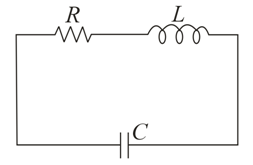
If a student plots graphs of the square of maximum charge $$(Q_{Max}^2)$$ on the capacitor with time (t) for two different values $$L_1$$ and $$L_2$$ ($$L_1 > L_2$$) of L then which of the following represents this graph correctly? (plots are schematic and not drawn to scale)
NTA JEE Main 4th April 2015 Offline - Question 23
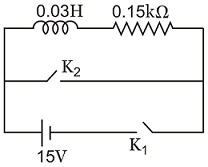
An inductor $$(L = 0.03$$ H$$)$$ and a resistor $$(R = 0.15$$ k$$\Omega)$$ are connected in series to a battery of 15 V E.M.F. in the circuit shown below. The key $$K_1$$ has been kept closed for a long time. Then at $$t = 0$$, $$K_1$$ is opened and key $$K_2$$ is closed simultaneously. At $$t = 1$$ ms, the current in the circuit will be: (Take, $$e^5 \approx 150$$)

NTA JEE Main 4th April 2015 Offline - Question 24
A red LED emits light at 0.1 watt uniformly around it. The amplitude of the electric field of the light at a distance of 1 m from the diode is:
NTA JEE Main 4th April 2015 Offline - Question 25
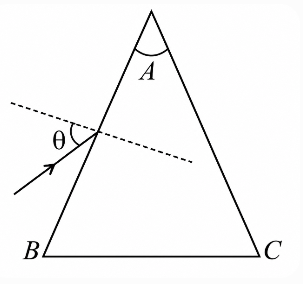
Monochromatic light is incident on a glass prism of angle A. If the refractive index of the material of the prism is $$\mu$$, a ray, incident at an angle $$\theta$$, on the face AB would get transmitted through the face AC of the prism provided:
NTA JEE Main 4th April 2015 Offline - Question 26
On a hot summer night, the refractive index of air is the smallest near the ground and increases with a height from the ground. When a light beam is directed horizontally, the Huygens' principle leads us to conclude that as it travels, the light beam,
NTA JEE Main 4th April 2015 Offline - Question 27
Assuming that the human pupil has a radius of 0.25 cm and a comfortable viewing distance of 25 cm. The minimum separation between two point objects that the human eye can resolve for the light of wavelength 500 nm is
NTA JEE Main 4th April 2015 Offline - Question 28
Match list-I (Fundamental Experiment) with List-II (its conclusion) and select the correct option from the choices given below the list:
List-I List-II
A. Franck-Hertz Experiment (i) Particle nature of light
B. Photo-electric experiment (ii) Discrete energy levels of the atom
C. Davison-Germer Experiment (iii) Wave nature of electron
(iv) Structure of atom
NTA JEE Main 4th April 2015 Offline - Question 29
As an electron makes a transition from an excited state to the ground state of a hydrogen-like atom/ion
NTA JEE Main 4th April 2015 Offline - Question 30
A signal of 5 kHz frequency is amplitude modulated on a carrier wave of frequency 2 MHz. The frequencies of the resultant signal is/are: