
Join Our JEE Preparation Group
Prep with like-minded aspirants; Get access to free daily tests and study material.
Sign in
Please select an account to continue using cracku.in
↓ →
Join Our JEE Preparation Group
Prep with like-minded aspirants; Get access to free daily tests and study material.
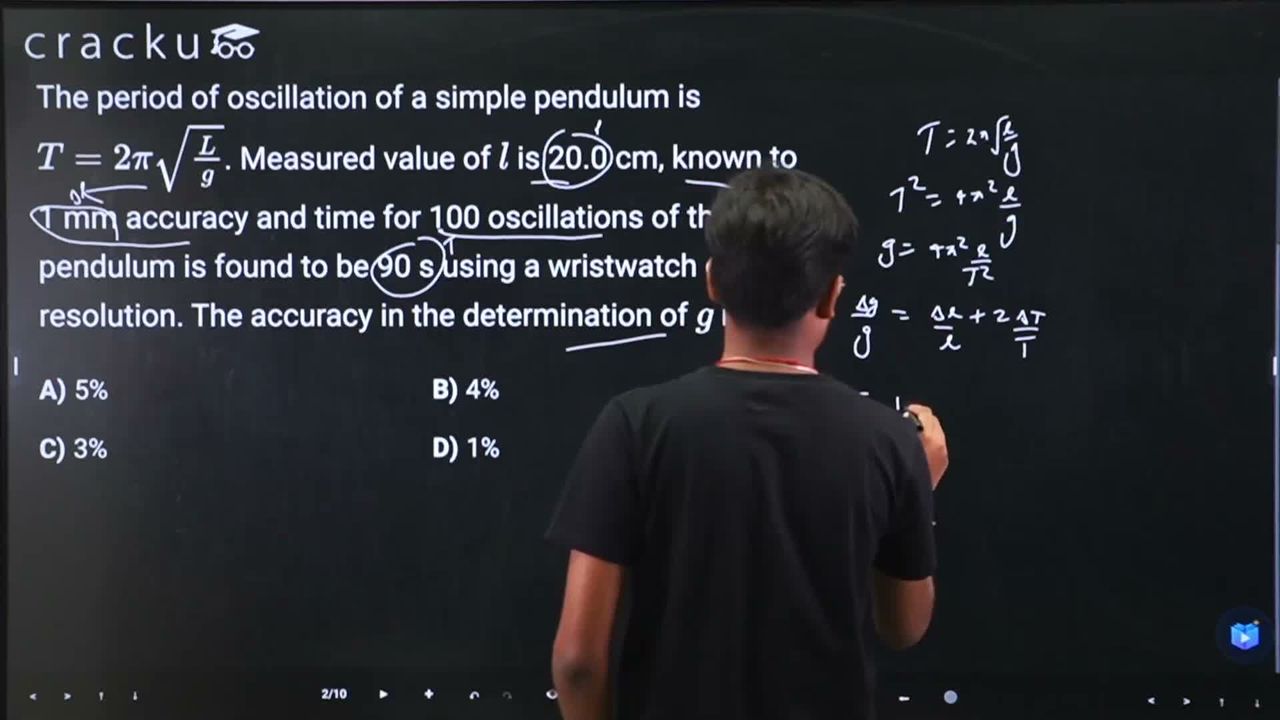
The period of oscillation of a simple pendulum is $$T = 2\pi\sqrt{\frac{L}{g}}$$. Measured value of $$l$$ is 20.0 cm, known to 1 mm accuracy and time for 100 oscillations of the pendulum is found to be 90 s using a wristwatch of 1 s resolution. The accuracy in the determination of $$g$$ is
We have the theoretical relation for a simple pendulum
$$T = 2\pi \sqrt{\frac{L}{g}}$$
In an experiment, the period is obtained and then inverted to get $$g$$. Solving the above expression for $$g$$ first, we write
$$T = 2\pi \sqrt{\frac{L}{g}} \;\Longrightarrow\; T^2 = 4\pi^2\frac{L}{g} \;\Longrightarrow\; g = \frac{4\pi^2L}{T^2}.$$
This form shows that $$g$$ depends directly on $$L$$ and inversely on $$T^2$$. For error propagation we recall the rule: if a quantity $$Q$$ depends on measured variables through a product or a power, then the fractional (percentage) error in $$Q$$ is the sum of the fractional errors of each variable multiplied by their respective powers. Concretely, for
$$g = 4\pi^2\,L\,T^{-2},$$
the fractional error is
$$\frac{\Delta g}{g} = \frac{\Delta L}{L} + 2\frac{\Delta T}{T}.$$
Now we evaluate the two individual error terms one by one.
Length measurement. The length is given as $$L = 20.0\text{ cm} = 0.200\text{ m}$$ with an accuracy of $$\pm 1\text{ mm} = \pm 0.001\text{ m}.$$ Hence
$$\frac{\Delta L}{L} = \frac{0.001}{0.200} = 0.005 = 0.5\%.$$
Time measurement. A total time $$t$$ for $$100$$ oscillations is measured. The given data are
$$t = 90\text{ s}, \quad \Delta t = \pm 1\text{ s}\;(\text{wrist-watch resolution}).$$
The period is $$T = \dfrac{t}{100}$$, so the absolute error in one period is $$\Delta T = \dfrac{\Delta t}{100}.$$ Because both numerator and denominator are divided by the same factor $$100$$, the fractional error remains unchanged:
$$\frac{\Delta T}{T} = \frac{\Delta t}{t} = \frac{1}{90}\approx 0.01111 = 1.11\%.$$
Combining the errors. Substituting the two fractional errors into the propagation formula we obtain
$$\frac{\Delta g}{g} = 0.005 + 2(0.01111) = 0.005 + 0.02222 = 0.02722.$$
Expressed as a percentage,
$$\frac{\Delta g}{g}\times 100\% \approx 2.7\%.$$
This rounds to about $$3\%$$ when quoted to the nearest whole percent.
Hence, the correct answer is Option C.
Was this solution helpful?
Click on the Email ☝️ to Watch the Video Solution
Create a FREE account and get:
_1.webp)

Educational materials for JEE preparation

Ask our AI anything

AI can make mistakes. Please verify important information.
AI can make mistakes. Please verify important information.


