
Join Our JEE Preparation Group
Prep with like-minded aspirants; Get access to free daily tests and study material.
Sign in
Please select an account to continue using cracku.in
↓ →
Join Our JEE Preparation Group
Prep with like-minded aspirants; Get access to free daily tests and study material.
Monochromatic light is incident on a glass prism of angle A. If the refractive index of the material of the prism is $$\mu$$, a ray, incident at an angle $$\theta$$, on the face AB would get transmitted through the face AC of the prism provided:
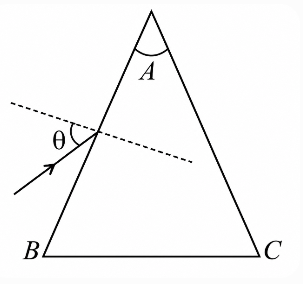
Let us begin by naming the angles in the usual way. The ray in air is incident on the first face $$AB$$ of the prism at an angle $$\theta$$ with the normal. After refraction into the prism its direction makes an angle $$r_1$$ with the same normal. When this ray reaches the second face $$AC$$ it meets the normal there at an angle $$r_2$$ (this $$r_2$$ is the angle of incidence for the second face).
For a prism of small thickness the two refracted angles inside the glass satisfy the simple geometrical relation
$$r_1 + r_2 = A,$$
because the angle between the two normals equals the prism angle $$A$$.
We want the ray to emerge through face $$AC$$. The only thing that can stop it is total internal reflection. Hence the condition for emergence is that the angle of incidence at the second face must be smaller than the critical angle. We first state the formula for the critical angle.
Critical-angle formula: For the interface “glass (index $$\mu$$) → air (index $$1$$)” the critical angle $$C$$ is defined by
$$\sin C = \frac{1}{\mu}.$$
Therefore the transmission condition is
$$r_2 < C.$$
Substituting the critical‐angle expression we write
$$r_2 < \sin^{-1}\!\left(\frac{1}{\mu}\right).$$
Now replace $$r_2$$ by $$A - r_1$$ from the prism geometry:
$$A - r_1 < \sin^{-1}\!\left(\frac{1}{\mu}\right).$$
Isolating $$r_1$$ on one side, we get
$$r_1 > A - \sin^{-1}\!\left(\frac{1}{\mu}\right).$$
Next we connect the external incident angle $$\theta$$ to the internal angle $$r_1$$ by Snell’s law at the first face.
Snell’s law: For refraction from air (index $$1$$) to glass (index $$\mu$$)
$$\sin\theta = \mu \sin r_1.$$
Because $$0^\circ \le r_1 \le 90^\circ$$ the sine function is strictly increasing, so “larger $$r_1$$” implies “larger $$\sin r_1$$” and therefore “larger $$\theta$$”. Keeping this monotonicity in mind, we turn the inequality for $$r_1$$ into one for $$\theta$$.
From Snell’s law we have
$$\theta = \sin^{-1}\!\bigl(\mu \sin r_1\bigr).$$
Since $$r_1$$ must satisfy $$r_1 > A - \sin^{-1}\!\left(\dfrac{1}{\mu}\right),$$ we substitute the right-hand side into the above expression for $$\theta$$ and preserve the same inequality sign (because of the monotonic behaviour just noted):
$$\theta > \sin^{-1}\!\left[ \mu \sin\!\left( A - \sin^{-1}\!\left(\frac{1}{\mu}\right) \right) \right].$$
This gives the desired condition for the external angle of incidence.
Comparing with the options, we see that this result matches exactly the statement in Option B:
$$\theta > \sin^{-1}\!\left[\mu \sin\!\left(A - \sin^{-1}\!\left(\frac{1}{\mu}\right)\right)\right].$$
Hence, the correct answer is Option B.
Was this solution helpful?
Create a FREE account and get:
_1.webp)

Educational materials for JEE preparation

Ask our AI anything

AI can make mistakes. Please verify important information.
AI can make mistakes. Please verify important information.


