
Join Our JEE Preparation Group
Prep with like-minded aspirants; Get access to free daily tests and study material.
Sign in
Please select an account to continue using cracku.in
↓ →
Join Our JEE Preparation Group
Prep with like-minded aspirants; Get access to free daily tests and study material.
If the angles of elevation of the top of a tower from three collinear points $$A$$, $$B$$ and $$C$$ on a line leading to the foot of the tower are $$30^\circ$$, $$45^\circ$$ and $$60^\circ$$ respectively, then the ratio $$AB : BC$$, is
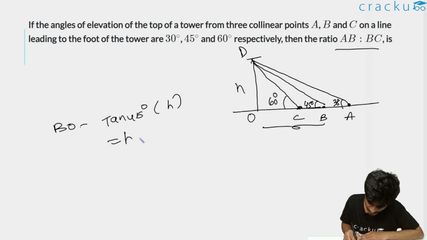
Let us denote the foot of the tower by the point $$O$$ and the top of the tower by the point $$T$$. The height of the tower is unknown, so we call it $$h = OT$$. The three points $$A,\,B,\,C$$ lie on the straight line that passes through $$O$$, with $$A$$ being the farthest from the tower and $$C$$ the closest, because the angle of elevation increases as we approach the tower.
We measure the horizontal distances from each point to the foot $$O$$ and name them $$OA = x_A,\qquad OB = x_B,\qquad OC = x_C.$$
From each of the three points we are given an angle of elevation to the top $$T$$: $$\angle ATO = 30^\circ,\qquad \angle BTO = 45^\circ,\qquad \angle CTO = 60^\circ.$$
Whenever we have a right-angled triangle with an angle $$\theta$$, the tangent formula states $$\tan\theta = \frac{\text{opposite side}}{\text{adjacent side}}.$$ Here the “opposite side’’ is always the height $$h$$ and the “adjacent side’’ is the corresponding horizontal distance. We therefore write for each point:
From point $$A$$: $$\tan 30^\circ = \frac{h}{x_A}.$$
From point $$B$$: $$\tan 45^\circ = \frac{h}{x_B}.$$
From point $$C$$: $$\tan 60^\circ = \frac{h}{x_C}.$$
Now we substitute the well-known numerical values $$\tan 30^\circ = \frac{1}{\sqrt3},\qquad \tan 45^\circ = 1,\qquad \tan 60^\circ = \sqrt3.$$
Hence we have the three equations
$$\frac{1}{\sqrt3} = \frac{h}{x_A} \;\;\Longrightarrow\;\; x_A = h\sqrt3,$$
$$1 = \frac{h}{x_B} \;\;\Longrightarrow\;\; x_B = h,$$
$$\sqrt3 = \frac{h}{x_C} \;\;\Longrightarrow\;\; x_C = \frac{h}{\sqrt3}.$$
Our required distances along the ground are the differences:
Distance $$AB$$: $$AB = OA - OB = x_A - x_B = h\sqrt3 - h = h(\sqrt3 - 1).$$
Distance $$BC$$: $$BC = OB - OC = x_B - x_C = h - \frac{h}{\sqrt3} = h\!\left(1 - \frac{1}{\sqrt3}\right) = h\!\left(\frac{\sqrt3 - 1}{\sqrt3}\right).$$
We now form the desired ratio $$AB:BC$$. First write both distances explicitly:
$$AB = h(\sqrt3 - 1),\qquad BC = h\!\left(\frac{\sqrt3 - 1}{\sqrt3}\right).$$
Because both terms contain the common factor $$h(\sqrt3 - 1)$$, we can cancel it:
$$\frac{AB}{BC} = \frac{h(\sqrt3 - 1)}{\,h(\sqrt3 - 1)/\sqrt3} = \frac{h(\sqrt3 - 1)}{h(\sqrt3 - 1)}\;\times\;\sqrt3 = \sqrt3.$$
Therefore the simplified ratio is
$$AB : BC = \sqrt3 : 1.$$
Hence, the correct answer is Option B.
Was this solution helpful?
Click on the Email ☝️ to Watch the Video Solution
Create a FREE account and get:
_1.webp)

Educational materials for JEE preparation

Ask our AI anything

AI can make mistakes. Please verify important information.
AI can make mistakes. Please verify important information.


