
Join Our JEE Preparation Group
Prep with like-minded aspirants; Get access to free daily tests and study material.
Sign in
Please select an account to continue using cracku.in
↓ →
Join Our JEE Preparation Group
Prep with like-minded aspirants; Get access to free daily tests and study material.
As an electron makes a transition from an excited state to the ground state of a hydrogen-like atom/ion
We are considering a hydrogen-like atom or ion, where an electron transitions from an excited state (higher principal quantum number, $$ n $$) to the ground state (lowest $$ n $$, which is $$ n = 1 $$). We need to determine how the kinetic energy, potential energy, and total energy change during this transition.
First, recall the formula for the total energy $$ E_n $$ of an electron in the nth orbit of a hydrogen-like atom:
$$ E_n = -\frac{13.6 Z^2}{n^2} \text{ eV} $$
Here, $$ Z $$ is the atomic number, and $$ n $$ is the principal quantum number. The total energy is negative, indicating that the electron is bound to the nucleus.
Next, we express the kinetic energy $$ K_n $$ and potential energy $$ U_n $$ in terms of the total energy $$ E_n $$. For a hydrogen-like atom, the following relationships hold:
$$ K_n = -E_n $$
$$ U_n = 2E_n $$
These relationships can be derived from the principles of circular motion and Coulomb's law. The centripetal force is provided by the electrostatic force:
$$ \frac{m v^2}{r} = \frac{k Z e^2}{r^2} $$
where $$ m $$ is the electron mass, $$ v $$ is the orbital speed, $$ r $$ is the orbital radius, $$ k = \frac{1}{4\pi\epsilon_0} $$, and $$ e $$ is the elementary charge. Solving for kinetic energy:
$$ K_n = \frac{1}{2} m v^2 = \frac{k Z e^2}{2r} $$
The potential energy due to the Coulomb attraction is:
$$ U_n = -\frac{k Z e^2}{r} $$
The total energy is the sum of kinetic and potential energy:
$$ E_n = K_n + U_n = \frac{k Z e^2}{2r} - \frac{k Z e^2}{r} = -\frac{k Z e^2}{2r} $$
Comparing with the expression for $$ K_n $$, we see:
$$ K_n = \frac{k Z e^2}{2r} = - \left( -\frac{k Z e^2}{2r} \right) = -E_n $$
Similarly, for potential energy:
$$ U_n = -\frac{k Z e^2}{r} = 2 \times \left( -\frac{k Z e^2}{2r} \right) = 2E_n $$
Thus, we have $$ K_n = -E_n $$ and $$ U_n = 2E_n $$.
Now, consider the transition from an excited state (higher $$ n $$) to the ground state (lower $$ n $$). As $$ n $$ decreases, the denominator $$ n^2 $$ in the total energy formula decreases, so the magnitude of $$ E_n $$ increases. Since $$ E_n $$ is negative, an increase in magnitude means $$ E_n $$ becomes more negative. Therefore, the total energy decreases.
Using the relationships:
To illustrate, take a hydrogen atom ($$ Z = 1 $$) and compare the energies for $$ n = 2 $$ (excited state) and $$ n = 1 $$ (ground state).
For $$ n = 2 $$:
$$ E_2 = -\frac{13.6}{2^2} = -\frac{13.6}{4} = -3.4 \text{ eV} $$
$$ K_2 = -E_2 = -(-3.4) = 3.4 \text{ eV} $$
$$ U_2 = 2E_2 = 2 \times (-3.4) = -6.8 \text{ eV} $$
For $$ n = 1 $$:
$$ E_1 = -\frac{13.6}{1^2} = -13.6 \text{ eV} $$
$$ K_1 = -E_1 = -(-13.6) = 13.6 \text{ eV} $$
$$ U_1 = 2E_1 = 2 \times (-13.6) = -27.2 \text{ eV} $$
Comparing:
Now, evaluating the options:
A. Kinetic energy and total energy decrease but potential energy increases → Incorrect, as kinetic energy increases.
B. Kinetic energy increases but potential energy and total energy decrease → Matches our analysis.
C. Kinetic energy, potential energy, and total energy decrease → Incorrect, as kinetic energy increases.
D. Kinetic energy decreases, potential energy increases but total energy remains same → Incorrect, as kinetic energy increases and total energy decreases.
Hence, the correct answer is Option B.
Was this solution helpful?
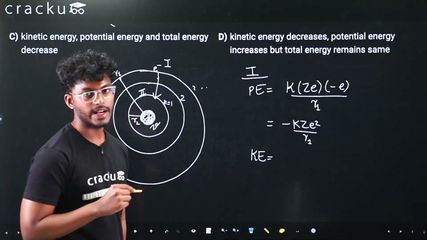
Click on the Email ☝️ to Watch the Video Solution
Create a FREE account and get:
_1.webp)

Educational materials for JEE preparation

Ask our AI anything

AI can make mistakes. Please verify important information.
AI can make mistakes. Please verify important information.


