
Join Our JEE Preparation Group
Prep with like-minded aspirants; Get access to free daily tests and study material.
Sign in
Please select an account to continue using cracku.in
↓ →
Join Our JEE Preparation Group
Prep with like-minded aspirants; Get access to free daily tests and study material.
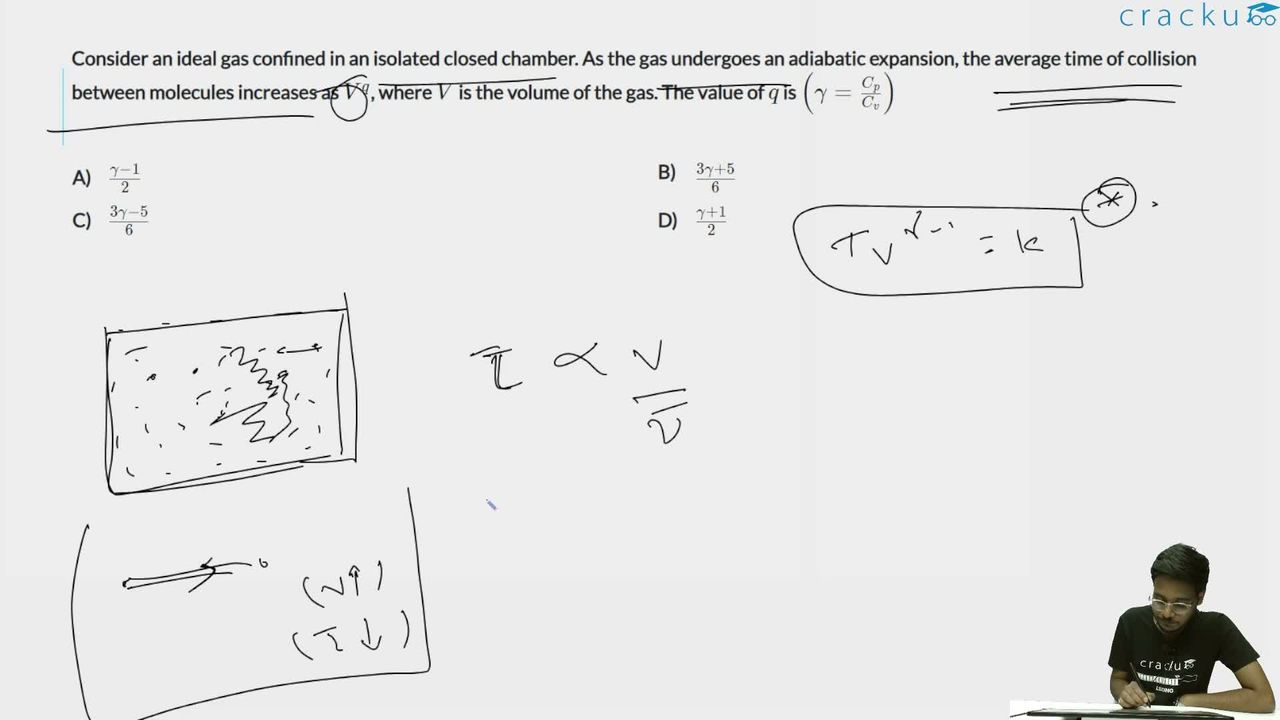
Consider an ideal gas confined in an isolated closed chamber. As the gas undergoes an adiabatic expansion, the average time of collision between molecules increases as $$V^q$$, where $$V$$ is the volume of the gas. The value of $$q$$ is $$\left(\gamma = \frac{C_p}{C_v}\right)$$
Let the average time between two successive molecular collisions be denoted by $$\tau$$. By kinetic theory, the collision frequency (collisions per unit time) is proportional to the number density of molecules multiplied by their average speed. Stating this idea in symbols:
$$\text{collision frequency}\;z \;\propto\; n\,\bar v$$
where
$$n=\frac{N}{V}$$
is the number density (here $$N$$ is the fixed number of molecules in the isolated chamber) and $$\bar v$$ is the mean molecular speed.
The average time between collisions is the reciprocal of the collision frequency, so
$$\tau \;=\;\frac{1}{z}\;\propto\;\frac{1}{n\,\bar v}.$$
Substituting $$n = \dfrac{N}{V}$$ we have
$$\tau \;\propto\;\frac{1}{(N/V)\,\bar v}\;=\;\frac{V}{N\,\bar v}.$$
The system is closed, hence $$N$$ is constant, and we may absorb it into the proportionality constant. Thus
$$\tau \;\propto\; \frac{V}{\bar v}.$$
For an ideal gas the average molecular speed varies with absolute temperature as
$$\bar v \;\propto\;\sqrt{T}.$$
Using this in the previous relation gives
$$\tau \;\propto\;\frac{V}{\sqrt{T}} \;=\;V\,T^{-1/2}.$$
Now an adiabatic process for an ideal gas satisfies the well-known relation
$$T\,V^{\gamma-1} = \text{constant},$$
where $$\gamma=\dfrac{C_p}{C_v}$$. From this equation we can express temperature in terms of volume:
$$T \;\propto\; V^{1-\gamma}.$$
Taking the square root on both sides, we obtain
$$\sqrt{T} \;\propto\; V^{\tfrac{1-\gamma}{2}}.$$
Substituting this result back into $$\tau \propto V\,T^{-1/2}$$ yields
$$\tau \;\propto\; V\,\bigl(V^{\tfrac{1-\gamma}{2}}\bigr)^{-1} \;=\;V\,V^{\tfrac{\gamma-1}{2}} \;=\;V^{\,1+\tfrac{\gamma-1}{2}}.$$
Adding the exponents explicitly,
$$1+\frac{\gamma-1}{2} \;=\; \frac{2+\gamma-1}{2} \;=\;\frac{\gamma+1}{2}.$$
Hence
$$\tau \;\propto\; V^{\tfrac{\gamma+1}{2}}.$$
Comparing with the statement of the problem, the exponent $$q$$ is
$$q=\frac{\gamma+1}{2}.$$
Hence, the correct answer is Option D.
Was this solution helpful?
Click on the Email ☝️ to Watch the Video Solution
Create a FREE account and get:
_1.webp)

Educational materials for JEE preparation

Ask our AI anything

AI can make mistakes. Please verify important information.
AI can make mistakes. Please verify important information.


