
Join Our JEE Preparation Group
Prep with like-minded aspirants; Get access to free daily tests and study material.
Sign in
Please select an account to continue using cracku.in
↓ →
Join Our JEE Preparation Group
Prep with like-minded aspirants; Get access to free daily tests and study material.
The sum of first 9 terms of the series $$\frac{1^3}{1} + \frac{1^3 + 2^3}{1+3} + \frac{1^3 + 2^3 + 3^3}{1+3+5} + \ldots$$ is
We begin by observing the pattern of the given series
$$\frac{1^3}{1}\;+\;\frac{1^3+2^3}{1+3}\;+\;\frac{1^3+2^3+3^3}{1+3+5}\;+\;\ldots$$
For the general $$n^{\text{th}}$$ term, the numerator contains the sum of the first $$n$$ cubes and the denominator contains the sum of the first $$n$$ odd numbers. Let us treat each of these sums separately.
Numerator: The sum of cubes formula states
$$1^3+2^3+\ldots+n^3=\left[\frac{n(n+1)}{2}\right]^2.$$
Denominator: The sum of the first $$n$$ odd numbers is a well-known result
$$1+3+5+\ldots+(2n-1)=n^2.$$
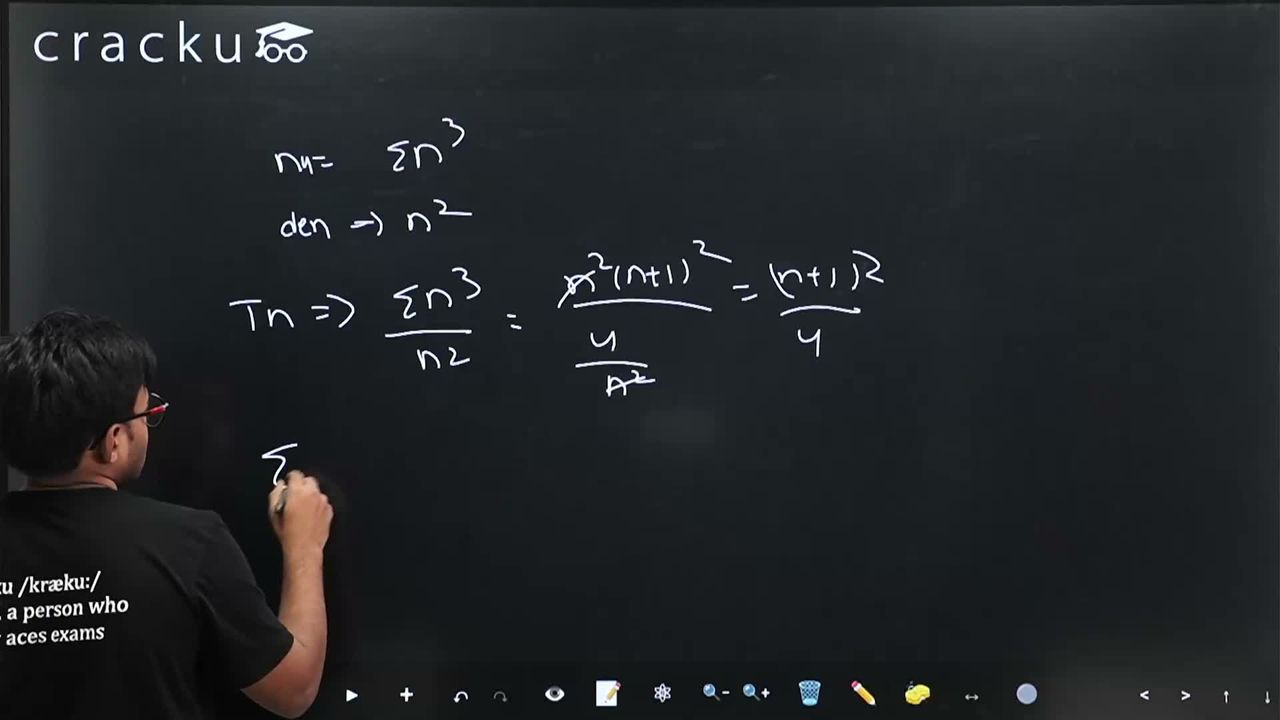
Hence the $$n^{\text{th}}$$ term $$T_n$$ of the series is
$$T_n=\frac{\displaystyle\left[\dfrac{n(n+1)}{2}\right]^2}{n^2}.$$
We now simplify $$T_n$$. First we expand the square in the numerator:
$$\left[\frac{n(n+1)}{2}\right]^2=\frac{n^2(n+1)^2}{4}.$$
Dividing this by the denominator $$n^2$$ gives
$$T_n=\frac{\,\dfrac{n^2(n+1)^2}{4}\,}{n^2} =\frac{(n+1)^2}{4}.$$
Therefore each term of the series is simply a quarter of a perfect square:
$$T_n=\frac{(n+1)^2}{4}.$$
We are asked for the sum of the first 9 terms, so we must evaluate
$$S_9=\sum_{n=1}^{9}T_n=\sum_{n=1}^{9}\frac{(n+1)^2}{4}.$$
Since the factor $$\frac14$$ is common to every term, we can factor it outside the summation:
$$S_9=\frac14\sum_{n=1}^{9}(n+1)^2.$$
To re-index the summation more comfortably, let us put $$m=n+1$$. Then, when $$n=1$$ we have $$m=2$$ and when $$n=9$$ we have $$m=10$$. Hence
$$\sum_{n=1}^{9}(n+1)^2=\sum_{m=2}^{10}m^2.$$
We now use the formula for the sum of the squares of the first $$k$$ natural numbers:
$$1^2+2^2+\dots+k^2=\frac{k(k+1)(2k+1)}{6}.$$
First we compute the sum up to $$k=10$$:
$$\sum_{m=1}^{10}m^2=\frac{10\,(10+1)\,(2\cdot10+1)}{6} =\frac{10\cdot11\cdot21}{6} =\frac{2310}{6} =385.$$
But we need the sum from $$m=2$$ to $$m=10$$, so we subtract the first term $$1^2=1$$:
$$\sum_{m=2}^{10}m^2=385-1=384.$$
Substituting this result back into our expression for $$S_9$$, we get
$$S_9=\frac14\times384=96.$$
Thus the total of the first nine terms of the given series equals 96.
Hence, the correct answer is Option C.
Was this solution helpful?
Click on the Email ☝️ to Watch the Video Solution
Create a FREE account and get:
_1.webp)

Educational materials for JEE preparation

Ask our AI anything

AI can make mistakes. Please verify important information.
AI can make mistakes. Please verify important information.


