
Join Our JEE Preparation Group
Prep with like-minded aspirants; Get access to free daily tests and study material.
Sign in
Please select an account to continue using cracku.in
↓ →
Join Our JEE Preparation Group
Prep with like-minded aspirants; Get access to free daily tests and study material.
If $$m$$ is the A.M. of two distinct real numbers $$l$$ and $$n$$ $$(l, n > 1)$$ and $$G_1$$, $$G_2$$ and $$G_3$$ are three geometric means between $$l$$ and $$n$$, then $$G_1^4 + 2G_2^4 + G_3^4$$ equals
We have two distinct real numbers $$l$$ and $$n$$ with $$l,n > 1$$. Their arithmetic mean (A.M.) is given to be $$m$$, so by definition of arithmetic mean
$$m = \dfrac{l + n}{2}.$$
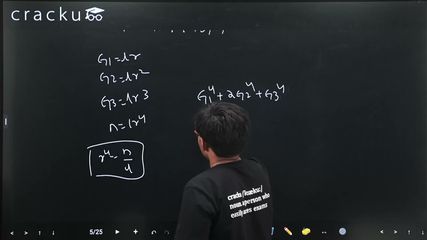
Next, the numbers $$G_1, G_2, G_3$$ are three geometric means between $$l$$ and $$n$$. Putting the two given numbers together with the three means, we obtain a geometric progression (G.P.) of five consecutive terms
$$l, \; G_1, \; G_2, \; G_3, \; n.$$
For any G.P. the ratio between successive terms is constant. Let that common ratio be $$r$$. Then
$$G_1 = lr, \qquad G_2 = lr^2, \qquad G_3 = lr^3, \qquad n = lr^4.$$
From the last relation we can express the fourth power of the ratio:
$$r^4 = \dfrac{n}{l} \;\;\Longrightarrow\;\; r = \left(\dfrac{n}{l}\right)^{1/4}.$$
We now calculate the required fourth powers one by one.
First term
$$G_1^4 = (lr)^4 = l^4 r^4.$$
Substituting $$r^4 = \dfrac{n}{l}$$ we get
$$G_1^4 = l^4 \left(\dfrac{n}{l}\right) = l^3 n.$$
Second term
$$G_2^4 = (lr^2)^4 = l^4 r^8.$$
Because $$r^8 = (r^4)^2 = \left(\dfrac{n}{l}\right)^2 = \dfrac{n^2}{l^2},$$
we have
$$G_2^4 = l^4 \left(\dfrac{n^2}{l^2}\right) = l^2 n^2.$$
Third term
$$G_3^4 = (lr^3)^4 = l^4 r^{12}.$$
Here $$r^{12} = (r^4)^3 = \left(\dfrac{n}{l}\right)^3 = \dfrac{n^3}{l^3},$$ so
$$G_3^4 = l^4 \left(\dfrac{n^3}{l^3}\right) = l n^3.$$
Now we assemble the expression demanded in the question:
$$G_1^4 + 2G_2^4 + G_3^4 = \bigl(l^3 n\bigr) + 2\bigl(l^2 n^2\bigr) + \bigl(l n^3\bigr).$$
Observe that each term contains the common factor $$ln$$. Taking this out,
$$G_1^4 + 2G_2^4 + G_3^4 = ln\bigl(l^2 + 2ln + n^2\bigr).$$
The expression inside the parentheses is a perfect square:
$$l^2 + 2ln + n^2 = (l + n)^2.$$
Hence
$$G_1^4 + 2G_2^4 + G_3^4 = ln(l + n)^2.$$
But we earlier defined $$m = \dfrac{l + n}{2}$$, so $$(l + n)^2 = 4m^2.$$ Substituting this value gives
$$G_1^4 + 2G_2^4 + G_3^4 = ln \times 4m^2 = 4l m^2 n.$$
This matches the expression in option C.
Hence, the correct answer is Option C.
Was this solution helpful?
Click on the Email ☝️ to Watch the Video Solution
Create a FREE account and get:
_1.webp)

Educational materials for JEE preparation

Ask our AI anything

AI can make mistakes. Please verify important information.
AI can make mistakes. Please verify important information.


