
Join Our JEE Preparation Group
Prep with like-minded aspirants; Get access to free daily tests and study material.
Sign in
Please select an account to continue using cracku.in
↓ →
Join Our JEE Preparation Group
Prep with like-minded aspirants; Get access to free daily tests and study material.
An inductor $$(L = 0.03$$ H$$)$$ and a resistor $$(R = 0.15$$ k$$\Omega)$$ are connected in series to a battery of 15 V E.M.F. in the circuit shown below. The key $$K_1$$ has been kept closed for a long time. Then at $$t = 0$$, $$K_1$$ is opened and key $$K_2$$ is closed simultaneously. At $$t = 1$$ ms, the current in the circuit will be: (Take, $$e^5 \approx 150$$)
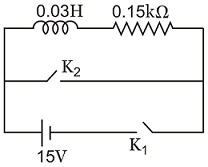
Before $$t = 0$$, the key $$K_1$$ has been closed for a long time and $$K_2$$ is open. In a DC circuit at steady state, an inductor acts as a short circuit.
$$I_0 = \frac{V}{R} = \frac{15\ \text{V}}{150\ \Omega} = 0.1\ \text{A} = 100\ \text{mA}$$
At $$t = 0$$, $$K_1$$ is opened (removing the battery) and $$K_2$$ is closed. The inductor now discharges its stored energy through the resistor $$R$$. This is a standard current decay in an RL circuit. The equation for decaying current is $$I(t) = I_0 e^{-\frac{t}{\tau}}$$
$$\tau = \frac{L}{R} = \frac{0.03\ \text{H}}{150\ \Omega} = 2 \times 10^{-4}\ \text{s} = 0.2\ \text{ms}$$
$$I(1\ \text{ms}) = 100\ \text{mA} \times e^{-\frac{1\ \text{ms}}{0.2\ \text{ms}}}$$
$$I = 100 \times e^{-5}\ \text{mA}$$
$$I = \frac{100}{150}\ \text{mA}$$
$$I = \frac{2}{3}\ \text{mA} \approx 0.666...\ \text{mA}$$
$$I \approx 0.67\ \text{mA}$$
Was this solution helpful?
Create a FREE account and get:
_1.webp)

Educational materials for JEE preparation

Ask our AI anything

AI can make mistakes. Please verify important information.
AI can make mistakes. Please verify important information.


