
Join Our JEE Preparation Group
Prep with like-minded aspirants; Get access to free daily tests and study material.
Sign in
Please select an account to continue using cracku.in
↓ →
Join Our JEE Preparation Group
Prep with like-minded aspirants; Get access to free daily tests and study material.
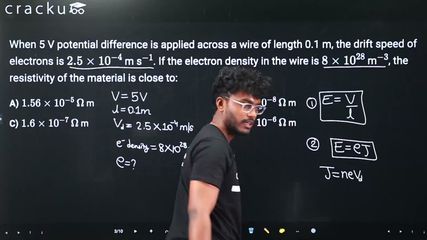
When 5 V potential difference is applied across a wire of length 0.1 m, the drift speed of electrons is $$2.5 \times 10^{-4}$$ m s$$^{-1}$$. If the electron density in the wire is $$8 \times 10^{28}$$ m$$^{-3}$$, the resistivity of the material is close to:
First, let us work out the magnitude of the electric field inside the wire. We know that electric field and potential difference are related by the formula $$E=\dfrac{V}{L},$$ where $$V$$ is the applied potential difference and $$L$$ is the length of the conductor. Substituting the given numbers, we have $$E=\dfrac{5\;\text{V}}{0.1\;\text{m}}=50\;\text{V m}^{-1}.$$
Next, we express the current-density $$J$$ in terms of the drift speed of electrons. The microscopic relation is stated as $$J = n e v_d,$$ where $$n$$ is the electron number density, $$e$$ is the magnitude of electronic charge, and $$v_d$$ is the drift speed. Using the given data $$n = 8\times 10^{28}\;\text{m}^{-3},\; e = 1.6\times 10^{-19}\;\text{C},\; v_d = 2.5\times 10^{-4}\;\text{m s}^{-1},$$ we obtain
$$\begin{aligned} J &= (8\times10^{28})\,(1.6\times10^{-19})\,(2.5\times10^{-4}) \\[4pt] &= 8 \times 1.6 \times 2.5 \times 10^{28-19-4} \\[4pt] &= 32 \times 10^{5} \\[4pt] &= 3.2 \times 10^{6}\;\text{A m}^{-2}. \end{aligned}$$
Resistivity $$\rho$$ is defined through Ohm’s microscopic form $$\rho = \dfrac{E}{J},$$ because $$\mathbf{E} = \rho \mathbf{J}.$$ Substituting the electric field and current density we have just found,
$$\begin{aligned} \rho &= \dfrac{50\;\text{V m}^{-1}}{3.2 \times 10^{6}\;\text{A m}^{-2}} \\[6pt] &= \left(\dfrac{50}{3.2}\right) \times 10^{-6}\;\Omega\;\text{m} \\[6pt] &= 15.625 \times 10^{-6}\;\Omega\;\text{m} \\[6pt] &= 1.5625 \times 10^{-5}\;\Omega\;\text{m}. \end{aligned}$$
The numerical value $$1.5625 \times 10^{-5}\;\Omega\;\text{m}$$ matches most closely with option A.
Hence, the correct answer is Option A.
Was this solution helpful?
Click on the Email ☝️ to Watch the Video Solution
Create a FREE account and get:
_1.webp)

Educational materials for JEE preparation

Ask our AI anything

AI can make mistakes. Please verify important information.
AI can make mistakes. Please verify important information.


