
Join Our JEE Preparation Group
Prep with like-minded aspirants; Get access to free daily tests and study material.
Sign in
Please select an account to continue using cracku.in
↓ →
Join Our JEE Preparation Group
Prep with like-minded aspirants; Get access to free daily tests and study material.
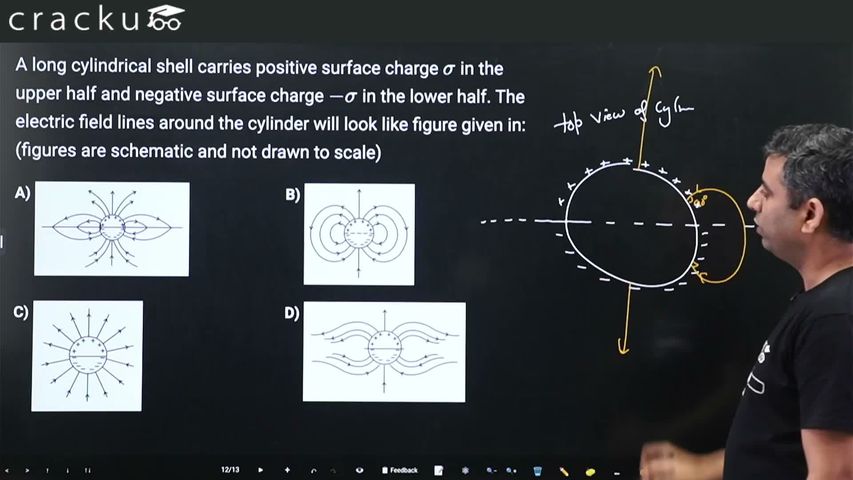
A long cylindrical shell carries positive surface charge $$\sigma$$ in the upper half and negative surface charge $$-\sigma$$ in the lower half. The electric field lines around the cylinder will look like figure given in: (figures are schematic and not drawn to scale)
We start from the very basic rule for electrostatic field lines: they originate on positive charge and they terminate on negative charge. Hence, wherever the surface charge density is $$+\sigma$$ the field lines must leave the surface, and wherever it is $$-\sigma$$ they must enter the surface.
Another fundamental fact, valid for any conductor in electro-static equilibrium, is the relation between the surface charge density $$\sigma$$ and the electric field just outside the conductor:
$$\mathbf E_{\text{out}}=\dfrac{\sigma}{\varepsilon_0}\,\hat n,$$
where $$\hat n$$ is the unit vector normal to the surface directed outward from the metal. Therefore
Because the shell is conducting, the electric field inside the metal itself is zero; hence no field lines can exist inside the cylindrical material, nor in the hollow region surrounded by it.
Putting these two pieces together we get the complete qualitative picture:
Among the four schematic figures supplied in the question, only Figure (2) shows lines that leave the upper semicylinder, curve through the external space, and enter the lower semicylinder, while the interior of the shell remains field-free. The other three options either show lines entering/leaving the wrong halves or show field lines existing inside the conductor, both of which violate the rules stated above.
Hence, the correct answer is Option B (Figure 2).
Was this solution helpful?
Click on the Email ☝️ to Watch the Video Solution
Create a FREE account and get:
_1.webp)

Educational materials for JEE preparation

Ask our AI anything

AI can make mistakes. Please verify important information.
AI can make mistakes. Please verify important information.


