
Join Our JEE Preparation Group
Prep with like-minded aspirants; Get access to free daily tests and study material.
Sign in
Please select an account to continue using cracku.in
↓ →
Join Our JEE Preparation Group
Prep with like-minded aspirants; Get access to free daily tests and study material.
The number of integers greater than 6000 that can be formed, using the digits 3, 5, 6, 7 and 8, without repetition is
We have five distinct digits, namely $$3,\,5,\,6,\,7,\,8$$. From these digits we wish to form integers that are greater than $$6000$$, and we are not allowed to repeat any digit in a single number.
Because every digit is positive and there is no zero, a number formed from these digits can be
$$\begin{aligned} \text{(i)} &\quad \text{a four-digit number},\\ \text{(ii)} &\quad \text{a five-digit number}. \end{aligned}$$
A three-digit number such as $$753$$ is obviously less than $$6000$$, so such numbers do not satisfy the condition. Hence we restrict our counting to four- and five-digit cases.
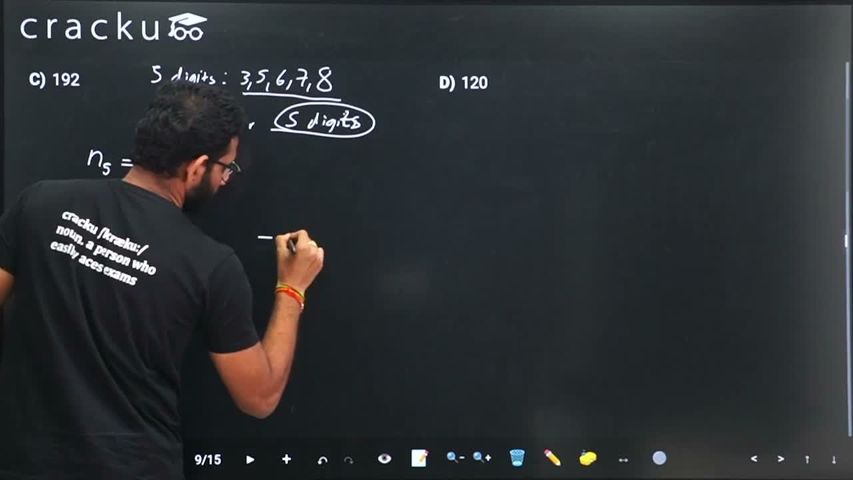
Counting the five-digit numbers - To get a five-digit number we must use all the digits $$3,\,5,\,6,\,7,\,8$$. The number of different five-digit arrangements of five distinct symbols is given by the permutation formula
$$^nP_n = n!,$$
where $$n=5$$. Therefore
$$5! = 5 \times 4 \times 3 \times 2 \times 1 = 120.$$
Every such number is at least $$35678$$, which is larger than $$6000$$, so all of these $$120$$ numbers are admissible.
Counting the four-digit numbers - A four-digit number is of the form $$\underline{\,a\,}\underline{\,b\,}\underline{\,c\,}\underline{\,d\,}$$, where the first digit $$a$$ is the thousands digit. For the entire number to exceed $$6000$$ we must have
$$a \ge 6.$$
The available choices for $$a$$ from our set $$\{3,5,6,7,8\}$$ that satisfy $$a \ge 6$$ are $$6,\,7,\,8$$. We consider each of these three possibilities one by one.
• First digit $$6$$: After fixing $$6$$ in the thousands place, the remaining three places must be filled with three distinct digits chosen from the set $$\{3,5,7,8\}$$ (four digits remain because we have already used $$6$$). The number of ways to choose the three required digits is the combination
$$^4C_3 = 4.$$
Once these three digits are chosen, they can be arranged in the hundreds, tens, and units places in $$3! = 6$$ different orders. So the total count for this first-digit choice is
$$4 \times 6 = 24.$$
• First digit $$7$$: Exactly the same reasoning applies. The set of remaining digits is $$\{3,5,6,8\}$$; we again have $$^4C_3 = 4$$ ways to pick the three digits and $$3! = 6$$ ways to arrange them, giving
$$4 \times 6 = 24$$
four-digit numbers beginning with $$7$$.
• First digit $$8$$: The remaining digits are $$\{3,5,6,7\}$$, and the identical calculation yields
$$4 \times 6 = 24$$
numbers.
Adding the contributions of the three admissible leading digits, the total number of four-digit integers exceeding $$6000$$ is
$$24 + 24 + 24 = 72.$$
Combining both cases - Finally, the total number of required integers is obtained by adding the five-digit and the four-digit counts:
$$120 \;(\text{five-digit}) \;+\; 72 \;(\text{four-digit}) \;=\; 192.$$
Hence, the correct answer is Option C.
Was this solution helpful?
Click on the Email ☝️ to Watch the Video Solution
Create a FREE account and get:
_1.webp)

Educational materials for JEE preparation

Ask our AI anything

AI can make mistakes. Please verify important information.
AI can make mistakes. Please verify important information.


