
Join Our JEE Preparation Group
Prep with like-minded aspirants; Get access to free daily tests and study material.
Sign in
Please select an account to continue using cracku.in
↓ →
Join Our JEE Preparation Group
Prep with like-minded aspirants; Get access to free daily tests and study material.
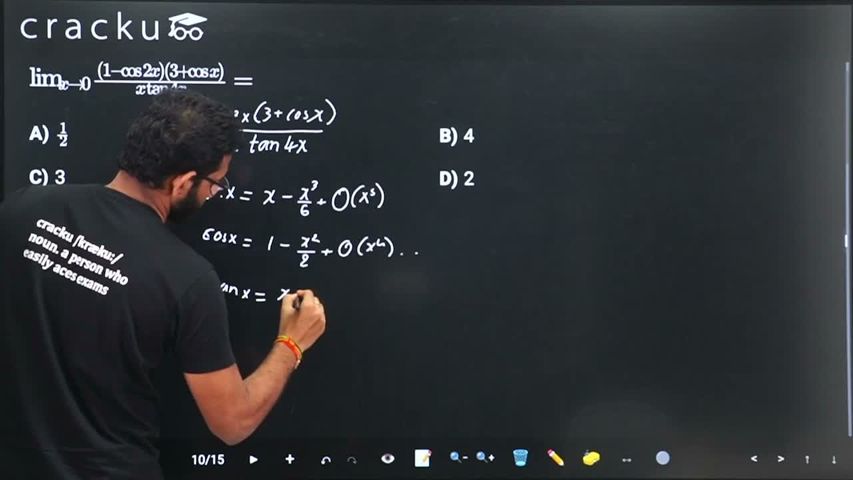
We have to evaluate the limit
$$\displaystyle \lim_{x\to 0}\frac{(1-\cos 2x)(3+\cos x)}{x\tan 4x}.$$
Because the expression gives the indeterminate form $$\dfrac{0}{0}$$ when $$x\rightarrow 0,$$ we simplify each factor by using their standard small-angle (Maclaurin) expansions.
First recall the series that hold as $$x\rightarrow 0$$:
$$\sin x = x - \dfrac{x^{3}}{6}+O(x^{5}),\qquad \cos x = 1-\dfrac{x^{2}}{2}+O(x^{4}),\qquad \tan x = x+\dfrac{x^{3}}{3}+O(x^{5}).$$
We also know the double-angle identity
$$1-\cos 2x = 2\sin^{2}x.$$
Using $$\sin x = x+O(x^{3})$$ we obtain
$$1-\cos 2x \;=\;2\sin^{2}x \;=\;2\bigl(x+O(x^{3})\bigr)^{2} \;=\;2x^{2}+O(x^{4}).$$
Next, for the factor $$3+\cos x$$ we write
$$3+\cos x \;=\;3+\Bigl(1-\dfrac{x^{2}}{2}+O(x^{4})\Bigr) \;=\;4-\dfrac{x^{2}}{2}+O(x^{4}).$$
Multiplying these two numerators term by term we get
$$\bigl(1-\cos 2x\bigr)\bigl(3+\cos x\bigr) \;=\;\bigl(2x^{2}+O(x^{4})\bigr)\bigl(4-\dfrac{x^{2}}{2}+O(x^{4})\bigr)$$
$$\hspace{3.8em}=\,2x^{2}\cdot 4\;+\; 2x^{2}\Bigl(-\dfrac{x^{2}}{2}\Bigr) \;+\;O(x^{6})$$
$$\hspace{3.8em}=\,8x^{2}-x^{4}+O(x^{6}).$$
So up to the order we really need, the numerator behaves like
$$8x^{2}+O(x^{4}).$$
Now consider the denominator $$x\tan 4x.$$ Using $$\tan x =x+\dfrac{x^{3}}{3}+O(x^{5})$$ we have
$$\tan 4x \;=\;4x+\dfrac{(4x)^{3}}{3}+O(x^{5}) \;=\;4x+\dfrac{64x^{3}}{3}+O(x^{5}).$$
Hence
$$x\tan 4x \;=\;x\Bigl(4x+\dfrac{64x^{3}}{3}+O(x^{5})\Bigr) \;=\;4x^{2}+\dfrac{64x^{4}}{3}+O(x^{6}).$$
So the denominator behaves like
$$4x^{2}+O(x^{4}).$$
Putting the approximations together gives
$$\frac{(1-\cos 2x)(3+\cos x)}{x\tan 4x} \;=\; \frac{\,8x^{2}+O(x^{4})\,}{\,4x^{2}+O(x^{4})\,}.$$
We can factor $$x^{2}$$ out of both numerator and denominator, which cancels immediately:
$$\frac{8x^{2}+O(x^{4})}{4x^{2}+O(x^{4})} \;=\; \frac{8\Bigl(1+O(x^{2})\Bigr)} {4\Bigl(1+O(x^{2})\Bigr)}.$$
Taking the limit as $$x\rightarrow 0$$ forces all higher-order terms $$O(x^{2})$$ to vanish, leaving simply
$$\frac{8}{4}=2.$$
Therefore,
$$\displaystyle \lim_{x\to 0}\frac{(1-\cos 2x)(3+\cos x)}{x\tan 4x}=2.$$
Hence, the correct answer is Option D.
Was this solution helpful?
Click on the Email ☝️ to Watch the Video Solution
Create a FREE account and get:
_1.webp)

Educational materials for JEE preparation

Ask our AI anything

AI can make mistakes. Please verify important information.
AI can make mistakes. Please verify important information.


