
Join Our JEE Preparation Group
Prep with like-minded aspirants; Get access to free daily tests and study material.
Sign in
Please select an account to continue using cracku.in
↓ →
Join Our JEE Preparation Group
Prep with like-minded aspirants; Get access to free daily tests and study material.
In Carius method of estimation of halogens, 250 mg of an organic compound gave 141 mg AgBr. What is the percentage of bromine in the compound (atomic mass of Ag = 108 and atomic number of Br = 80)?
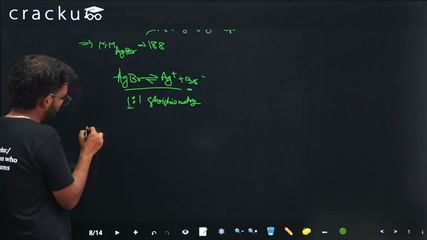
In the Carius method for estimating halogens, the bromine present in the organic compound is converted into silver bromide (AgBr) during the process. This means that all the bromine from the organic compound ends up in the AgBr precipitate. Therefore, the mass of bromine in the AgBr is equal to the mass of bromine that was originally in the organic compound.
Given:
Mass of organic compound = 250 mg
Mass of AgBr obtained = 141 mg
Atomic mass of silver (Ag) = 108
Atomic number of bromine (Br) is given as 80, but atomic number is not used in mass calculations. Since bromine's actual atomic number is 35, this must be a typo, and we assume it refers to the atomic mass of bromine, which is approximately 80 g/mol. So, atomic mass of Br = 80.
First, find the molar mass of AgBr. This is the sum of the atomic masses of silver and bromine:
Molar mass of AgBr = atomic mass of Ag + atomic mass of Br = 108 + 80 = 188 g/mol.
The mass fraction of bromine in AgBr is the ratio of the atomic mass of bromine to the molar mass of AgBr. So, the mass of bromine in the AgBr precipitate is calculated as:
Mass of Br = $$\left( \frac{\text{atomic mass of Br}}{\text{molar mass of AgBr}} \right) \times \text{mass of AgBr}$$
Substitute the values:
Mass of Br = $$\left( \frac{80}{188} \right) \times 141 \text{mg}$$
Simplify the fraction $$\frac{80}{188}$$ by dividing both numerator and denominator by their greatest common divisor, which is 4:
$$\frac{80 \div 4}{188 \div 4} = \frac{20}{47}$$
So, $$\frac{80}{188} = \frac{20}{47}$$
Now, mass of Br = $$\left( \frac{20}{47} \right) \times 141 \text{mg}$$
Next, compute $$\frac{141}{47}$$:
Since 47 multiplied by 3 equals 141 (because $$47 \times 3 = 141$$), so $$\frac{141}{47} = 3$$.
Therefore, mass of Br = $$20 \times 3 = 60 \text{mg}$$
This mass of bromine (60 mg) came entirely from the 250 mg of the organic compound. The percentage of bromine in the compound is given by:
Percentage of bromine = $$\left( \frac{\text{mass of Br}}{\text{mass of compound}} \right) \times 100$$
Substitute the values:
Percentage of bromine = $$\left( \frac{60}{250} \right) \times 100$$
Simplify $$\frac{60}{250}$$ by dividing both numerator and denominator by 10:
$$\frac{60 \div 10}{250 \div 10} = \frac{6}{25}$$
So, $$\frac{60}{250} = \frac{6}{25}$$
Now, percentage = $$\frac{6}{25} \times 100$$
Compute $$\frac{6}{25} \times 100 = 6 \times \frac{100}{25} = 6 \times 4 = 24$$ (since $$\frac{100}{25} = 4$$)
Alternatively, $$\frac{60}{250} \times 100 = \frac{60 \times 100}{250} = \frac{6000}{250}$$
Divide 6000 by 250: $$6000 \div 250 = 24$$
So, the percentage of bromine is 24.
Hence, the correct answer is Option B.
Was this solution helpful?
Click on the Email ☝️ to Watch the Video Solution
Create a FREE account and get:
_1.webp)

Educational materials for JEE preparation

Ask our AI anything

AI can make mistakes. Please verify important information.
AI can make mistakes. Please verify important information.


