
Join Our JEE Preparation Group
Prep with like-minded aspirants; Get access to free daily tests and study material.
Sign in
Please select an account to continue using cracku.in
↓ →
Join Our JEE Preparation Group
Prep with like-minded aspirants; Get access to free daily tests and study material.
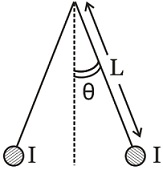
Two long currents carrying thin wires, both with current $$I$$, are held by insulating threads of length L and are in equilibrium as shown in the figure, with threads making an angle $$\theta$$ with the vertical. If wires have a mass $$\lambda$$ per unit length then the value of I is: ($$g$$ = gravitational acceleration)
Weight $$w = \lambda g$$ (Acts vertically downwards)
Magnetic Force $$F_m = \frac{\mu_0 I^2}{2 \pi d}$$
The total distance ($$d$$) between the two wires is $$d = 2L \sin \theta$$
Let $$T$$ be the tension per unit length of the thread. Resolving the tension into components:
Vertical equilibrium: $$T \cos \theta = \lambda g$$ --- (Eq. 1)
Horizontal equilibrium: $$T \sin \theta = F_m$$ --- (Eq. 2)
$$\tan \theta = \frac{F_m}{\lambda g}$$
$$\tan \theta = \frac{\mu_0 I^2}{2 \pi (2L \sin \theta) \lambda g}$$
$$\tan \theta = \frac{\mu_0 I^2}{2 \pi d \lambda g}$$
$$\frac{\sin \theta}{\cos \theta} = \frac{\mu_0 I^2}{4 \pi L \lambda g \sin \theta}$$
$$I^2 = \frac{4 \pi \lambda g L \sin^2 \theta}{\mu_0 \cos \theta}$$
$$I = \sqrt{\frac{4 \pi \lambda g L \sin^2 \theta}{\mu_0 \cos \theta}}$$
$$I = 2 \sin \theta \sqrt{\frac{\pi \lambda g L}{\mu_0 \cos \theta}}$$
Was this solution helpful?
Create a FREE account and get:
_1.webp)

Educational materials for JEE preparation

Ask our AI anything

AI can make mistakes. Please verify important information.
AI can make mistakes. Please verify important information.


