Group
Group
 Group
Group


 Preferred Source

 Google Discover

JEE Electric Potential & Capacitance PYQs
JEE Electric Potential & Capacitance PYQs are previous year questions covering electric potential, potential difference, potential energy, equipotential surfaces, and capacitors. These questions test how charges create electric potential and how capacitors store charge and energy.
Solving JEE Electric Potential & Capacitance Questions helps you apply these concepts to charge arrangements, capacitor networks, and dielectric insertion problems. Before calculating, identify the quantity being asked, choose a reference for potential where needed, and check whether the capacitor is connected to a battery or isolated.
A clear understanding of the relationships between electric field, potential, and energy makes this chapter easier to approach. For example, electric potential is a scalar, so potentials due to individual charges are added algebraically. Electric fields, however, must be added as vectors.
This page provides a downloadable PYQ PDF, important formulas with their conditions, and five common mistakes to avoid. Use these resources for chapter revision, then practise questions independently to check your understanding.
JEE Electric Potential & Capacitance Important PYQs PDF
Download the Top 30 JEE Electric Potential & Capacitance PYQ PDF for focused practice. Attempt each question before checking its answer or solution. Draw the charge arrangement or capacitor circuit wherever possible, and label the given charges, distances, capacitances, and potential differences.
During your JEE Mains PYQ practice, focus on the reasoning behind each solution. In capacitor problems, identify which quantities remain constant. In potential and potential energy problems, retain the signs of the charges throughout the calculation.
After completing the questions, revisit incorrect answers and slow attempts. Identify whether the difficulty came from understanding the circuit, choosing a formula, or handling signs and units. Reattempt those problems after revising the relevant concept.
Important Formulas for JEE Electric Potential & Capacitance PYQs
The main formulas in this chapter connect electric potential, work, charge, capacitance, and stored energy. Learn the meaning and conditions of each expression. In particular, distinguish work done by the electric field from work done by an external agent, as their signs differ when the charge moves without a change in kinetic energy.
Use the table below alongside your JEE Study material for revision. You can also refer to the JEE Mains Formula Sheet when revising related Physics chapters.
| Concept | Formula | Condition or Meaning |
|---|---|---|
| Electric Potential | $$V = \frac{U}{q}$$ | Potential energy per unit test charge, using a consistent reference for potential and energy. |
| Potential Difference and Work | $$V_B - V_A = -\frac{W_{\mathrm{field},\,A\to B}}{q}$$ | W represents the work done by the electric field on charge q. |
| Potential Difference and Electric Field | $$V_B - V_A = -\int_A^B \vec{E}\cdot d\vec{l}$$ | In electrostatics, potential decreases in the direction of the electric field. |
| Potential Due to a Point Charge | $$V = \frac{kQ}{r}$$ | For a point charge in vacuum, taking potential at infinity as zero. |
| Potential Due to Multiple Point Charges | $$V = k\sum_i \frac{Q_i}{r_i}$$ | Add potentials algebraically, including the sign of each charge. |
| Capacitance | $$C = \frac{Q}{\Delta V}$$ | Q is the magnitude of charge on either plate, and ΔV is the potential difference between the plates. |
| Parallel Plate Capacitor in Vacuum | $$C = \frac{\varepsilon_0 A}{d}$$ | For plate separation much smaller than plate dimensions, neglecting edge effects. |
| Parallel Plate Capacitor Fully Filled with a Dielectric | $$C = \frac{K\varepsilon_0 A}{d}$$ | K is the dielectric constant of the material filling the entire space between the plates. |
| Capacitors in Series | $$\frac{1}{C_{\mathrm{eq}}} = \frac{1}{C_1} + \frac{1}{C_2} + \frac{1}{C_3}$$ | For a simple series combination, potential differences add. |
| Capacitors in Parallel | $$C_{\mathrm{eq}} = C_1 + C_2 + C_3$$ | Each capacitor is connected across the same two nodes and has the same potential difference. |
| Energy Stored in a Capacitor | $$U = \frac{1}{2}C(\Delta V)^2 = \frac{Q^2}{2C} = \frac{1}{2}Q\Delta V$$ | Choose the expression based on the given quantities and what remains constant. |
| Potential Energy of Two Point Charges | $$U = \frac{kQ_1Q_2}{r}$$ | For charges in vacuum, taking potential energy at infinite separation as zero. |
| Electric Field Energy Density in Vacuum | $$u = \frac{1}{2}\varepsilon_0 E^2$$ | Energy stored per unit volume of the electric field in vacuum. |
Here, k = 1/(4πε₀), A is the overlapping plate area, and d is the plate separation. Keep charge signs in potential and potential energy calculations. For capacitor calculations, use the magnitude of plate charge and the potential difference between the plates.
Top 5 Common Mistakes to Avoid in JEE Electric Potential & Capacitance PYQs
Small errors in signs, circuit connections, and fixed quantities can change the final answer. Check these five points while solving questions from this chapter.
1. Confusing electric potential with potential energy
Electric potential is potential energy per unit charge and is measured in volts. Potential energy is measured in joules and depends on the interacting charges. Also remember that zero potential at a point does not necessarily mean the electric field there is zero.
2. Identifying capacitor combinations incorrectly
Decide whether capacitors are in series or parallel by tracing their connections, rather than judging their position in the diagram. Parallel capacitors share the same two nodes. In a simple series chain with initially neutral, isolated intermediate conductors, the capacitors carry equal charge magnitudes.
3. Applying the dielectric formula without checking the arrangement
The capacitance becomes K times its original value when a dielectric completely fills the space between the plates without changing their geometry. A partially inserted dielectric or a dielectric slab thinner than the plate separation requires a different calculation. Read the arrangement carefully before applying a formula.
4. Forgetting whether charge or voltage remains constant
For a capacitor connected across an ideal battery, the potential difference remains constant, while charge can change. For a disconnected, isolated capacitor with no charge leakage, charge remains constant, while the potential difference can change. This distinction determines how stored energy changes when a dielectric is inserted or plate separation is altered.
5. Making unit conversion errors
Convert capacitance into farads, charge into coulombs, and distances into metres before substituting values. Check area conversions separately: converting square centimetres into square metres requires squaring the length conversion factor.
Once you are comfortable with chapter-wise questions, attempt a Free JEE Mains mock test to practise applying these concepts under time pressure. Review mistakes after the test and solve similar problems again to check whether you have corrected the underlying issue.
List of JEE Electric Potential & Capacitance PYQs
Below is a test-style set of JEE Electric Potential & Capacitance Questions based on electric potential, potential energy, capacitors, dielectric materials, and capacitor combinations. Try to solve each question on your own before checking the answer.
Question 1
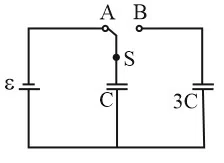
The figure shows a capacitor of capacitance C connected to a battery via a switch, having a total charge Q on it, in steady-state. When the switch S is turned from position A to position B, the energy dissipated in the circuit is
correct answer:- 2
Question 2
If the electric potential at any point $$(x, y, z)$$ m in space is given by $$V = 3x^2$$ volt. The electric field at the point $$(1, 0, 3)$$ m will be:
correct answer:- 3
Question 3
The space between the plates of a parallel plate capacitor is filled with a 'dielectric' whose 'dielectric constant' varies with distance as per the relation: $$K(x) = K_o + \lambda x$$ ($$\lambda$$ = a constant). The capacitance C, of the capacitor, would be related to its vacuum capacitance C$$_o$$ for the relation:
correct answer:- 3
Question 4
A parallel plate capacitor with air between the plate has a capacitance of 15 pF. The separation between the plate becomes twice and the space between them is filled with a medium of dielectric constant 3.5. Then the capacitance becomes $$\frac{x}{4}$$ pF. The value of $$x$$ is _____.
correct answer:- 105
Question 5
A parallel plate capacitor is having separation between plates 0.885 mm. It has a capacitance of 1 $$\mu$$F when the space between the plates is filled with an insulating material of resistivity $$1 \times 10^{13}$$ $$\Omega$$m and resistance $$17.7 \times 10^{14}$$ $$\Omega$$. Relative permittivity of the insulating material is $$a \times 10^7$$. The value of $$a$$ is __________. (Take permittivity of free space $$= 8.85 \times 10^{-12}$$ F/m)
correct answer:- 2

Question 6
A three coulomb charge moves from the point (0, -2, -5) to the point (5, 1, 2) in an electric field expressed as $$\vec{E} = 2x\hat{i} + 3y^2\hat{j} + 4\hat{k}$$ N/C. The work done in moving the charge is _______ J.
correct answer:- 186
Question 7
27 similar drops of mercury are maintained at 10 V each. All these spherical drops combine into a single big drop. The potential energy of the bigger drop is ______ times that of a smaller drop.
correct answer:- 243
Question 8
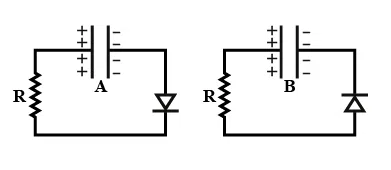
Two identical capacitors $$A$$ and $$B$$, charged to the same potential $$5V$$ are connected in two different circuits as shown below at time $$t = 0$$. If the charge on capacitors $$A$$ and $$B$$ at time $$t = CR$$ is $$Q_A$$ and $$Q_B$$ respectively, then (Here $$e$$ is the base of natural logarithm)
correct answer:- 3
Question 9
A parallel plate capacitor has square plates of side $$L$$ and plate separation distance $$d$$. A dielectric slab of relative permittivity $$\varepsilon_r$$ and thickness $$d$$ is inserted symmetrically between the plates such that it covers only a length $$x$$ ($$x < L$$) along the side of the plates. The net capacitance $$C$$ of this system as a function of $$x$$ is given by:
correct answer:- 1
Question 10
A capacitor is connected to a 20 V battery through a resistance of 10$$\Omega$$. It is found that the potential difference across the capacitor rises to 2 V in 1 $$\mu$$s. The capacitance of the capacitor is _________ $$\mu$$F.
Given $$\ln\frac{10}{9} = 0.105$$
correct answer:- 1

Question 11
The energy stored in the electric field produced by a metal sphere is 4.5 J. If the sphere contains 4 $$\mu$$C charge, its radius will be: $$\left[\text{Take } : \frac{1}{4\pi\epsilon_0} = 9 \times 10^9 \text{ N m}^2 \text{ C}^{-2}\right]$$
correct answer:- 2
Question 12
Two capacitors $$C_1$$ and $$C_2$$ are charged to 120 V and 200 V respectively. It is found that by connecting them together the potential on each one can be made zero. Then:
correct answer:- 4
Question 13
An electric field $$\vec{E} = \left(25\hat{i} + 30\hat{j}\right)$$ N C$$^{-1}$$ exists in a region of space. If the potential at the origin is taken to be zero then the potential at $$x = 2$$ m, $$y = 2$$ m is:
correct answer:- 1
Question 14
There is a uniform electrostatic field in a region. The potential at various points on a small sphere centred at $$P$$, in the region, is found to vary between the limits 589.0 V to 589.8 V. What is the potential at a point on the sphere whose radius vector makes an angle of 60° with the direction of the field?
correct answer:- 4
Question 15
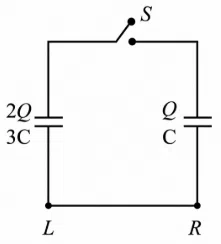
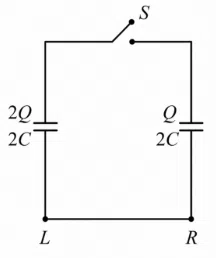
Two circuits (a) and (b) have charged capacitors of capacitance C, 2C and 3C with open switches. Charges on each of the capacitor are as shown in the figures. On closing the switches
Circuit (a) Circuit (b)
correct answer:- 3

Question 16
This question has statement 1 and statement 2. Of the four choices given after the statements, choose the one that best describes the two statements.
An insulating solid sphere of radius $$R$$ has a uniformly positive charge density $$\rho$$. As a result of this uniform charge distribution there is a finite value of electric potential at the centre of the sphere, at the surface of the sphere and also at a point out side the sphere. The electric potential at infinity is zero.
Statement 1: When a charge $$q$$ is taken from the centre to the surface of the sphere, its potential energy changes by $$\frac{qP}{3\varepsilon_0}$$.
Statement 2: The electric field at a distance $$r\ (r < R)$$ from the centre of the sphere is $$\frac{\rho r}{3\varepsilon_0}$$
correct answer:- 3
Question 17
The parallel combination of two air filled parallel plate capacitors of capacitance C and nC is connected to a battery of voltage, V. When the capacitors are fully charged, the battery is removed and after that a dielectric material of dielectric constant K is placed between the two plates of the first capacitor. The new potential difference of the combined system is:
correct answer:- 1
Question 18
$$27$$ identical drops are charged at $$22$$ V each. They combine to form a bigger drop. The potential of the bigger drop will be ______ V.
correct answer:- 198
Question 19
Two parallel plate capacitors $$C_1$$ and $$C_2$$ each having capacitance of 10 $$\mu$$F are individually charged by a 100 V D.C. source. Capacitor $$C_1$$ is kept connected to the source and a dielectric slab is inserted between it plates. Capacitor $$C_2$$ is disconnected from the source and then a dielectric slab is inserted in it. Afterwards the capacitor $$C_1$$ is also disconnected from the source and the two capacitors are finally connected in parallel combination. The common potential of the combination will be ______ V.
(Assuming Dielectric constant = 10)
correct answer:- 55
Question 20
A parallel plate capacitor with area 200 cm$$^2$$ and separation between the plates 1.5 cm, is connected across a battery of emf V. If the force of attraction between the plates is $$25 \times 10^{-6}$$ N, the value of V is approximately: $$\left(\varepsilon_0 = 8.85 \times 10^{-12} \frac{C^2}{N \cdot m^2}\right)$$
correct answer:- 3

Question 21
Voltage rating of a parallel plate capacitor is 500 V. Its dielectric can withstand a maximum electric field of $$10^{6}$$ V/m. The plate area is $$10^{-4}$$ m$$^{2}$$. What is the dielectric constant if the capacitance is 15 pF? (given $$\varepsilon_0 = 8.86 \times 10^{-12}$$ C$$^{2}$$/Nm$$^{2}$$)
correct answer:- 2
Question 22
A uniformly charged ring of radius 3a and total charge q is placed in x-y plane centred at origin. A point charge q is moving towards the ring along the z-axis and has speed v at z = 4a. The minimum value of v such that it crosses the origin is:
correct answer:- 4
Question 23
A parallel plate capacitor filled with a medium of dielectric constant 10, is connected across a battery and is charged. The dielectric slab is replaced by another slab of dielectric constant 15. Then the energy of capacitor will
correct answer:- 1
Question 24
For the given input voltage waveform $$V_{in}(t)$$, the output voltage waveform $$V_0(t)$$, across the capacitor is correctly depicted by:
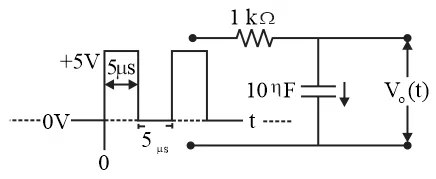
correct answer:- 1
Question 25
A capacitor C is fully charged with voltage $$V_0$$. After disconnecting the voltage source, it is connected in parallel with another uncharged capacitor of capacitance $$\frac{C}{2}$$. The energy loss in the process after the charge is distributed between the two capacitors is:
correct answer:- 4

Question 26
64 identical drops each charged upto potential of $$10$$ mV are combined to form a bigger drop. The potential of the bigger drop will be _____ mV.
correct answer:- 160
Question 27
A point charge $$q = 8.85\ \mu\text{C}$$ is placed at the center of a closed cubical surface. The total electric flux ($$\Phi$$) passing through one of the six faces of the cube is $$k \times 10^5\text{ N m}^2\text{ C}^{-1}$$. Find the value of the integer $$k$$. (Take permittivity of free space $$\varepsilon_0 = 8.85 \times 10^{-12}\text{ C}^2\text{ N}^{-1}\text{m}^{-2}$$).
correct answer:- 10
Question 28
An electric dipole consists of two opposite charges of magnitude $$2 \times 10^{-6}\text{ C}$$ separated by a distance of $$3\text{ cm}$$. It is placed in an external uniform electric field of $$2 \times 10^5\text{ N C}^{-1}$$. The maximum torque exerted by the field on the dipole is:
correct answer:- 1
Question 29
A parallel plate air capacitor has a capacitance $$C$$. A dielectric slab of dielectric constant $$K = 4$$ is introduced between the plates so as to fill half the distance between them. The new capacitance of the capacitor will be:
correct answer:- 2
Question 30
Twelve identical resistors, each having a resistance of $$12\ \Omega$$, are connected together to form the edges of a symmetrical three-dimensional cube. A ideal current source is connected across two adjacent corners of this cube network, passing current through a single edge branch. Determine the total equivalent resistance (in $$\Omega$$) of the cube network measured between these two adjacent corners.
correct answer:- 7