Group
Group
 Group
Group

JEE Work Power Energy PYQs
JEE Work Power Energy PYQs are an important part of the JEE Physics syllabus. These questions help you check how well you understand the main concepts of the chapter, such as work done by a force, kinetic energy, potential energy, power, conservation of energy, spring energy, and the work-energy theorem.
In the exam, questions from work, power, and energy can appear as direct numerical problems or concept-based questions. The good thing is that this chapter becomes much easier when your basics are clear. Once you understand the ideas properly and know which formula to use, solving questions feels much more simple. You do not need to see this chapter as something very difficult. With regular practice and careful solving, you can do well in it.
In this blog, you will get a simple formula PDF, a section for important JEE Work Power Energy PYQs in download format, a few practice questions with answers, and some extra questions to solve on your own. You will also read about common mistakes students often make and a few easy tips to save time in the exam.
JEE Work Power Energy Important PYQs PDF
This PDF can include the most important previous year questions from work, power, and energy. It may cover topics like work done by a constant force, variable force, kinetic energy, potential energy, power, conservation of mechanical energy, spring energy, and the work-energy theorem.
Practicing these questions can help you understand the type of problems asked in JEE. It also improves your speed, accuracy, and confidence before the exam.
Important Formulas for JEE Work Power Energy PYQs
You only need a few important formulas to solve most work, power, and energy questions in JEE. These formulas help you calculate work done, power, kinetic energy, potential energy, and other values used in this chapter.
You can download the full formula PDF from the link above. Here is a quick look at some of the main formulas:
Concept | Formula |
Work Done | $$W = F s cos θ$$ |
Kinetic Energy | $$KE = ½mv²$$ |
Potential Energy | $$PE = mgh$$ |
Power | $$P = W/t$$ |
Instantaneous Power | $$P = Fv$$ |
Work-Energy Theorem | $$W = ΔKE$$ |
Mechanical Energy | $$E = KE + PE$$ |
Spring Force | $$F = -kx$$ |
Spring Potential Energy | $$U = ½kx²$$ |
Conservation of Mechanical Energy | $$KE₁ + PE₁ = KE₂ + PE₂$$ |
These formulas are commonly used in questions based on force, motion, energy change, springs, and conservation of energy. If you revise them well, many JEE questions become easier to solve.
Top 5 Common Mistakes to Avoid in JEE Work Power Energy PYQs
Many students feel that this chapter is confusing, but in most cases, the problem is not the chapter itself. It is the small mistakes made while solving. Here are some common mistakes you should avoid:
Forgetting the angle in work done
In work done questions, the angle between force and displacement matters a lot. If the force is not acting in the same direction as displacement, you must use cos θ correctly.
Mixing up work and power
Work and power are closely related, but they are not the same thing. Work is the total energy transferred, while power tells you how quickly that work is done.
Not using conservation of energy when needed
Sometimes students use long calculations when the question can be solved much faster with conservation of mechanical energy.
Using the wrong sign in work or energy
Work done by friction is often negative, and potential energy depends on position. A sign mistake can change the whole answer.
Ignoring units
Always check units carefully. Use SI units like joule, watt, newton, metre, kilogram, and second. Even if the method is correct, the wrong unit can lead to the wrong final answer.
List of JEE Work Power Energy PYQs
Here is a short set of JEE-style work, power, and energy questions for practice. These include common question types from work done, kinetic energy, power, and conservation of energy. Solving them regularly can help you become faster and more confident.
Question 1
A body of mass 2 kg is moving along x-direction such that its displacement as function of time is given by x(t) = $$\alpha t^{2} +\beta t +ym$$, where $$\alpha=1m/s^{2}, \beta=1m/s$$ and y=1m. The work done on the body during the time interval t = 2 s to t = 3 s, is _________ J.
correct answer:- 2
Question 2
Potential energy (V) versus distance (x) is given by the graph. Rank various regions as per the magnitudes of the force (F) acting on a particle from high lo low.
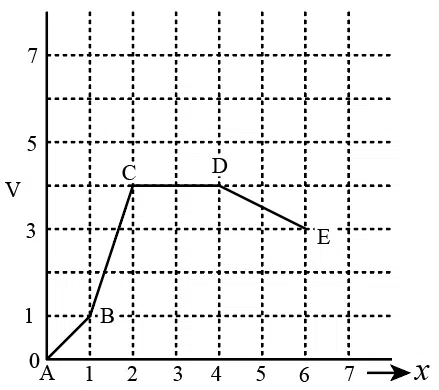
correct answer:- 4
Question 3
Given below are two statements:
Statement I : An object moves from position $$r_{1}$$ to position $$r_{2}$$ under a conservative force field $$\overrightarrow{F}$$.
The work done by the force is W = $$\int_{r_{1}}^{r_{2}} \overrightarrow{F}.\overrightarrow{dr}.$$
Statement II: Any object moving from one location to another location can follow infinite number of paths. Therefore, the amount of work done by the object changes with the path it follows for a conservative force.
In the light of the above statements, choose the correct answer from the options given below :
correct answer:- 2
Question 4
Given below are two statements:
Statement I : For a mechanical system of many particles total kinetic energy is the sum of kinetic energies of all the particles.
Statement II: The total kinetic energy can be the sum of kinetic energy of the center of mass w.r.t to the origin and the kinetic energy of all the particles w.r.t. the center of mass as the reference.
In the light of the above statements, choose the correct answer from the options given below :
correct answer:- 3
Question 5
Two masses m and 2m are connected by a light string going over a pulley (disc) of mass 30m with radius r = 0.1 m. The pulley is mounted in a vertical plane and it is free to rotate about its axis. The 2m mass is released from rest and its speed when it has descended through a height of 3.6 m is m/ s. (Assume string does not slip and $$g = 10m/s^{2}$$)
correct answer:- 2

Question 6
A small bob A of mass m is attached to a massless rigid rod of length 1 m pivoted at point P and kept at an angle of 60° with vertical as shown in figure. At distance of 1 m below point P, an identical bob B is kept at rest on a smooth horizontal surface that extends to a circular track of radius R as shown in figure. If bob B just manages to complete the circular path of radius R upto a point Q after being hit elastically by bob A, then radius R is ____ m.
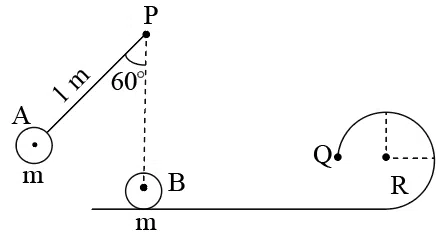
correct answer:- 4
Question 7
An object is projected with kinetic energy K from a point A at an angle 60° with the horizontal The ratio of the difference in kinetic energies at points B and C to that at point A (see figure), in the absence of air friction is :
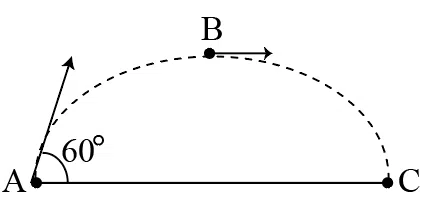
correct answer:- 1
Question 8
Two blocks with masses 100 g and 200 g are attached to the ends of springs A and B as shown in figure. the energy stored in A is E. The energy stored in B, when spring constants $$K_{A},K_{B}$$ of A and B, respectively satisfy the relation $$4K_{A}=3K_{B}$$ is:
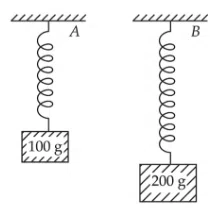
correct answer:- 1
Question 9
In a perfectly inelastic collision, two spheres made of the same material with masses 15 kg and 25 kg, moving in opposite directions with speeds of 10 m/s and 30 m/s, respectively, strike each other and stick together. The rise in temperature (in $$^{\circ}C$$), if all the heat produced during the collision is retained by these spheres, is :
(specific heat of sphere material 31 cal/kg.$$^{\circ}C$$ and 1 cal =4.2 J)
correct answer:- 4
Question 10
Three masses 200 kg, 300 kg and 400 kg are placed at the vertices of an equilateral triangle with sides 20 m. They are rearranged on the vertices of a bigger triangle of side 25 m and with the same centre. The work done in this process ____ J. (Gravitational constant $$G=6.7 \times 10^{-11} Nm^{2}/kg^{2}$$)
correct answer:- 4

Question 11
In case of vertical circular motion of a particle by a thread of length r if the tension in the thread is zero at an angle $$30^{\circ}$$ shown in figure, the velocity at the bottom point (A) of the circular path is
(g = gravitational acceleration)
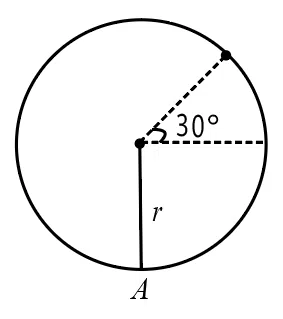
correct answer:- 3
Question 12
A bead $$P$$ sliding on a frictionless semi-circular string ($$ACE$$) and it is at point $$S$$ at $$t = 0$$ and at this instant the horizontal component of its velocity is $$v$$. Another bead $$Q$$ of the same mass as $$P$$ is ejected from point $$A$$ at $$t = 0$$ along the horizontal string $$AB$$, with the speed $$v$$, friction between the beads and the respective strings may be neglected in both cases. Let $$t_{P}$$ and $$t_{Q}$$ be the respective times taken by beads P and Q to reach the point B, then the relation between $$t_{P}$$ and $$t_{Q}$$ is
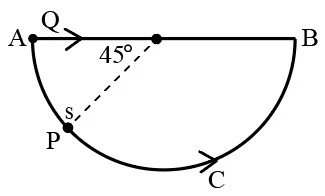
correct answer:- 4
Question 13
A block is sliding down on an inclined plane of slope 0 and at an instant t = 0 this block is given an upward momentum so that it starts moving up on the inclined surface with velocity u. The distance (S) travelled by the block before its velocity become zero, is ______.
(g = gravitational acceleration)
correct answer:- 4
Question 14
A ball of mass 100 g is projected with velocity 20 m/s at $$60^{\circ}$$ with horizontal. The decrease in kinetic energy of the ball during the motion from point of projection to highest point is
correct answer:- 2
Question 15
A body of mass 100 g is moving in circular path of radius 2 m on vertical plane as shown in figure. The velocity of the body at point is 10 m/s. The ratio of its kinetic energies at point and is :
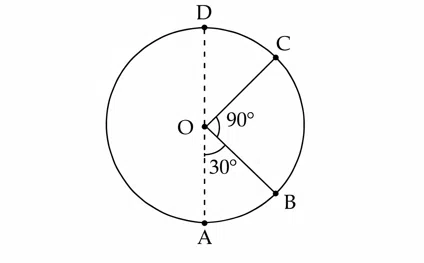
(Take acceleration due to gravity as $$10 m/s^{2}$$)
correct answer:- 3

Question 16
A force $$\overrightarrow{F}=2\widehat{i}+b\widehat{j}+\widehat{k}$$ is applied on a particle and it undergoes a displacement $$\widehat{i}-2\widehat{j}-\widehat{k}$$.What will be the value of , if work done on the particle is zero.
correct answer:- 2
Question 17
A bob of mass m is suspended at a point O by a light string of length l and left to perform vertical motion (circular) as shown in figure. Initially, by applying horizontal velocity $$v_o$$ at the point ' A ', the string becomes slack when, the bob reaches at the point ' D '. The ratio of the kinetic energy of the bob at the points B and C is
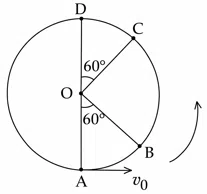
________.
correct answer:- 2
Question 18
A ball having kinetic energy KE, is projected at an angle of $$60^{\circ}$$ from the horizontal. What will be the kinetic energy of ball at the highest point of its flight ?
correct answer:- 4
Question 19
A force $$F=\alpha+\beta x^2$$ acts on an object in the $$x$$-direction. The work done by the force is $$5\,J$$ when the object is displaced by $$1\,m.$$ If the constant $$\alpha=1\,N$$ then $$\beta$$ will be:
correct answer:- 2
Question 20
Given below are two statements: one is labelled as Assertion A and the other is labelled as Reason R Assertion A: In a central force field, the work done is independent of the path chosen. Reason R: Every force encountered in mechanics does not have an associated potential energy. In the light of the above statements, choose the most appropriate answer from the options given below
correct answer:- 2

Question 21
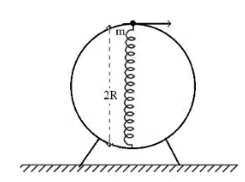
A bead of mass 'm' slides without friction on the wall of a vertical circular hoop of radius 'R' as shown in figure. The bead moves under the combined action of gravity and a massless spring ( k ) attached to the bottom of the hoop. The equilibrium length of the spring is 'R'. If the bead is released from top of the hoop with (negligible) zero initial speed, velocity of bead, when the length of spring becomes ' R ', would be (spring constant is 'k', g is accleration due to gravity
correct answer:- 1
Question 22
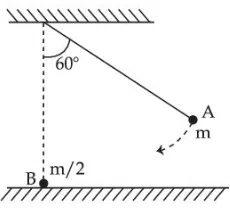
As shown below, bob A of a pendulum having massless string of length 'R' is released from $$60^{\circ}$$ to the vertical. It hits another bob B of half the mass that is at rest on a friction less table in the center. Assuming elastic collision, the magnitude of the velocity of bob A after the collision will be (take g as acceleration due to gravity.)
correct answer:- 4
Question 23
A body of mass 'm' connected to a massless and unstretchable string goes in verticle circle of radius 'R' under gravity g. The other end of the string is fixed at the center of circle. If velocity at top of circular path is $$n\sqrt{gR}$$, where, $$n /geq$$, then ratio of kinetic energy of the body at bottom to that at top of the circle is
correct answer:- 2
Question 24
A force $$f=x^{2}y\widehat{i}+y^{2}\widehat{j}$$ acts on a particle in a plane x+y=10. The work done by this force during a displacement from (0,0) to (4m,2m) is Joule
(round off to the nearest integer)
correct answer:- 152
Question 25
Given below are two statements. One is labelled as Assertion (A) and the other is labelled as Reason (R).
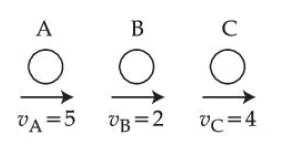
Assertion (A) :
Three identical spheres of same mass undergo one dimensional motion as shown in figure with initial velocities $$v_A = 5\,\text{m/s},\; v_B = 2\,\text{m/s},\; v_C = 4\,\text{m/s}$$. If we wait sufficiently long for elastic collision to happen, then $$v_A = 4\,\text{m/s},\; v_B = 2\,\text{m/s},\; v_C = 5\,\text{m/s}, will be the final velocities.
Reason (R): In an elastic collision between identical masses, two objects exchange their velocities. In the light of the above statements, choose the correct answer from the options given below :
correct answer:- 1

Question 26
A sand dropper drops sand of mass m(t) on a conveyer belt at a rate proportional to the square root of speed (v)of the belt, i.e. $$\frac{dm}{dt} \propto \sqrt{v}$$. If P is the power delivered to run the belt at constant speed then which of the following relationship is true?
correct answer:- 3
Question 27
If a rubber ball falls from a height h and rebounds upto the height of h/2. The percentage loss of total energy of the initial system as well as velocity of ball before it strikes the ground, respectively, are:
correct answer:- 1
Question 28
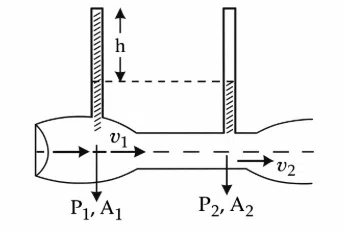
Given below are two statements: Statement I: When speed of liquid is zero everywhere, pressure difference at any two points depends on equation $$P_1 - P_2 = \rho g(h_2 - h_1)$$. Statement II: In venturi tube shown, $$2gh = v_1^2 - v_2^2$$. Choose the most appropriate answer from the options given below.
correct answer:- 2
Question 29
A solid sphere and a hollow cylinder roll up without slipping on same inclined plane with same initial speed $$\upsilon$$. The sphere and the cylinder reaches upto maximum heights $$h_1$$ and $$h_2$$, respectively, above the initial level. The ratio $$h_1 : h_2$$ is $$\frac{n}{10}$$. The value of n is _____.
correct answer:- 7
Question 30
A body of mass 4 kg is placed on a plane at a point P having coordinate (3,4)m. Under the action of force $$\overrightarrow{F} = (2\hat{i}+3\hat{j})N$$, it moves to a new point Q having coordinates (6,10)m in 4 sec . The average power and instanteous power at the end of 4 sec are in the ratio of :
correct answer:- 4
Question 31
A simple pendulum of length $$1$$ m has a wooden bob of mass $$1$$ kg. It is struck by a bullet of mass $$10^{-2}$$ kg moving with a speed of $$2 \times 10^{2}$$ m s$$^{-1}$$. The bullet gets embedded into the bob. The height to which the bob rises before swinging back is. (use $$g = 10$$ m s$$^{-2}$$)
correct answer:- 2
Question 32
Two bodies of mass $$4$$ g and $$25$$ g are moving with equal kinetic energies. The ratio of magnitude of their linear momentum is :
correct answer:- 3
Question 33
The potential energy function (in J) of a particle in a region of space is given as $$U = (2x^2 + 3y^3 + 2z)$$. Here $$x, y$$ and $$z$$ are in meter. The magnitude of $$x$$-component of force (in N) acting on the particle at point $$P(1, 2, 3)$$ m is:
correct answer:- 3
Question 34
The bob of a pendulum was released from a horizontal position. The length of the pendulum is $$10$$ m. If it dissipates $$10\%$$ of its initial energy against air resistance, the speed with which the bob arrives at the lowest point is: [Use, $$g = 10 \text{ m s}^{-2}$$]
correct answer:- 1
Question 35
A particle is placed at the point $$A$$ of a frictionless track $$ABC$$ as shown in figure. It is gently pushed towards right. The speed of the particle when it reaches the point $$B$$ is: (Take $$g = 10 \text{ m s}^{-2}$$).
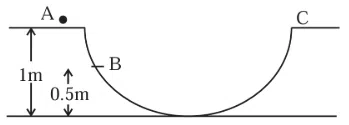
correct answer:- 2
Question 36
A block of mass 1 kg is pushed up a surface inclined to horizontal at an angle of $$60°$$ by a force of 10 N parallel to the inclined surface as shown in figure. When the block is pushed up by 10 m along inclined surface, the work done against frictional force is : $$g = 10$$ m s$$^{-2}$$
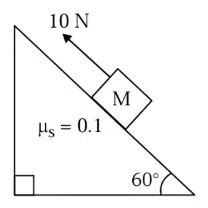
correct answer:- 2
Question 37
A body of mass 2 kg begins to move under the action of a time dependent force given by $$\vec{F} = (6t)\hat{i} + (6t^2)\hat{j}$$ N. The power developed by the force at the time $$t$$ is given by:
correct answer:- 4
Question 38
A body of $$m$$ kg slides from rest along the curve of vertical circle from point $$A$$ to $$B$$ in friction less path. The velocity of the body at $$B$$ is: (given, $$R = 14$$ m, $$g = 10$$ m/s$$^2$$ and $$\sqrt{2} = 1.4$$)
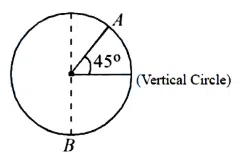
correct answer:- 4
Question 39
A body is moving unidirectionally under the influence of a constant power source. Its displacement in time $$t$$ is proportional to :
correct answer:- 2
Question 40
A body of mass $$50 \text{ kg}$$ is lifted to a height of $$20 \text{ m}$$ from the ground in the two different ways as shown in the figures. The ratio of work done against the gravity in both the respective cases, will be :
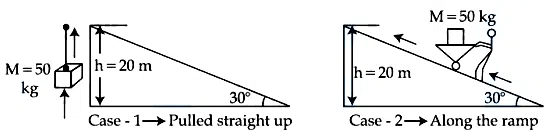
correct answer:- 4
Question 41
A bullet of mass $$50 \text{ g}$$ is fired with a speed $$100 \text{ m/s}$$ on a plywood and emerges with $$40 \text{ m/s}$$. The percentage loss of kinetic energy is :
correct answer:- 1
Question 42
Four particles $$A, B, C, D$$ of mass $$\frac{m}{2}, m, 2m, 4m$$, have same momentum, respectively. The particle with maximum kinetic energy is :
correct answer:- 2
Question 43
When kinetic energy of a body becomes 36 times of its original value, the percentage increase in the momentum of the body will be:
correct answer:- 4
Question 44
A stationary particle breaks into two parts of masses $$m_A$$ and $$m_B$$ which move with velocities $$v_A$$ and $$v_B$$ respectively. The ratio of their kinetic energies $$(K_B : K_A)$$ is :
correct answer:- 1
Question 45
Three bodies A, B and C have equal kinetic energies and their masses are $$400 \text{ g}$$, $$1.2 \text{ kg}$$ and $$1.6 \text{ kg}$$ respectively. The ratio of their linear momenta is :
correct answer:- 2
Question 46
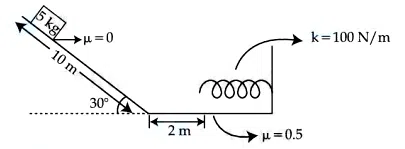
A block is simply released from the top of an inclined plane as shown in the figure above. The maximum compression in the spring when the block hits the spring is :
correct answer:- 4
Question 47
A particle of mass $$m$$ moves on a straight line with its velocity increasing with distance according to the equation $$v = \alpha\sqrt{x}$$, where $$\alpha$$ is a constant. The total work done by all the forces applied on the particle during its displacement from $$x = 0$$ to $$x = d$$, will be :
correct answer:- 4
Question 48
A heavy iron bar, of weight $$W$$ is having its one end on the ground and the other on the shoulder of a person. The bar makes an angle $$\theta$$ with the horizontal. The weight experienced by the person is :
correct answer:- 2
Question 49
A force $$(3x^2 + 2x - 5) \text{ N}$$ displaces a body from $$x = 2 \text{ m}$$ to $$x = 4 \text{ m}$$. Work done by this force is ______ J.
correct answer:- 58
Question 50
A block of mass 5 kg is placed at rest on a table of rough surface. Now, if a force of 30 N is applied in the direction parallel to surface of the table, the block slides through a distance of 50 m in an interval of time 10 s. Coefficient of kinetic friction is (given, $$g = 10 \text{ m s}^{-2}$$):
correct answer:- 3
.webp)